1 Percent Rule Rental Calculator
Check monthly rent against purchase price or full acquisition basis, estimate the target rent at 1%, and solve the maximum purchase price supported by your rent.
Price used by the classic rent / purchase price formula.
Used when acquisition cost basis is selected.
Use current signed rent before vacancy.
Parking, laundry, pet rent, storage, or utility recovery.
1.00% is the classic target, but some markets screen lower or higher.
Acquisition basis makes the screen stricter for value-add deals.
| Property type | Unit pattern | Rule use | Screening note |
|---|---|---|---|
| Single-family rental | 1 unit | Fast rent-to-price check | Condition and rent comps matter most |
| Condo or townhome | 1 unit | Often below 1% in pricier markets | Separate HOA dues from this rule |
| Duplex | 2 units | Common 1% rule target | Check both leases separately |
| Triplex | 3 units | Useful small multifamily screen | Vacancy can shift monthly income quickly |
| Fourplex | 4 units | Good rent roll shorthand | Compare total rent and per-unit rent |
| 5 to 12 unit multifamily | 5+ units | Portfolio screen only | Move quickly to NOI after this check |
| Student housing | Bed or unit leases | Can pass on rent but need vacancy review | Lease calendar matters |
| Vacation rental | Nightly income | Rough monthly equivalent only | Seasonality makes this less stable |
| Preset | Type | Basis mode | Total monthly rent | Rule result | Target at 1% |
|---|---|---|---|---|---|
| Midwest SFR | Single-family | Purchase | $2,400 | 1.00% | $2,400 |
| Sunbelt duplex | Duplex | Acquisition | $3,900 | 0.89% | $4,380 |
| Value-add fourplex | Fourplex | Acquisition | $6,200 | 0.88% | $7,050 |
| Small-town triplex | Triplex | Purchase | $3,450 | 1.15% | $3,000 |
| Urban condo | Condo | Purchase | $2,650 | 0.66% | $4,000 |
| Student six-unit | Student | Acquisition | $9,900 | 1.07% | $9,290 |
| Workforce 10-unit | Multifamily | Acquisition | $12,500 | 0.95% | $13,180 |
| Vacation cabin | Vacation | Purchase | $5,800 | 1.16% | $5,000 |
| Newer townhome | Townhome | Purchase | $2,950 | 0.74% | $4,000 |
| Rule result | Quick read | What it can mean | Next check |
|---|---|---|---|
| Under 0.70% | Below classic screen | Often higher-price market or low current rent | Rent comps and NOI |
| 0.70% to 0.89% | Soft screen | May need growth, low expenses, or appreciation case | Operating expenses |
| 0.90% to 0.99% | Near target | Small rent or basis changes can alter pass/fail | Repair scope and vacancy |
| 1.00% to 1.19% | Passes classic target | Rent is at least 1% of selected basis | Cap rate and debt service |
| 1.20% or higher | Strong rent-to-basis screen | May signal condition, location, or management risk | Lease quality and repairs |
| Scenario | Property type | Units | Purchase price | Acquisition basis | Monthly rent | Other income | Target % | Rule % | Rent gap |
|---|
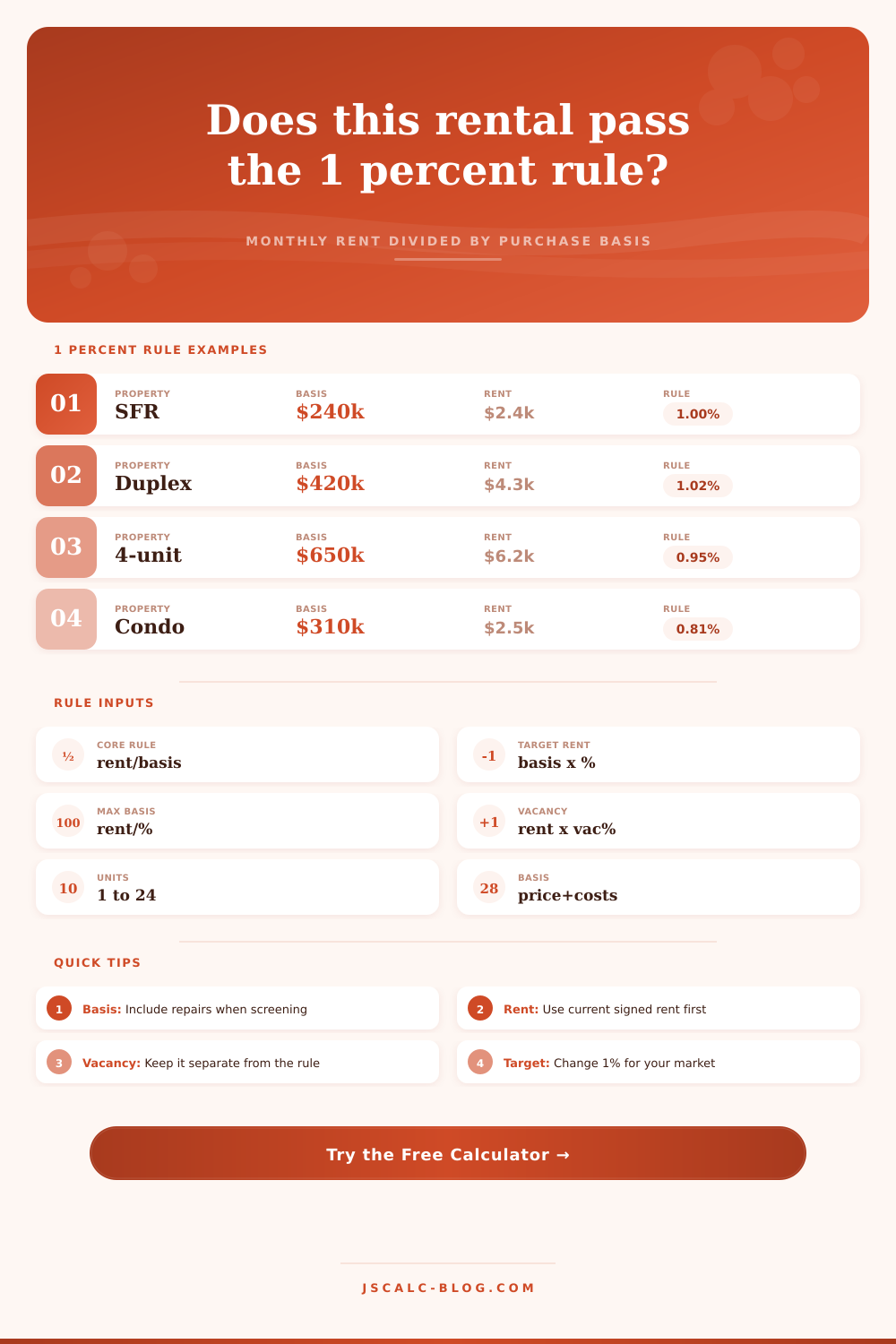
The 1 percent rule: Divide the monthly rent by your purchase price. Buy it if this results in 1 percent or more. Walk away if answer comes up short. This gives you a clean line where you should start and stop investing in rentals.
Here’s the problem: In real life, there is no clean lines. Real estate doesn’t always follow simple rules. Sometimes, your deal will fail even though it “passed” the rule, because the tenants are jerks, or the roof require repairs. Other times, an investment will exceed expectations even if it doesn’t meet the rule. (Because it appreciates.)
Real Problems With The 1 Percent Rule
Estimate = bad. It is good to use a calculator to do math for you. Many first-time investors view purchase price as their sole expense. If I buy a house for $200,000, then I must charge $2,000 in rent per month. However, what about the cost of repairs? Fresh paint? New HVAC system? What about those repairs? These are actualy out-of-pocket expenses made at purchase time.
To calculate your true acquisition basis, include these repairs into your purchase price. Chances are, this basis will be greater than your sticker price. When you use this higher basis, the rule becomes tougher. It compels you to ask whether your rental income covers all investments, not simply headline purchase price. This is the difference between amateur math and professional underwriting.
There’s also empty space to consider. The old rule states gross potential rent (assuming full occupancy). That’s fine in theory, but markets are never like that. People breaks their leases. Units will remain vacant between tenants. Before you trust your cash flow estimates, factor in this downtime. By keeping vacancy as an add-on to the main estimate, we’re recognizing reality without losing track of our baseline. Depending on job growth in your market, a good vacancy buffer can range from 5-10 percent. When a unit is vacant, the rosy picture vanishes if you don’t take this into consideration.
Under this view, different types of properties will show different behavior. High-end single family homes in coastal cities almost never reach 1 percent (unless they’re super-cheap or have too much debt). Does that make them a bad investment? No. It simply suggests that your return may come from equity build up and appreciation, instead of the monthly cash flow stream.
Older apartments in industrial cities tend to be much more than 1 percent. Rents hasn’t kept pace with the price spike, while land values are dirt-cheap. Is it a hard-and-fast rule you apply to all deals? Nope. Look for where your particular property falls on the range.
Consider the other side of the equation: how much can you afford? Want to stay at the 1 percent rule? Fine. Your max purchase price for that property that rents for $2,500/month would be $250,000. Use this to negotiate with clarity, because now you know exactly what number on the bottom of the page will satisfy your requirements.
When the seller says they’ll accept $300,000, you immediately know that this deal fails your first screen (unless you cut expenses somewhere else, or increase the rent). It turns vague haggling into precise arithmetic.
The 1 percent rule isn’t a verdict. It’s a screening tool. It weeds out obvious dogs. It identifies potential contenders. It prevents you from getting excited and letting emotion cloud your judgment. But it doesn’t consider management fees, maintenance reserves, insurance, and property taxes. When a deal clears that first hurdle, you have to get down and dirty with the real-world operating expenses.
The 1 percent rule opens the door. Detailed analysis decides whether you should of enter. Begin with the easy math and complicate it with reality.