Essay Word Count Calculator
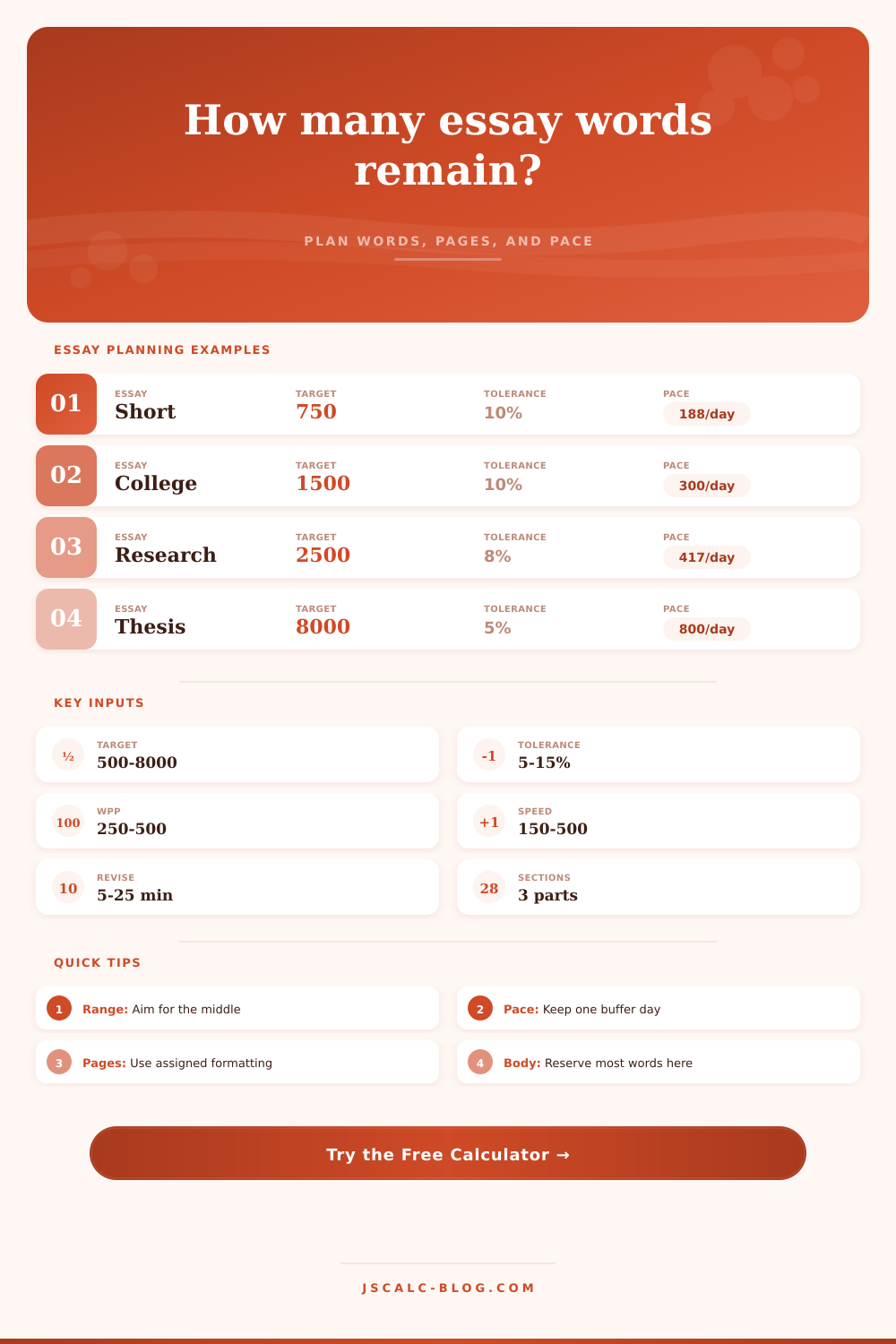
Plan an essay around target words, tolerance range, counted exclusions, page estimate, writing time, revision time, section allocation, and deadline pace on JSCalc-Blog.com.
Choose a common assignment setup, then adjust the target, current draft, formatting, exclusions, and deadline window.
| Assignment | Common Target | Common Tolerance | Planning Note |
|---|---|---|---|
| High school essay | 500 to 1000 words | 10% above or below | Keep each body paragraph close to the same size unless evidence needs more room. |
| College short essay | 1200 to 1800 words | 10% above or below | Use the range to protect the introduction and conclusion from becoming too thin. |
| Literary analysis | 1500 to 3000 words | 5% to 10% | Quoted evidence may count, so check whether block quotes are included. |
| Research paper | 2500 to 6000 words | 5% to 10% | References, appendices, abstracts, and captions may be excluded by the rubric. |
| Personal statement | 500 to 1000 words | Usually strict | Stay under the maximum when the application portal enforces a hard limit. |
| Thesis section | 5000 to 12000 words | Department rules | Plan revision time separately because citations and transitions take longer. |
| Words Per Page | Format Assumption | 750 Words | 1500 Words | 2500 Words |
|---|---|---|---|---|
| 250 WPP | Double spaced, 12 pt | 3 pages | 6 pages | 10 pages |
| 275 WPP | Dense double spaced | 2.7 pages | 5.5 pages | 9.1 pages |
| 300 WPP | MLA or APA estimate | 2.5 pages | 5 pages | 8.3 pages |
| 500 WPP | Single spaced, 12 pt | 1.5 pages | 3 pages | 5 pages |
| 600 WPP | Compact report layout | 1.3 pages | 2.5 pages | 4.2 pages |
| Writing Speed | Drafting Mode | 500 Words | 1000 Words | 2000 Words |
|---|---|---|---|---|
| 150 WPM | Careful drafting | 3.3 minutes | 6.7 minutes | 13.3 minutes |
| 250 WPM | Normal drafting | 2 minutes | 4 minutes | 8 minutes |
| 350 WPM | Fast drafting | 1.4 minutes | 2.9 minutes | 5.7 minutes |
| 500 WPM | Dictation or rough notes | 1 minute | 2 minutes | 4 minutes |
| Formula Step | Calculation | Inputs Used | Output |
|---|---|---|---|
| Remaining words | Target minus current counted draft | Target words, current words, exclusions | Words still needed |
| Target range | Target plus or minus tolerance percent | Target words, tolerance | Minimum and maximum acceptable words |
| Pages | Counted words divided by words per page | Net words, WPP setting | Estimated formatted pages |
| Time | Remaining / writing WPM + pages x revision minutes | Remaining words, WPM, revision minutes | Total planning time |
| Deadline pace | Remaining words divided by active writing days | Remaining words, active days | Words per active day |
A lot of students treat the number of words required as a hard limit to be nailed precisely. That’s almost never true. Instead, there’s a buffer zone. This is a range with some leeway that your professor assumes you will work within. A little shorter than the max? Fine. A bit longer then the min? OK, but here’s how I’ll cut it so we can fit in everything I want you to say.
Enter your goals and your state of progress, and this calculator crunches numbers for you. Enter your goals and your state of progress, and this calculator crunches the numbers for you. That way you don’t have to do the math in your head while you’re supposed to be doing the writing. That way you don’t have to do the math in your head, while you’re supposed to be doing the writing.
How to Use the Essay Word Count Calculator
But the best input is the tolerance percentage. Most assignments will say something like “fifteen hundred words.” What they mean by that is fifteen hundred with a tolerance of roughly ten percent. Why ten percent? That’s your safety net. It covers things like introductory paragraphs that are still too lengthy after revisions or paragraphs that expands beyond expectations.
Based off that tolerance, the calculator sets both a minimum and maximum word count. And these two numbers are far better than a single fixed one. If you want to hit a sweet spot, shoot for midpoint between those two numbers. Then you have just as much wiggle room going either way: cutting down fat or adding in extra evidence.
Too many folks skip over this part. Think about what exactly goes into that word count. Does it include references? Does it include the bibliography? Does it include appendices? Does it include titles? Depending upon your professor, you may or may not want these sections counted. Fortunately, the tool has checkboxes for these so you can flag which parts of the document should be included.
For instance, if you have a lengthy bibliography section, you don’t necessarily want that to inflate word count since this won’t add any analytical depth to your paper. Similarly, if you accidental include one of the excluded sections, you might end up thinking you’ve reached your quota while in reality you’ve underwritten your core argument. By checking off the boxes, you’ll know that they’re counting the words that really matter as far as keeping pace with the deadline.
That’s normally where the fear would live: the deadline feature. The calculator will ask how many writing days, rather than calendar days, you have left before submission. Not every hour from this moment until deadline means you’re writing. You burst-write in spurts. Plug in the real number of hours you intend to spend each day, and the tool gives you a word-a-day goal that takes into account your bodys energy levels.
Is it telling you to write four hundred words a day for three days? Perform a reality check. Did you make your schedule realistic? Or should you get started sooner?
A structure breakdown provides a sanity check for your outline. Typically an academic essay have a familiar rhythm: a few paragraphs at the start (intro), followed by several more that do all the heavy lifting (the body) before one last section wrapping up the argument (the conclusion). You can visualize this using a reference grid on the page (which varies depending on the type of essay being written). This will illustrate what percentage of words you ought to expect each paragraph type to make up.
For instance, a rookie error involves devoting half of word count to the intro, since it’s the “most important” bit. Nope! It’s not. That’s the job of the body. If you keep the intro brief and the conclusion punchy, then the middle won’t feel squeezed.
The other thing I see people skip when planning is revision time. And then they end up submitting things rushed. The calculator includes time per page for editing. Because once your draft is done, it’s not done. Once your draft is polished, THAT’S when it’s done. Otherwise, you risk promising a delivery date and not being able to deliver.
So in conclusion: It’s not so much that there is an exact word count (there isn’t!), it’s just that there should of been within a certain range. It’s not so much a number game as an expectation-management game. Think of the number as a guard rail, not a destination. Don’t think so much about getting exactly to the right number. Focus instead on how fast you’re moving day-to-day.
Suddenly the essay writes itself.