Elo Rating Calculator
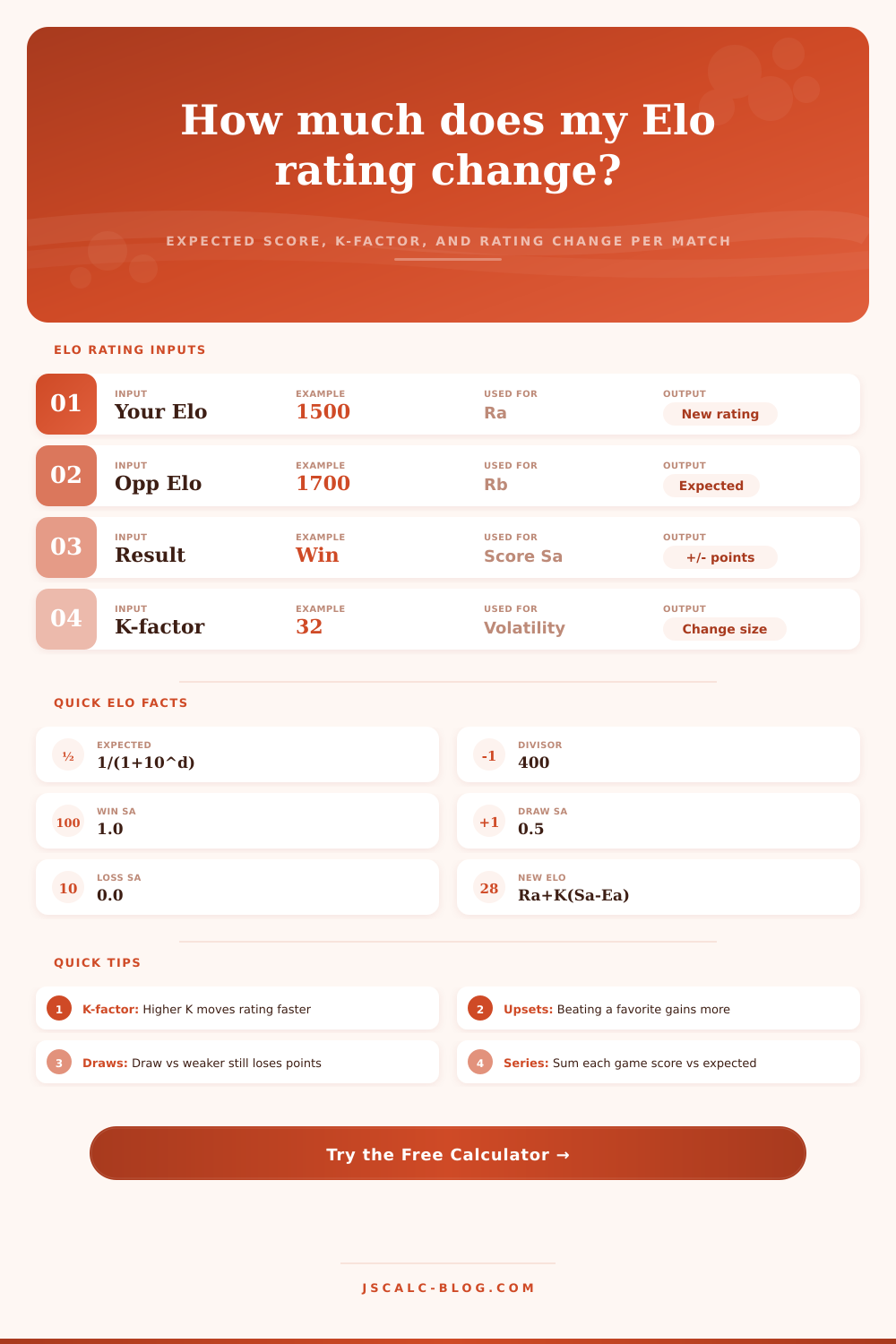
Estimate your new Elo rating, points gained or lost, expected score, and win probability after a single match or a full series using the exact Elo formula with your chosen K-factor.
♟Real Match Presets
📝Match Inputs
Used when mode is single match.
Used when mode is series.
🔢Formula Snapshot
🎯Expected Score by Rating Difference
| Rb – Ra | Your Ea | Opponent Eb | Meaning |
|---|---|---|---|
| Enter ratings above to build the expected-score table. | |||
⚖K-Factor Guidelines by Level
| K-Factor | Player Level | Max Swing | Typical Use |
|---|---|---|---|
| 40 | New / provisional | ±40 pts | First ~30 rated games |
| 32 | Beginner / casual | ±32 pts | Online blitz, rating below 2100 |
| 24 | Improving club | ±24 pts | Standard club and rapid play |
| 16 | Established | ±16 pts | Rating 2100 to 2400 range |
| 10 | Elite / master | ±10 pts | Rating above 2400, top events |
📊Rating Difference to Win Probability
| You Are Higher By | Favorite Win % | Underdog Win % | Interpretation |
|---|---|---|---|
| 0 pts | 50.0% | 50.0% | Even coin flip |
| 50 pts | 57.1% | 42.9% | Slight edge |
| 100 pts | 64.0% | 36.0% | Clear favorite |
| 200 pts | 75.9% | 24.1% | Strong favorite |
| 400 pts | 90.9% | 9.1% | Heavy favorite |
| 800 pts | 99.0% | 1.0% | Near certainty |
🗂Rating Class Reference Grid
| Class / Title | Elo Range | Suggested K | Ea vs 1500 | Ea vs 2000 |
|---|---|---|---|---|
| Novice | Under 1200 | 40 | 0.15 | 0.03 |
| Class C | 1200 to 1399 | 32 | 0.32 | 0.08 |
| Class B | 1400 to 1599 | 32 | 0.50 | 0.15 |
| Class A | 1600 to 1799 | 24 | 0.68 | 0.26 |
| Expert | 1800 to 1999 | 24 | 0.85 | 0.42 |
| Master | 2000 to 2199 | 16 | 0.92 | 0.57 |
| Intl Master | 2200 to 2399 | 16 | 0.97 | 0.74 |
| Grandmaster | 2400 and up | 10 | 0.99 | 0.85 |
⚙Full Formula Breakdown
📋Reference Values
| Item | Common Value | How It Is Used | Effect on Change |
|---|---|---|---|
| Score win | Sa = 1.0 | Full point in Sa – Ea | Largest gain vs a favorite |
| Score draw | Sa = 0.5 | Half point in Sa – Ea | Gains vs stronger, loses vs weaker |
| Score loss | Sa = 0.0 | Zero in Sa – Ea | Smallest drop vs a favorite |
| K-factor | 10 to 40 | Multiplies (Sa – Ea) | Scales every change up or down |
| Divisor | 400 standard | Sets curve steepness | Smaller divisor = sharper odds |
💡Practical Elo Tips
Okay, I won against someone 200+ points above me. That’s a nice victory! My ego loves this one.
My rating will definitely shoot up immediatly, right? Not so fast.” The truth is that it’s likely to go only slightly up, or not at all. Why? Because Elo systems takes into account not only the outcome of the game but also your expectation before the match. After entering your results and ratings in calculator, it spits out how many points you truly won (and should of expected). Expected score is the primary control variable of the system.
How the Rating System Works
Before a match begins, the system calculates probability of one player winning over the other by comparing their ratings. This means that if I have a 1500 rating and play someone with a 1800 rating, the math tell me I should expect to lose some seventy-five percent of the time. If I beat them, that’s an upset. And the system rewards me well for the upset, because it shouldn’t be an upset. It penalizes me only slightly when I lose to same player, because the system knew we would end up here. Surprise is rewarded, failure is punished based off expectations.
The second thing to consider here is the K-factor, also known as volatility dial. Essentially this is how heavily each individual game weigh on your overall rating over time. In most cases new players will start off with a higher number (thirty-two or maybe forty) since we really don’t know what they’re capable of yet. Each outcome changes things drasticly in order for the system to gain enough information and get an accurate read. Then after a while when you become an established player it’s reduced down to something like sixteen or even just ten. That locks in the rating to prevent one bad match against someone weak from wiping out months of solid play, it doesn’t let people who’ve earned their place in the rankings bounce around wildly.
The interaction between draws and this system is missed by most. A draw gets counted as half a point. That sounds neutral but consider what it does to your expected score. If you’re the clear cut favorite in a match up, your expected score may well be ninety percent. So drawing gives you only half of what you expected. In fact, you’ll lose rating points when you tie somebody who’s worse then yourself. Even though you didn’t lose on the board. The reason is that this keeps the system honest. It ensures that you don’t artificialy inflate your rating by playing down and settling for draws. To move ahead you have to do better than predicted; whether the end result ends in a tie or a win doesn’t matter.
You can even use the tool to make comparison across an entire tournament series instead of just one game. Long tournaments falls under the law of large numbers. Individual luck and upsets even out, and you get a better view of how strong you are compared to the rest of the field. You input the sum of all your tournament results (wins, draws, losses) and it calculates what your aggregate expected score would have been against that same set of opponents. Does this show that you were consistently beating the field? Or did you simply catch some lucky breaks here and there? This gives you a far more accurate sense of improvement than variance from single-game results.
This allows you to avoid aimlessly chasing arbitrary numbers, and instead make tangible gains toward something meaningful. It causes you to recognize that when you lose to a better player, it’s not a failing of any sort, just upholding the mathematical truth. It makes you understand why leveling up against correctly matched opponents is the most reliable way to improve, where each point won or lost represent an actual difference from performance norms. This system exists to establish your balance, not give you points for playing within your comfort zone.
Any rating change is a correction on your perceived probabilities. It’s a probability correction in disguise, which makes it feel personal since it touches on your own sense of competence. But if you see it that way, you’ll also see that each game becomes a data point that refines your position. If you play enough games, the numbers will settle out at about your actual skill level.
All of this is just practice for understanding the rating system’s language. That’s the ultimate point: to understand its language rather than trying to hack it. Once you realize that an upset scores less then you think it should; or that a draw penalizes your score; or that a loss against a higher-rated player feels worse than one against a lower-rated opponent, then you don’t fight the algorithm anymore. You begin to use it to measure genuine progress. The rating isn’t a judgment; it’s a map leading you to better play and stronger competition.