Effective Half-Life Calculator
Combine the biological half-life of a compound with the physical half-life of a radioisotope to find the effective half-life, remaining activity, effective decay constant, and percent remaining for nuclear medicine.
☢Radiopharmaceutical Presets
📝Half-Life Inputs
Used when the source is a known isotope.
🔢Formula Snapshot
⚙Full Formula Breakdown
📊Isotope Physical Half-Lives
| Isotope | Physical Half-Life | In Hours | Emission | Common Role |
|---|---|---|---|---|
| F-18 | 109.7 min | 1.83 h | Positron (PET) | FDG PET imaging |
| Tc-99m | 6.01 h | 6.01 h | Gamma | Bone, cardiac, renal |
| I-123 | 13.2 h | 13.2 h | Gamma | Thyroid uptake |
| Ga-67 | 3.26 d | 78.24 h | Gamma | Infection, tumor imaging |
| Tl-201 | 73 h | 73 h | X-ray / gamma | Myocardial perfusion |
| Xe-133 | 5.24 d | 125.76 h | Gamma / beta | Lung ventilation |
| Lu-177 | 6.65 d | 159.6 h | Beta / gamma | PRRT therapy |
| Y-90 | 64.1 h | 64.1 h | Beta | Radioembolization |
| I-131 | 8.02 d | 192.48 h | Beta / gamma | Thyroid therapy |
🗂Effective vs Biological vs Physical
| Agent | Physical (Tp) | Typical Biological (Tb) | Effective (Teff) | Emission | Clinical Use |
|---|---|---|---|---|---|
| I-131 thyroid Rx | 8.02 d | ~80 d (gland) | ~7.3 d | Beta / gamma | Hyperthyroid, cancer |
| Tc-99m MDP bone | 6.01 h | ~24 h | ~4.8 h | Gamma | Skeletal imaging |
| F-18 FDG | 1.83 h | ~24 h | ~1.70 h | Positron | Oncology PET |
| I-123 NaI uptake | 13.2 h | ~80 d (gland) | ~13.1 h | Gamma | Thyroid function |
| Lu-177 DOTATATE | 6.65 d | ~3 d (tumor) | ~2.06 d | Beta / gamma | Neuroendocrine PRRT |
| Ga-67 citrate | 3.26 d | ~9 d (body) | ~2.39 d | Gamma | Infection, lymphoma |
| Tl-201 chloride | 73 h | ~57 h (heart) | ~32.0 h | X-ray / gamma | Cardiac perfusion |
| Xe-133 gas | 5.24 d | ~0.5 h (exhaled) | ~0.50 h | Gamma / beta | Lung ventilation |
📉Activity Remaining per Effective Half-Life
| Effective Half-Lives | Fraction Remaining | Percent Remaining | Percent Decayed |
|---|---|---|---|
| 0 | 1.000 | 100% | 0% |
| 1 | 0.500 | 50.0% | 50.0% |
| 2 | 0.250 | 25.0% | 75.0% |
| 3 | 0.125 | 12.5% | 87.5% |
| 4 | 0.0625 | 6.25% | 93.75% |
| 5 | 0.03125 | 3.13% | 96.88% |
| 7 | 0.00781 | 0.78% | 99.22% |
| 10 | 0.000977 | 0.10% | 99.90% |
📋Common Nuclear-Medicine Agents
| Radiopharmaceutical | Isotope | Physical Half-Life | Main Target Organ | Study Type |
|---|---|---|---|---|
| Tc-99m MDP | Tc-99m | 6.01 h | Bone | Planar / SPECT |
| Tc-99m MAA | Tc-99m | 6.01 h | Lung | Perfusion scan |
| F-18 FDG | F-18 | 109.7 min | Whole body | PET |
| I-123 NaI | I-123 | 13.2 h | Thyroid | Uptake / imaging |
| I-131 NaI | I-131 | 8.02 d | Thyroid | Therapy |
| Ga-67 citrate | Ga-67 | 3.26 d | Reticuloendothelial | Infection imaging |
| Tl-201 chloride | Tl-201 | 73 h | Myocardium | Perfusion |
| Lu-177 DOTATATE | Lu-177 | 6.65 d | Somatostatin tumors | PRRT therapy |
| Y-90 microspheres | Y-90 | 64.1 h | Liver tumor | Radioembolization |
💡Practical Half-Life Tips
In a nuclear medicine lab you have vial of tracer that is radioactive. That radioactivity can be used to diagnose things, but over time radiation will decay. Two factor drive this decay. The first is a physics factor, determined by the nature of atom itself. The second is a human body factor, driven by how the human body processes and gets rid off this chemical compound through the bile, urine, or exhaled air. The first factor do not influence the second. The second doesn’t influence the first. They both happens at the same time.
This means that simply looking at either of these two rates will not yield an accurate result. Understanding the relationship between physical decay and biological clearance require the effective half-life. To find out, type in your biological clearance rate and isotopes (above) and calculator will do it for you. No need to calculate reciprocals or units manualy.
What is Effective Half-Life?
The basic idea is easy: Times don’t add; rates do. For example, taking two half-lives and averaging them by adding and dividing by 2 will not work. Instead, each half-life must be converted to a decay constant. Then the two constants is added together and total is converted back to a half life. This is important for both image quality and patient safety.
Consider an example: How do you think diagnostic imaging differ from therapeutic treatment? Most bone scans use Technetium-99m as the tracer. It has a physical half-life around six hours. After a day, your body will clear out majority of the tracer. Since both stages occur quickly, the effective half-life become roughly five hours. That means technicians can images their patients rapidly while keeping them under radioactive conditions for fairly little time.
On the other hand, Thyroid cancer treated with Iodine-131 therapy have an eight-day physical half-life. However, iodine is trapped in thyroid gland where it stays for weeks or even months. The biology’s very slow retention hardly affect the physical decay rate. Consequently, the effective half-life is just slightly lower then its physical value. Patients remain dangerous for far more than what atoms themselves would predict.
The timing for everything assume that the half-life is a physical property. That’s wrong. If agent comes out too fast then it’s the biological clearance rate that typically becomes the dominant component of equation. In other words, if you’re doing a lung ventilation study using Xenon-133 gas, it’s exhaled within minutes. No matter how stable isotope’s physical half-life, the effective half-life is just slightly greater than respiratory cycle.
The calculator accounts for extremes by letting you enter a manual biological value. This is necessary if pre-loaded values do not match your particular clinical protocol. One common error is using mixed units. For instance, you calculate with one biological half life in hours, another physical half life in days. Then it won’t work unless you change the scale. The calculator does that for you inside (typically converting to hours).
It doesn’t matter whether you measure something in seconds or years, unless you compare across time scales. That’s where most errors happen by treating days and hours as if they can be added together. Pick an output scale that fits what you plan to do with the numbers. Radiation safety release requirements may be given in days, imaging schedules in hours. Change output scale too! The meaning changes when the number is bigger versus smaller.
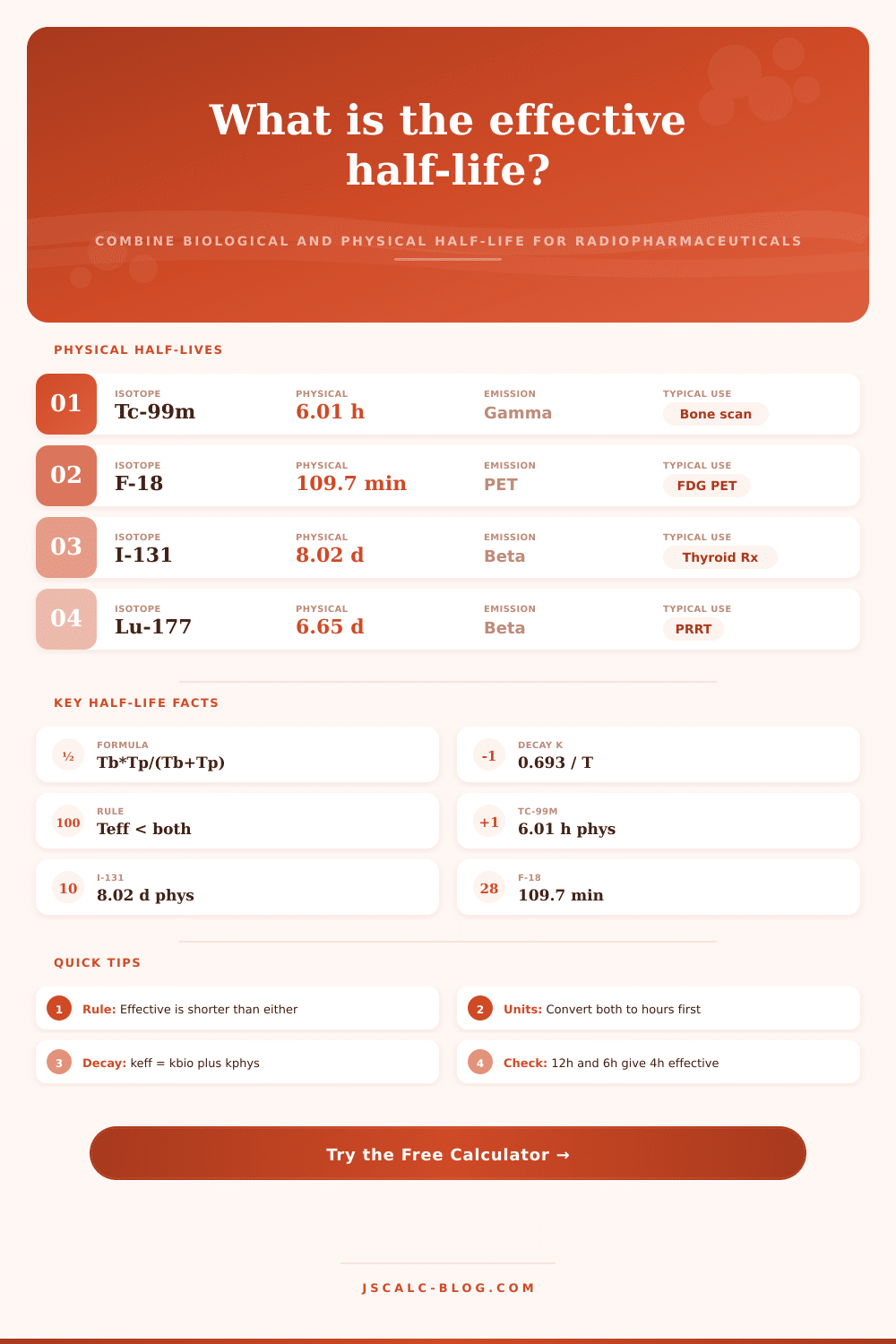
Smaller. So what is effective half-life? Effective half-life is how long it takes to get rid of 50% of radioactive substance from your body. Effective half life is shorter than either one of these rates because there are two opposing forces at work: nuclear decay (removing radioactivity) vs. Metabolic clearance also removes radioactivity. And since each force operates at different speeds, it’s just a question of which is fastest.
You should of used the correct units. It is a race between enzymes and atoms. Once the syringe pierces the vein, the race begins. Effective half-life measures the combined speed, bringing complex nuclear figures down to earth in terms that can be used medicaly.