Elimination Half-Life Calculator
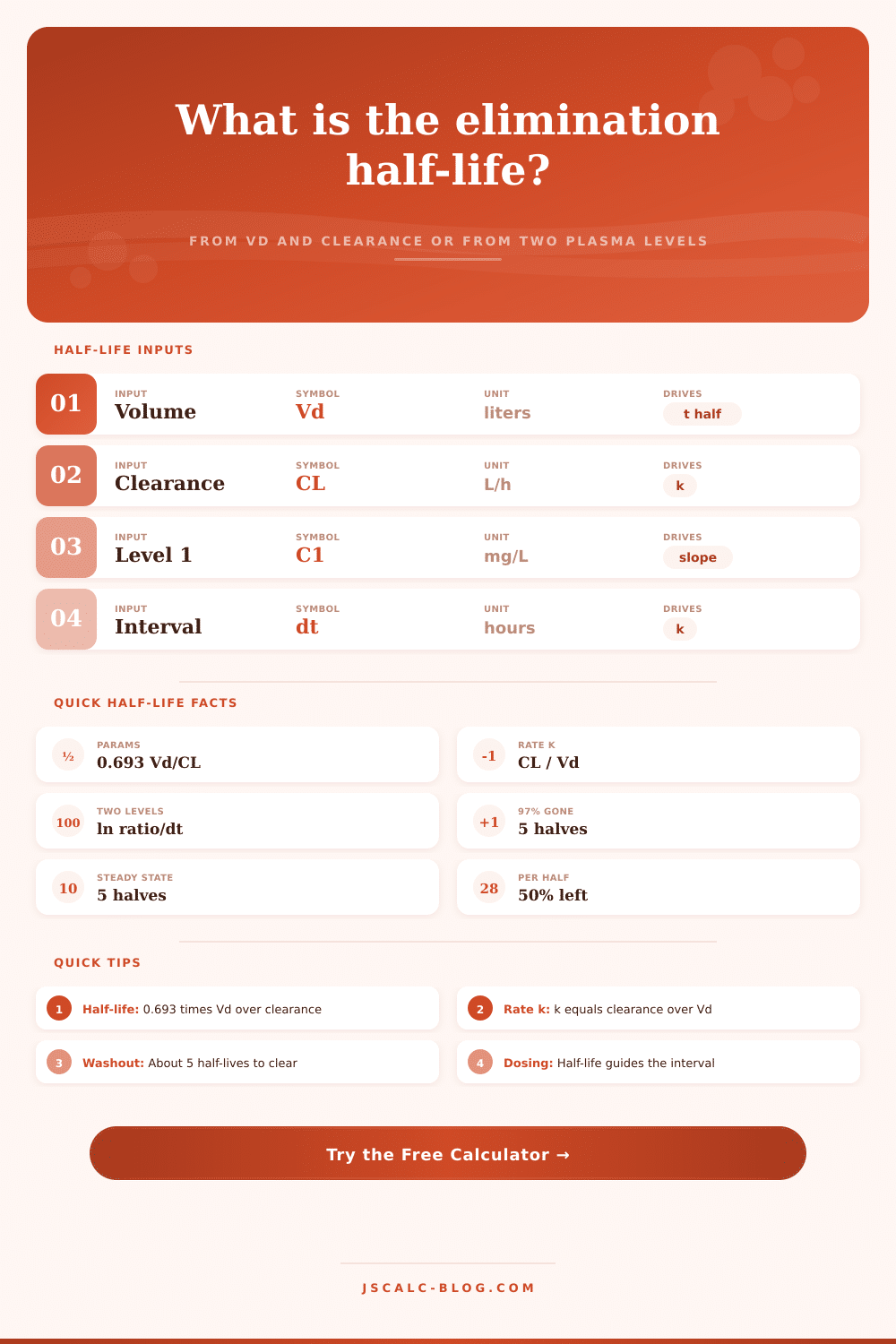
Compute the elimination half-life from volume of distribution and clearance, or from two measured plasma concentrations. Also returns the rate constant k, the time to 97% washout, and the time to steady state.
🎯Real Half-Life Presets
📝Pharmacokinetic Inputs
Time to fall to this percent of the level, e.g. 3% means 97% eliminated.
Used in the Vd and clearance method.
Used in the Vd and clearance method.
Used in the two plasma levels method.
Must be lower than C1 and measured later.
Interval t2 minus t1 for the two levels method.
Optional. Shows how much remains after each half-life.
🔢Formula Snapshot
📊Decay Timeline By Half-Life
| Half-Lives | Elapsed Time | % Remaining | % Eliminated | Amount Left |
|---|---|---|---|---|
| Enter values above to build the decay timeline. | ||||
🗂Vd & CL Half-Life Comparison Grid
| Scenario | Vd (L) | CL (L/h) | k (/h) | Half-Life | Steady State |
|---|---|---|---|---|---|
| Low Vd fast CL | 15 | 10 | 0.667 | 1.04 h | 5.2 h |
| Balanced drug | 42 | 7 | 0.167 | 4.16 h | 20.8 h |
| Standard example | 50 | 5 | 0.100 | 6.93 h | 34.7 h |
| High Vd lipophilic | 200 | 6 | 0.030 | 23.1 h | 115.5 h |
| Renal slow CL | 60 | 2 | 0.033 | 20.8 h | 104 h |
| Loading dose drug | 350 | 4 | 0.011 | 60.6 h | 303 h |
| Fast clearance | 40 | 15 | 0.375 | 1.85 h | 9.2 h |
| Very high Vd | 500 | 3.5 | 0.007 | 99 h | 495 h |
🧪Half-Lives Of Common Reference Drugs
| Drug Class Example | Typical Half-Life | Rate Constant k | Practical Note |
|---|---|---|---|
| Short-acting analgesic | 2 – 3 h | 0.23 – 0.35 /h | Frequent dosing needed |
| Standard oral antibiotic | 6 – 8 h | 0.09 – 0.12 /h | Two to three times daily |
| Once-daily agent | 12 – 24 h | 0.03 – 0.06 /h | Single daily dose works |
| Long-acting agent | 36 – 72 h | 0.01 – 0.02 /h | Slow washout, watch buildup |
| Very long half-life drug | 4 – 10 days | < 0.01 /h | Loading dose often used |
📉Percent Eliminated Per Half-Life
| Half-Lives Passed | % Remaining | % Eliminated | Stage Meaning |
|---|---|---|---|
| 1 | 50% | 50% | Level halved once |
| 2 | 25% | 75% | Three quarters gone |
| 3 | 12.5% | 87.5% | Approaching washout |
| 4 | 6.25% | 93.75% | Near complete |
| 5 | 3.125% | 96.875% | Steady state or washout |
| 6 | 1.56% | 98.44% | Essentially cleared |
| 7 | 0.78% | 99.22% | Trace remaining |
⚙Full Formula Breakdown
📋Input Reference Values
| Parameter | Common Range | Unit | How It Is Used |
|---|---|---|---|
| Volume of distribution | 10 – 700 | liters | Larger Vd lengthens half-life |
| Clearance | 1 – 60 | L/h | Higher CL shortens half-life |
| Concentration C1 | 1 – 100 | mg/L | Earlier, higher sample |
| Concentration C2 | Below C1 | mg/L | Later, lower sample |
| Sampling interval | 0.5 – 48 | hours | Time gap sets the slope |
💡Practical Half-Life Tips
So what is elimination half-life? You may think of it as an abstract term, until you’re on hold at pharmacy, waiting three days for a medication to kick in… Or three hours for it to leave your body.
When you’re staring down at the bottle, half life determines the tempo of the treatment: How frequently to take a pill and when the next therapy needs to be used. Half life isn’t simply a line in a pharmacokinetic text book. It’s your own personal metronome that controls whether drug remains within the therapeutic window…or vanishes into nothingness before the next dose.
Understanding Drug Half-Life
To save yourself from fighting with natural logs on a busy shift, the calculator above does all that math for you when you enter clearance and volume of distribution. If you’ve got concentrations at two different time points (plasma levels), you can even get the value that way. Beyond just providing you with the half-life as a number, the tool will give you elimination rate constant. What’s that? That’s how fast it decays per hour. How long before drug gets to a point where 97% of it has been eliminated? And when would you expect to reach steady state? All these outputs transform one number into a timeline, something you can use clinically.
The tricky one here is volume of distribution, which is no indication of literal physical space within your body. It’s a measure of the drug spreading away from blood into tissue. If you have a lipophilic (fat loving) drug diving into muscles and fat, its apparent volume will be large. This means it will be diluted in the bloodstream at any given moment, leaving less for kidneys and liver to deal with on an hourly basis.
Clearance is the other side of the coin. How effectively can the body clear the drug? Higher clearance will pull down the half life, while lower clearance mean it stays in the body longer. These two factors interact to make some medications act more like a marathon runner, others like a sprinter.
What people often overlook is that washout and steady state have similar timelines: about five half lives. That means when you begin a new drug, don’t assume you’re “there” after the first dose. It takes multiple cycles before your body reaches balance; i.e., you’re filling a bucket with a hole in the bottom of it.
On the flip side, once a patient has adverse reactions from a drug, they can stop taking it but won’t immediately feel better because the drug’s still working for quite some time. That’s why there are drugs with long half-lives and why they have loading doses. Giving a large dose initially allow you to rapidly get to desired levels while skipping the gradual rise.
They offer example scenarios and reference tables, including changes in input, to show how they change the timeline. A long half-life means a drug can be taken less often, such as daily or perhaps weekly. A shorter half-life requires more frequent dosing to keep the drug working. In other words, look at the decay timeline below. If something has a half-life of 8 hours, 50% is still there by the end of one cycle. After two cycles, 25% is left, etc. That’s a geometric drop off, which we’re not used to thinking about. We tend to think things are going to drop out linearally and then go away quicker. If you know it’s a geometric drop off, you shouldn’t of stop treatment too soon and let your drug wear off.
However, when renal function is impaired, it all goes out of the window again. Reduced kidney function reduces clearance. This increases the half life quite a lot, meaning that we need to adjust our dose interval to prevent any potential toxicity. We can play around with this using the calculator. It will demonstrate how reduced clearance affects your wash-out time. This is especially important when dealing with drugs with a narrow therapeutic index, such as anticoagulants and antibiotics.
These are the figures you work with in practice, how much do you balance efficacy against convenience? How much is too much? How little is too little? If you want very tight control over the drug’s effect, you need it to have a short half life. This requires that the patient be strict about following their regimen. If instead you’re more interested in compliance (and less concerned about accumulation), then you can go for a drug with a long half life. No number is ideal; every case will depend on the specifics of the clinical situation as well as what the patient can reasonably stick to.
You want to keep the concentration within the therapeutic window for as long as possible. What connects us as humans to a chemical’s properties is its elimination half life. It converts the molecular mechanics into “take it like this” language. Whether you are on a simple or complicated drug regime, understanding that makes it clear how a medication acts. And we know the clock is ticking. We can understand how to interpret the timepiece so that medicine can do its work instead of floating around uselessly in your body.