Early Payment Discount Calculator
Compare invoice discount terms such as 2/10 net 30 against your annual cash cost. The calculator reports captured discount, discounted payment, days accelerated, implied annual return, carrying cost, and annual net impact.
🎯Invoice Term Presets
🧮Discount Inputs
Choosing a pattern fills discount percent, discount day, and net due day.
Use the pre-discount invoice total before sales tax adjustments.
For 2/10 net 30, enter 2.
Use the day cash leaves your account, often the discount deadline.
Use the latest day you could pay without losing standing.
Compare the discount return with your credit line or cash hurdle rate.
Repeated purchases turn one invoice decision into annual cash impact.
Many vendor comparisons use 365; some credit facilities use 360.
Method float adjusts how many days your cash is accelerated.
A cushion helps when invoices are disputed or cash forecasts are uncertain.
🔢Current Discount Snapshot
📐Formula Breakdown
📋Common Payment Term Returns
| Terms | Discount | Discount Day | Net Day | Days Accelerated | 365-Day Return | Typical Read |
|---|---|---|---|---|---|---|
| 0.5/7 net 14 | 0.5% | 7 | 14 | 7 | 26.2% | Small discount, very short acceleration |
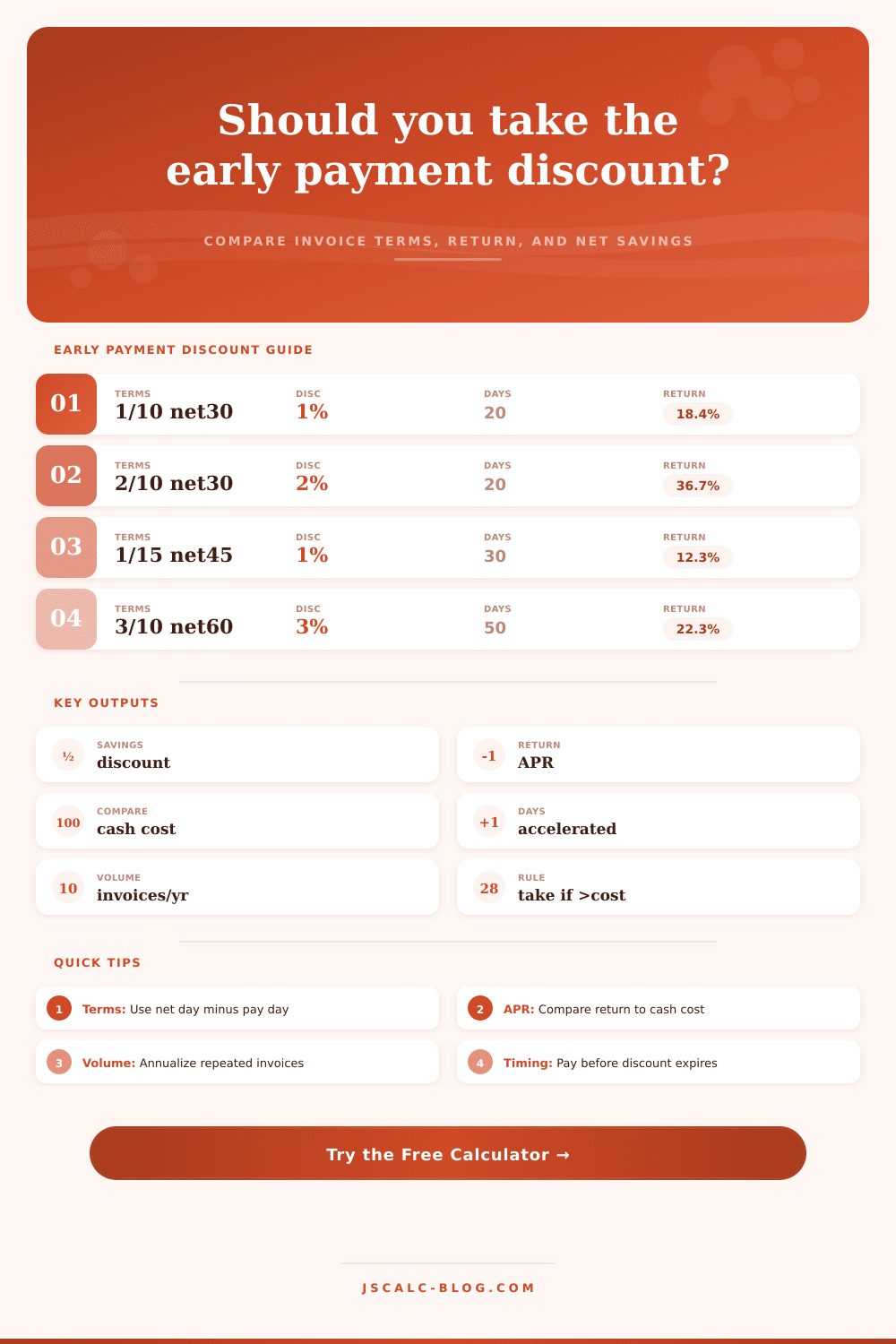
| 1/10 net 30 | 1.0% | 10 | 30 | 20 | 18.4% | Often attractive when cash cost is modest |
| 2/10 net 30 | 2.0% | 10 | 30 | 20 | 37.2% | Classic supplier discount benchmark |
| 1.5/10 net 30 | 1.5% | 10 | 30 | 20 | 27.8% | Still strong versus many credit lines |
| 1/15 net 45 | 1.0% | 15 | 45 | 30 | 12.3% | Useful if liquidity is stable |
| 2/15 net 45 | 2.0% | 15 | 45 | 30 | 24.8% | Good for inventory and recurring vendors |
| 3/10 net 60 | 3.0% | 10 | 60 | 50 | 22.6% | Large dollar discount with longer cash pull |
| 2/7 net 60 | 2.0% | 7 | 60 | 53 | 14.1% | Lower return because cash moves far earlier |
| 5/10 net 90 | 5.0% | 10 | 90 | 80 | 24.0% | High discount but long working-capital lock |
💳Cash Cost Comparison Grid
| Annual Cash Cost | Use As | Take 1/10 Net 30? | Take 2/10 Net 30? | Decision Note |
|---|---|---|---|---|
| 0% to 5% | Idle cash or low-cost credit | Usually yes | Usually yes | Discount return normally dominates |
| 6% to 12% | Common working-capital hurdle | Often yes | Usually yes | Check cash forecast and invoice disputes |
| 13% to 20% | Expensive credit line | Borderline | Often yes | Smaller discounts need review |
| 21% to 30% | Tight cash or card funding | Usually no | May still pass | Only high-return terms clear the hurdle |
| Above 30% | Emergency capital | No | Compare carefully | Preserve liquidity unless return is extreme |
| Strategic vendor | Relationship priority | Maybe | Maybe | Use policy cushion to reflect strategy |
🔍Preset Scenario Benchmarks
| Scenario | Invoice | Terms | Cash Cost | Invoices/Yr | Return | Annual Net | Typical Decision |
|---|---|---|---|---|---|---|---|
| 2/10 net 30 supplier | $25,000 | 2/10 net30 | 8% | 24 | 37.2% | $9,431 | Take discount |
| Office invoice | $4,800 | 1/10 net30 | 7% | 18 | 18.4% | $533 | Take if cash stable |
| Inventory vendor | $62,000 | 2/15 net45 | 11% | 12 | 24.8% | $6,903 | Usually take |
| Seasonal stock | $118,000 | 3/10 net60 | 15% | 6 | 22.6% | $4,825 | Check liquidity |
| Cash tight 1.5/10 | $36,500 | 1.5/10 net30 | 24% | 20 | 27.8% | $1,365 | Small cushion |
| Large batch | $210,000 | 2/10 net30 | 9% | 8 | 37.2% | $24,557 | Strong take |
| Short terms | $13,400 | 0.5/7 net14 | 16% | 30 | 26.2% | $784 | Take with ACH |
| Quarterly vendor | $78,000 | 1/15 net45 | 10% | 4 | 12.3% | $181 | Nearly neutral |
| Fast-pay rebate | $29,500 | 3/7 net30 | 12% | 16 | 49.1% | $10,057 | Take if approved |
💡Early Payment Discount Tips
What does 2/10 net 30 mean? It’s accounting shorthand, right? It’s also a silent invitation for you to recieve what most stock traders would be jealous of: a return on your cash.
Here’s how it works: you’re making an investment decision with a fixed maturity date (that’s why they call it “net”). You can receive this return by paying early, or at no time at all if you let the invoice age until normal due date. That’s why you need to understand that when you write a check for something, you aren’t simply writing a check. You’re doing some short-term investing.
How to Save Money on Early Payments
Most business owners considers these terms as mere administrative details. You should of think of them as a hidden yield curve. Plug your own cash position and invoice terms into the calculator above, and let it do the math for you. That saves you from having to crunch numbers for yearly rates.
The basic idea is straightforward, and it’s a doozy: A vendor pays you to borrow its money if it gives you two percent off if you pay in ten days different than thirty days. Sounds small? No. Calculate that two percent return over the course of a three hundred sixty-five day year, and the effective interest rate leap dramatically. It is often higher then what you can earn from traditional savings accounts. It is higher than what you can get from short-term government bonds. It is sometimes higher than what you can get from more risky equity investments.
Why do people miss it? Because they’re obsessed with amount of money saved. Ten-thousand-dollars times two percent equals two-hundred dollars, which seems like rounding error. In finance, it isn’t about absolute dollars, it’s about rates of return. Two-hundred-dollars earned in twenty-days is a high-velocity trade. So that’s why we recommend factoring in your own cost of capital when evaluating the return.
For example, if you have excess cash in a money market account at four percent, then it’s an easy yes: swap a low-yield asset (cash) with a high-yield one (discount). In these circumstances, the math favor you.
But let’s say you lack spare cash. Let’s say you need to borrow via a line of credit. How do you evaluate the discount offer then? Now you’ll want to look at the return from the discount as compared to your cost of borrowing. Suppose your credit line carries an annual rate of 12 percent. And suppose the discount represent a corresponding rate of thirty percent. You’re still coming out ahead. You’re profiting from the gap between those two numbers.
The discount calculator helps highlight this gap, because it removes the financing cost from the gross discount. The result reveal how much you pocket once interest is removed.
And then there’s the issue of timing. When you pay early, it speeds up your cash outflow. Money goes out of your bank account faster. That could be risky if you’re pinching pennies for cash. You might save yourself two hundred bucks today… only to have a deficit next month because you forgot about rent.
The tool lets you estimate how many similar invoice you get per year. Then it calculates the yearly effect. Will you deplete your reserves or build equity over time? Can you afford to capture these discounts? Or does it make sense as a strategic policy?
There are complications. Never prepay unless you’re certain the invoice matches and that they recieved the goods correctly. After paying out the cash, you don’t have any power. Why can’t you wait to pay them? How do you know if they’ll deliver what’s promised in good condition? Because once it’s paid, you lose the leverage to withhold payment until issues is resolved. The calculator presumes this is a clean transaction. In real life, it isn’t always so clean.
For the financial baseline use the tool; for the operational reality, use some human judgment. Unless you’re sure of how much or what you got, let the invoice age until its normal due date. The discount lost is insurance money.
But bottom line: These discounts are compensation for efficiency. The vendors will give it to you if they can get their cash sooner. If you take it, you’re working together with them. You speed up their cash flow. And you improve your own return on capital. That’s one of those few win-wins in business.
So don’t blow off that fine print. Those terms aren’t rules; they’re opportunities. Read ’em right. Use the numbers. They’ll tell you the truth; assuming you understand the context in which to read them.