Cash Discount Terms Calculator
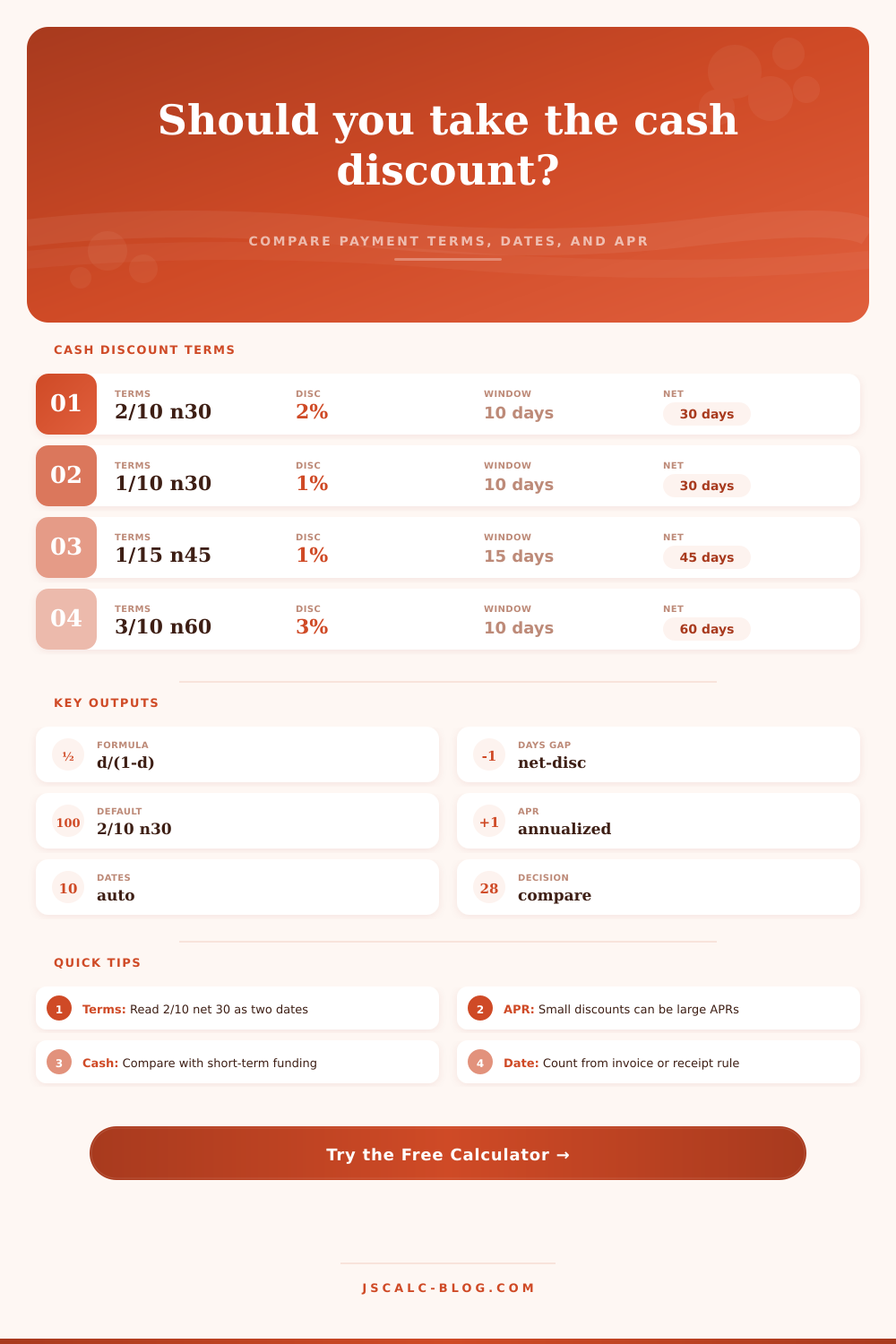
Evaluate supplier payment terms such as 2/10 net 30, 1/15 net 45, or custom early-payment discounts. The calculator converts the offer into saved amount, pay-by dates, simple annualized rate, effective annual rate, and a clear take-or-skip comparison.
🎯Cash Discount Presets
🧮Payment Terms Inputs
Pick a common pattern or leave custom values below.
Annualized rate uses this day-count convention.
Enter the gross invoice total eligible for the discount.
For 2/10 net 30, enter 2.
Number of days allowed for the reduced payment.
Final due date if the discount is not taken.
Dates are calendar-day estimates from this invoice date.
Use this to test if a current plan misses the discount.
Compare the discount yield with your borrowing or cash hurdle rate.
Annualizes the repeated discount dollars for planning.
🔢Current Terms Snapshot
📐Formula Breakdown
📋Common Cash Discount Terms
| Terms | Meaning | Discount Payment Date | Full Net Date | Extra Credit Days | Simple APR, 365 | Typical Read |
|---|---|---|---|---|---|---|
| 2/10 net 30 | 2% discount if paid within 10 days | Invoice date + 10 days | Invoice date + 30 days | 20 | 37.24% | Classic high-yield early pay offer |
| 1/10 net 30 | 1% discount if paid within 10 days | Invoice date + 10 days | Invoice date + 30 days | 20 | 18.43% | Often worth taking versus ordinary credit |
| 1/15 net 45 | 1% discount if paid within 15 days | Invoice date + 15 days | Invoice date + 45 days | 30 | 12.29% | Compare carefully with funding rate |
| 2/15 net 60 | 2% discount if paid within 15 days | Invoice date + 15 days | Invoice date + 60 days | 45 | 16.55% | Moderate annualized return |
| 3/10 net 60 | 3% discount if paid within 10 days | Invoice date + 10 days | Invoice date + 60 days | 50 | 22.58% | Large discount despite longer net term |
| 0.5/10 net 30 | 0.5% discount if paid within 10 days | Invoice date + 10 days | Invoice date + 30 days | 20 | 9.17% | Thin discount; depends on cash use |
| 2/20 net 75 | 2% discount if paid within 20 days | Invoice date + 20 days | Invoice date + 75 days | 55 | 13.55% | Longer gap lowers annualized yield |
| 1/10 EOM | 1% discount from end-of-month dating | EOM + 10 days | Often EOM + 30 days | 20 | 18.43% | Confirm the exact statement convention |
💳Discount Yield Quick Reference
| Discount | Extra Days | Simple APR 365 | Effective Annual Rate | Compare Against |
|---|---|---|---|---|
| 0.5% | 20 | 9.17% | 9.60% | Credit line, sweep account, cash hurdle |
| 1.0% | 20 | 18.43% | 20.14% | Most ordinary short-term borrowing rates |
| 2.0% | 20 | 37.24% | 44.59% | Very high opportunity return |
| 1.0% | 30 | 12.29% | 12.96% | Card float or revolving short-term debt |
| 2.0% | 45 | 16.55% | 17.92% | Seasonal working-capital funding |
| 3.0% | 50 | 22.58% | 24.87% | Supplier financing alternative |
🗓Payment Timing Cases
| Planned Payment | Discount Status | Cash Effect | Calculator Signal | Action |
|---|---|---|---|---|
| Before discount day | Available | Lower remittance | Take discount if APR clears hurdle | Schedule payment for early window |
| On discount day | Available | Lower remittance | Last eligible day | Confirm receipt cutoff and time zone |
| Between discount and net date | Missed | Full remittance | Discount lost | Compare lost discount with cash retained |
| On net due date | Missed | Full remittance | No late buffer | Pay full amount or renegotiate terms |
| After net due date | Past due | Potential service risk | Warning message | Resolve with supplier before delay grows |
| EOM dating | Rule-dependent | Statement date driven | Use custom dates if needed | Confirm whether clock starts at invoice or EOM |
💡Cash Discount Terms Tips
There’s a polite but firm threat: pay within ten days and get a two percent discount; pay at the end of thirty days and pay the full amount. Sounds like a trivial question, should I save a little cash now or hold onto it a bit longer? Most people look at the percentage and think, “Oh yeah, that looks small.” A small number equals negligible savings. This is the first trap.
The discount rate isn’t the story here. The story lies in actual cost of the credit you are implicitly buying when you delay payment. If you don’t take the discount, then you aren’t just paying a little extra, you’re borrowing money from your supplier at an interest rate often higher than your mortgage.
The Real Cost of Missing Discounts
That’s where this calculator comes in: It’ll do the math for you, translate all those terms and discounts and dry numbers into annualized rates. All you have to do is plug in the invoice amount, the discount percentage, and the days until each one (the number of days until the discount window closes, as well as the final due date). Then the calculator will tell you exactly how much money you’re saving by paying early, but more importantly, what you’re paying in order to not pay on time. It turns that difference between the net date and the discount date into an easy-to-understand annual percentage rate. That figure shows you the real price you are paying for the added time you get to hang onto your money.
A 10 day discount on a 30 day net term doesn’t seem like much when it’s just two percent. But annualized, that lost discount costs you over thirty-seven percent a year. That’s the sort of rate that makes short-term borrowing look cheap in comparison.
So what do all those words mean? Read them like this: “If you pay me within ten days, I’ll give you a two percent discount; otherwise the full amount is due within thirty days.” There is your discount window of ten days. Then there is your final deadline of thirty days. That’s the credit period you’re buying, the time between the two events. Pay on day eleven and you forfeit your discount. You’ve bought yourself an additional twenty days of float, but at a price, that two percent fee.
Here’s how various combinations of dates look in practice, using the reference table on the page. In general, longer discounts at lower rates are cheaper forms of credit than shorter discounts at higher rates. The length of the loan is as important as the discount itself. Now compare this implied rate with what you pay for funds. Suppose you pay 12% on your business credit line. Borrow that cash, take the discount, and you’re making money. Skipping that discount costs you over thirty-seven percent a year. You’ll pay your bank twelve percent for the privilege of borrowing that cash. That’s a no-brainer.
But maybe you don’t have easy access to low-cost credit. In that case, you’ll want to think about what you lose by tying up your own cash. Would you rather make thirty-seven percent on this or hold cash? The answer is probably “thirty-seven percent.” Double digit returns almost always beat cash sitting in a bank account.
Here’s another way to look at it: skipping the discount is essentially borrowing money from your supplier. You’re giving him an interest-free loan. And he’s going to charge you for this service? This isn’t charity. He’s not charging below-market rates just out of the kindness of his heart. Because he’s charging zero, he has to compensate by pricing the discount aggressively. After all, there’s risk here, he could go bankrupt before he collects his money.
But raw numbers don’t tell the whole story. Often sales tax and freight aren’t subject to the discount. Paying full price with those extra costs reduces your actual savings. To keep things honest, the calculator asks how much is actualy eligible for the discount. It also requires you consider the date used. Is it counting from invoice date or the end of the month? Misreading the start date can bump you right past the window. By using the invoice date as the starting point, the tool calculates exactly what day you’ll be due so you can see the dates in front of you. When your desired payment date falls outside the cutoff, it flags it to avoid embarrassment after you write a check on day eleven only to wonder why the discount never applied.
Paying early is nice, but it’s not always possible, and sometimes it just builds a relationship with the supplier (which isn’t bad). But if the APR is high, paying on time and missing out on the discount will get pricey. Know what you are paying. And negotiate a better deal when the implied rate is too high. 1/30 net 60 is different from 2/10 net 30. The first one charges you a different rate than the second. Use the calculator to benchmark these deals. Turn vague promises into hard comparisons. See who is really financing your growth, and at what cost.
Rate + timing = cash management. Know the annualized cost of each invoice, and you have a leverage point. Start viewing discounts as significant returns on capital, rather than small perks.
The bottom line is that the discount itself is a sign. A high rate indicates that your supplier wants his cash now. A low rate says he’s willing to give you time. Crack the code. Input your numbers, calculate the annualized cost and ask yourself whether those additional days are worth the price. It’s not rocket science. And you wouldn’t of been wrong if you overlook it. Each invoice is a deal. Treat it as such.