Discount Calculator
Find the sale price, dollars saved, and the true effective percent off for single percent-off deals, fixed coupons, stacked or double discounts, and find-the-discount comparisons, with quantity and optional sales tax.
🏷Real Deal Presets
📝Discount Inputs
Switches which fields drive the result.
Used for percent-off and stacked modes.
Applied after the first in stacked mode.
Used for fixed-amount and coupon deals.
Used to find the % in find-discount mode.
Applied to the discounted price. Use 0 to skip.
🔢Method Snapshot
📊Percent-Off Quick Table
| Original | 10% Off | 20% Off | 25% Off | 50% Off | 75% Off |
|---|---|---|---|---|---|
| Enter an original price above to fill this table. | |||||
✖Discount to Multiplier
| Discount % | Keep Multiplier | You Pay On $100 | You Save On $100 |
|---|---|---|---|
| 5% off | × 0.95 | $95.00 | $5.00 |
| 10% off | × 0.90 | $90.00 | $10.00 |
| 15% off | × 0.85 | $85.00 | $15.00 |
| 20% off | × 0.80 | $80.00 | $20.00 |
| 25% off | × 0.75 | $75.00 | $25.00 |
| 30% off | × 0.70 | $70.00 | $30.00 |
| 40% off | × 0.60 | $60.00 | $40.00 |
| 50% off | × 0.50 | $50.00 | $50.00 |
| 60% off | × 0.40 | $40.00 | $60.00 |
| 70% off | × 0.30 | $30.00 | $70.00 |
| 75% off | × 0.25 | $25.00 | $75.00 |
🔗Stacked Discount Effective Rate
| First + Second | Sum Looks Like | Real Multiplier | True Effective % |
|---|---|---|---|
| 10% + 10% | 20% off | 0.90 × 0.90 = 0.81 | 19% off |
| 20% + 10% | 30% off | 0.80 × 0.90 = 0.72 | 28% off |
| 25% + 15% | 40% off | 0.75 × 0.85 = 0.6375 | 36.25% off |
| 30% + 20% | 50% off | 0.70 × 0.80 = 0.56 | 44% off |
| 40% + 10% | 50% off | 0.60 × 0.90 = 0.54 | 46% off |
| 50% + 20% | 70% off | 0.50 × 0.80 = 0.40 | 60% off |
| 50% + 25% | 75% off | 0.50 × 0.75 = 0.375 | 62.5% off |
| 50% + 50% | 100% off | 0.50 × 0.50 = 0.25 | 75% off |
½Fraction to Percent Sale Reference
| Sign Says | As a Fraction | Percent Off | Keep Multiplier |
|---|---|---|---|
| Take 1/10 off | 1/10 | 10% off | × 0.9000 |
| Take 1/5 off | 1/5 | 20% off | × 0.8000 |
| Take 1/4 off | 1/4 | 25% off | × 0.7500 |
| Take 1/3 off | 1/3 | 33.33% off | × 0.6667 |
| Take 3/8 off | 3/8 | 37.5% off | × 0.6250 |
| Take 1/2 off | 1/2 | 50% off | × 0.5000 |
| Take 2/3 off | 2/3 | 66.67% off | × 0.3333 |
| Take 3/4 off | 3/4 | 75% off | × 0.2500 |
🗂Deal Comparison Grid
| Deal Type | Example | On $100 | You Pay | Effective % | Best For |
|---|---|---|---|---|---|
| Single percent | 25% off | × 0.75 | $75.00 | 25% off | Simple sales |
| Fixed coupon | $50 off | -$50 | $50.00 | 50% off | High-price carts |
| Stacked | 20% + 10% | × 0.72 | $72.00 | 28% off | Coupon on sale |
| BOGO 50% | 2 items | × 0.75 avg | $75.00 | 25% off | Buying in pairs |
| BOGO free | 2 items | × 0.50 avg | $50.00 | 50% off | Stock-up pairs |
| Clearance | 70% off | × 0.30 | $30.00 | 70% off | End of season |
| Member perk | 10% off | × 0.90 | $90.00 | 10% off | Everyday buys |
| Final sale | 60% off | × 0.40 | $40.00 | 60% off | No-return items |
⚙Full Formula Breakdown
📋Common Discount Reference
| Scenario | What It Means | How To Compute | Watch Out For |
|---|---|---|---|
| Percent off | A flat rate cut | Price × (1 - rate) | Confirm it is off the full price |
| Dollar coupon | A set amount off | Price minus the amount | May need a minimum spend |
| Stacked codes | Two cuts in a row | Multiply the keep rates | Sum overstates the real deal |
| BOGO 50% | Half off second item | Average over both items | Only when you buy in pairs |
| Tax after discount | Tax on the sale price | Sale × (1 + tax rate) | Some coupons apply post-tax |
💡Smart Discount Tips
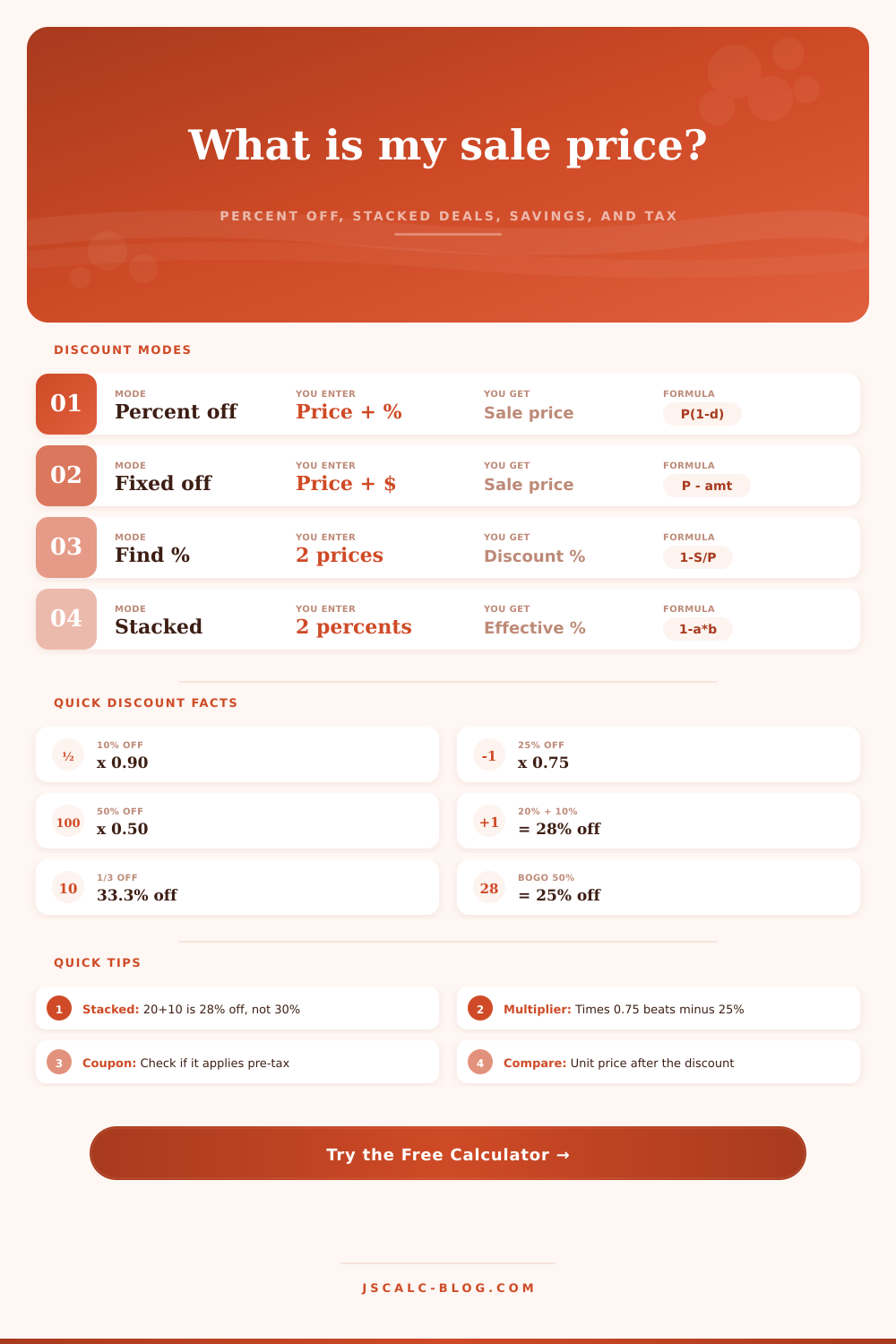
There are two price tags in front of you, one offering 20% off; another offering an additional 10%, provided you enter a discount code. Math tell you they should add up to 30%. But math isn’t running this show. The world of retail is built to make things appear easier than they are, relying on you to respond to the larger headline by grabbing the offer without performing any calculations.
And that’s why knowing exactly what something costs is less about having a skill and more about saving money. After that, all you need do is punch your numbers into the calculator up top, no more tired mind at the cash register, and it figure out the rest for you. It does this by splitting total cost into two parts: the raw amount paid and the method used to knock money off of it.
Simple Ways to Understand Store Discounts
With the bare-bones percentage, it will multiply the starting price with the leftover fraction. For example, if you pay $80 on an item discounted at 25%, you don’t take $20 off. You’re spending $0.75 for each dollar’s worth of product. This concept of multiplying by a remaining fraction is important, as it applies to any price and adjust automatically. There’s no need to recalculate anything.
The problem arises when the store piles its discounts on top of one another. During holidays, for example, you’ll often see big sign advertising “30% off” while a small tag says, “Take an extra 10% off at register.” Consumers think they’re receiving a 40% discount, huge! What they don’t realize is that the lower price is discounted by a second amount. That means the second discount was taken from the discount price. So instead of 40%, we’re probably seeing about 28%. It’s still a great deal; just not as earth-shattering than the digits imply. Knowing this will help when final purchase seems more expensive than expected.
With fixed amount coupons, the math works in an entirely different way. A $50 coupon seems like such a great deal, until you see you have to buy $200 worth of stuff to trigger the coupon. Depending on which items is eligible and how much you put in your cart, the actual discount rate decreases as the cart size grows. If you’re just below the bar, then that flat saving is a massive reduction. But if you’re buying a lot, the same coupon discounts hardly anything at all. When comparing a percentage versus a fixed dollar amount, you need to think about the final result… Not the face value of the coupon.
Another thing people often overlook is tax. In most places, sales tax are applied to the discounted amount, so if you haggle down the starting price, you’ll pay reduced tax on it. However, some promo codes are set up to be applied after tax, and some have restrictions that remove whole categories from discounts altogether. If you’re not sure whether your discount kicks in pre- or post-tax, it will affect how much money you save per item. By allowing you to toggle between different tax rates, the tool takes all that into account and gives you an accurat total instead of a hopeful one based off pre-tax figures.
And then there are those fractional discounts in the clearance section… The two-thirds-off and one-third-off deals. These are actualy disguised percentages that try to sound more limited or precise. Two-thirds off is around sixty-six percent; one third is closer to thirty three percent. It’s easy enough to make this conversion in your head but it can lead to mistakes, particularly if you’re comparing a fractional discount with a neat twenty five percent markdown somewhere else in the store. If everything were turned into a decimal multiplier it’d be easy to compare, simply see who’s keeping less of your cash.
Quantity enters the mix when we buy in bulk. That discount on a single item seems awesome, until you remember that you’re using six of them for this project. Calculate the per-unit cost after the discount and before tax to see if it’s within your budget. Stretching to reach a certain quantity cutoff and get a tiny fraction off might not be worth paying full price for less. You should of checked this first.
How does it work? The page has a set of reference tables that explain the way different discounts stack up against one another in real-world situations. It’s a visual aid that will help you identify patterns in people’s pricing strategies, things that you may not notice if you look at individual calculation over time. Eventually, you’ll begin to know which discounts are really good ones and which are merely marketing noise. You want your dollars to earn their keep; that clarity is the best discount you can get for yourself.