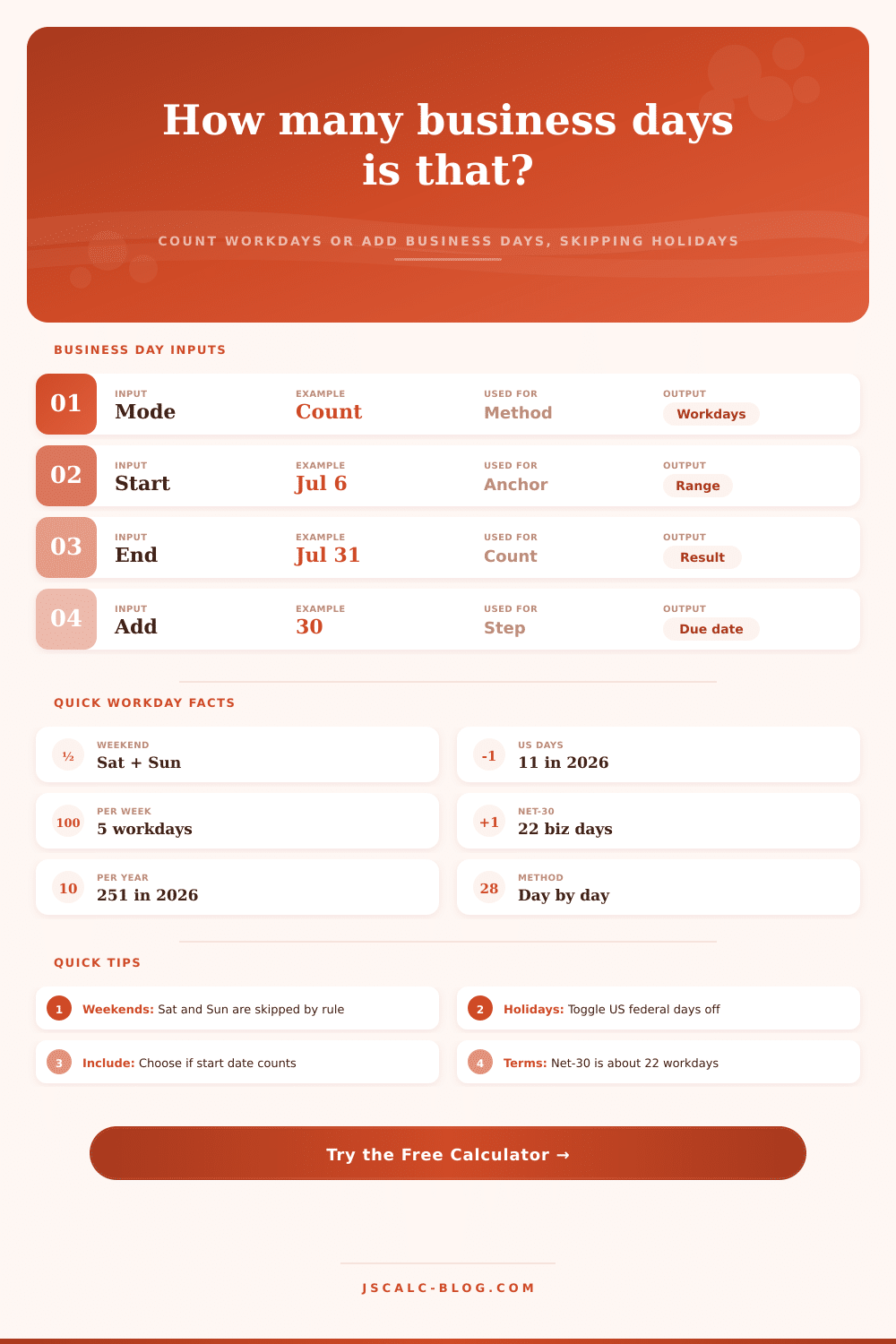
Business Days Calculator
Count the working days between two dates, or add and subtract business days from a start date. Weekends and US federal holidays are skipped so due dates, shipping windows, and Net terms land on real working days.
🎯Real Workday Presets
📝Date Inputs
Used only when counting business days between two dates.
Used only when adding or subtracting business days.
🔢Method Snapshot
🇺🇸US Federal Holidays 2026
| Holiday | Observed Date | Weekday | Skipped? |
|---|---|---|---|
| Holiday impact appears after calculation. | |||
The 11 federal holidays above make up the default US calendar. When an observance falls on a weekend it is shifted to the nearest weekday, which is why Independence Day is observed Friday, July 3, 2026.
📅Business Days Per Month 2026
| Month | Calendar Days | Weekend Days | Holidays | Business Days |
|---|---|---|---|---|
| January | 31 | 10 | 2 | 19 |
| February | 28 | 8 | 1 | 19 |
| March | 31 | 9 | 0 | 22 |
| April | 30 | 8 | 0 | 22 |
| May | 31 | 10 | 1 | 20 |
| June | 30 | 8 | 1 | 21 |
| July | 31 | 8 | 1 | 22 |
| August | 31 | 10 | 0 | 21 |
| September | 30 | 8 | 1 | 21 |
| October | 31 | 9 | 1 | 21 |
| November | 30 | 9 | 2 | 19 |
| December | 31 | 8 | 1 | 22 |
| Total 2026 | 365 | 105 | 11 | 249 |
Weekday-only total is 260 in 2026; removing 11 federal holidays that fall on weekdays leaves about 249 to 251 workdays depending on the holidays your organization observes.
📦Payment and Shipping Terms
| Term | Calendar Days | Business Days | Common Use |
|---|---|---|---|
| Net-7 | 7 | ~5 | Fast invoices |
| Net-15 | 15 | ~11 | Freelance work |
| Net-30 | 30 | ~22 | Standard B2B |
| Net-45 | 45 | ~32 | Larger vendors |
| Net-60 | 60 | ~43 | Enterprise |
| Net-90 | 90 | ~64 | Long terms |
Business-day figures assume a 5-day work week and no holidays in the window. Switch the mode to Add business days to convert any Net term into an exact due date.
🗓Weekday Reference
| Weekday | Index | Sat-Sun Rule | Fri-Sat Rule | Sun-Only Rule |
|---|---|---|---|---|
| Sunday | 0 | Weekend | Workday | Weekend |
| Monday | 1 | Workday | Workday | Workday |
| Tuesday | 2 | Workday | Workday | Workday |
| Wednesday | 3 | Workday | Workday | Workday |
| Thursday | 4 | Workday | Workday | Workday |
| Friday | 5 | Workday | Weekend | Workday |
| Saturday | 6 | Weekend | Weekend | Workday |
🗂Scenario Comparison Grid
| Scenario | Mode | Start | Value | Weekend Rule | Holidays |
|---|---|---|---|---|---|
| Ship in 5 days | Add | Jul 6, 2026 | 5 days | Sat-Sun | US on |
| Net-30 invoice | Add | Jul 6, 2026 | 22 days | Sat-Sun | US on |
| 10-day legal notice | Add | Jul 6, 2026 | 10 days | Sat-Sun | US on |
| Q1 workday count | Count | Jan 1, 2026 | to Mar 31 | Sat-Sun | US on |
| Project deadline | Add | Jul 6, 2026 | 45 days | Sat-Sun | US on |
| Back-date filing | Subtract | Jul 6, 2026 | 15 days | Sat-Sun | US on |
| Retail 6-day week | Add | Jul 6, 2026 | 12 days | Sun only | US on |
| Calendar days only | Count | Jul 6, 2026 | to Jul 31 | None | Off |
⚙Full Method Breakdown
💡Practical Workday Tips
On Tuesday morning, you create an invoice with Net-30 terms, but then what? When does your customer need to pay? Is it 30 days from now… calendar days? Or does the weekend count? Does a federal holiday count? This is a common source of confusion for businesses.
We live in a world where work runs on a five-day-a-week schedule, but life; with its bank hours, government requirements, and weekend fun, run on a seven-day week. The disconnect between those two worlds mean cash flow forecasts falls short, and deadlines gets missed. Counting the days off a wall calendar isn’t good enough. That approach doesn’t account for federal holidays or closed office.
How to Count Business Days Correctly
Here’s the tool (above) that does all this math for you, day by day. No need for you to write “Sat” and “Sun” on a planner yourself. And this makes a difference: One holiday during a four-week stretch might bump a due date into the next week, which in turn change when you have money available by a few days.
When in search mode, engine looks for a deadline by moving forward one day at a time after you click “add. It leaps over non-working days … then stops when it hits number of days you want. This is not like if you were just adding X days to a date and counting weekends than. If you’re adding calendar days, you’ll end up on Friday or Saturday, when nobody pays anything.
The biggest reason this isn’t 4 weeks is because everyone thinks “Net-30” means four weeks. But it doesn’t. It’s actualy 30 business days, which is not always the same as 30 calendar days. There are 8 weekend during that period, so 30 days of business is more like 44 days of calendar. Plus, if one of those week happens to contain a federal holiday such as Thanksgiving, then that add another day to the process. That moves the deadline even further.
You can enable/disable holidays from the calculator interface. Why? Because while the federal government observes certain days, other companies do not. Whether or not your customer considers MLK Jr. Whether a day is a workday can shift your payment date by an entire week. They’re based off actual variations in inputs that no formula will capture.
A lot of hospitality and retail company work six days per week, with Sunday as their day off. You can toggle the definition of “weekend” to exclude Sunday alone, keeping your lead times up-to-date for these type of companies.
Whether or not to include the start date is an ongoing disagreement between clients and freelancers. Usually, legal notices say it’s counted from the next working day; after the service has started. On the other hand, internal project milestones may start ticking from the very first minute of work. Get this setting correct so you avoids missing a statutory deadline because you forgot.
This accuracy is helpful when planning your shipping window too. What day will it be delivered? For instance, if you claim five business days, then you should of know exactly which calendar date that falls on so that customers aren’t shocked there’s no delivery during the weekend.
The page breaks down month-to-month variations into reference tables. You’ll see that certain months has fewer or more working days based off when holidays fall. For example, March keeps all twenty-two of its typical workdays, but January loses two workdays to holidays in 2026. Over time these little things add up and greatly impact your estimate of yearly productivity.
Clarity and timing are everything in business. Calendar days leave room for interpretation. Work days establish a universal benchmark based on how many hours your employees spends working. It makes sense to count business days rather than all days. Use them for determining legal notice times, scheduling project deliverables, or establishing payment terms.
All days aren’t equal; neither are workdays. What one means is the difference between a smooth transaction or a mad scramble. Define what precision is for your business. Once defined, the math will remain consistent. It’s simply a matter of ensuring the clock tick on the correct day.