Dice Probability Calculator With Rerolls
Find your success chance on any die when a reroll rule lets you reroll low results once. Compare base odds, reroll odds, and full-fail rerolls for one or many dice.
🎲Tabletop Reroll Presets
📝Dice and Reroll Inputs
Each die uses the same success and reroll rule.
The face compared against, based on the condition above.
Any face from 1 to R is rerolled once. Used only for the threshold rule.
🔢Formula Snapshot
🎯Single-Die Success Odds
| Die | Need 2+ | Need 3+ | Need 4+ | Need 5+ | Need 6+ |
|---|---|---|---|---|---|
| d4 | 75.0% | 50.0% | 25.0% | 0.0% | 0.0% |
| d6 | 83.3% | 66.7% | 50.0% | 33.3% | 16.7% |
| d8 | 87.5% | 75.0% | 62.5% | 50.0% | 37.5% |
| d10 | 90.0% | 80.0% | 70.0% | 60.0% | 50.0% |
| d12 | 91.7% | 83.3% | 75.0% | 66.7% | 58.3% |
| d20 | 95.0% | 90.0% | 85.0% | 80.0% | 75.0% |
🔄Reroll Improvement on a d6
| Target | Base (p) | Reroll 1s | Reroll 1–2 | Reroll All Fails | All-Fail Gain |
|---|---|---|---|---|---|
| 2+ | 83.3% | 86.1% | 88.9% | 97.2% | +13.9 pts |
| 3+ | 66.7% | 77.8% | 77.8% | 88.9% | +22.2 pts |
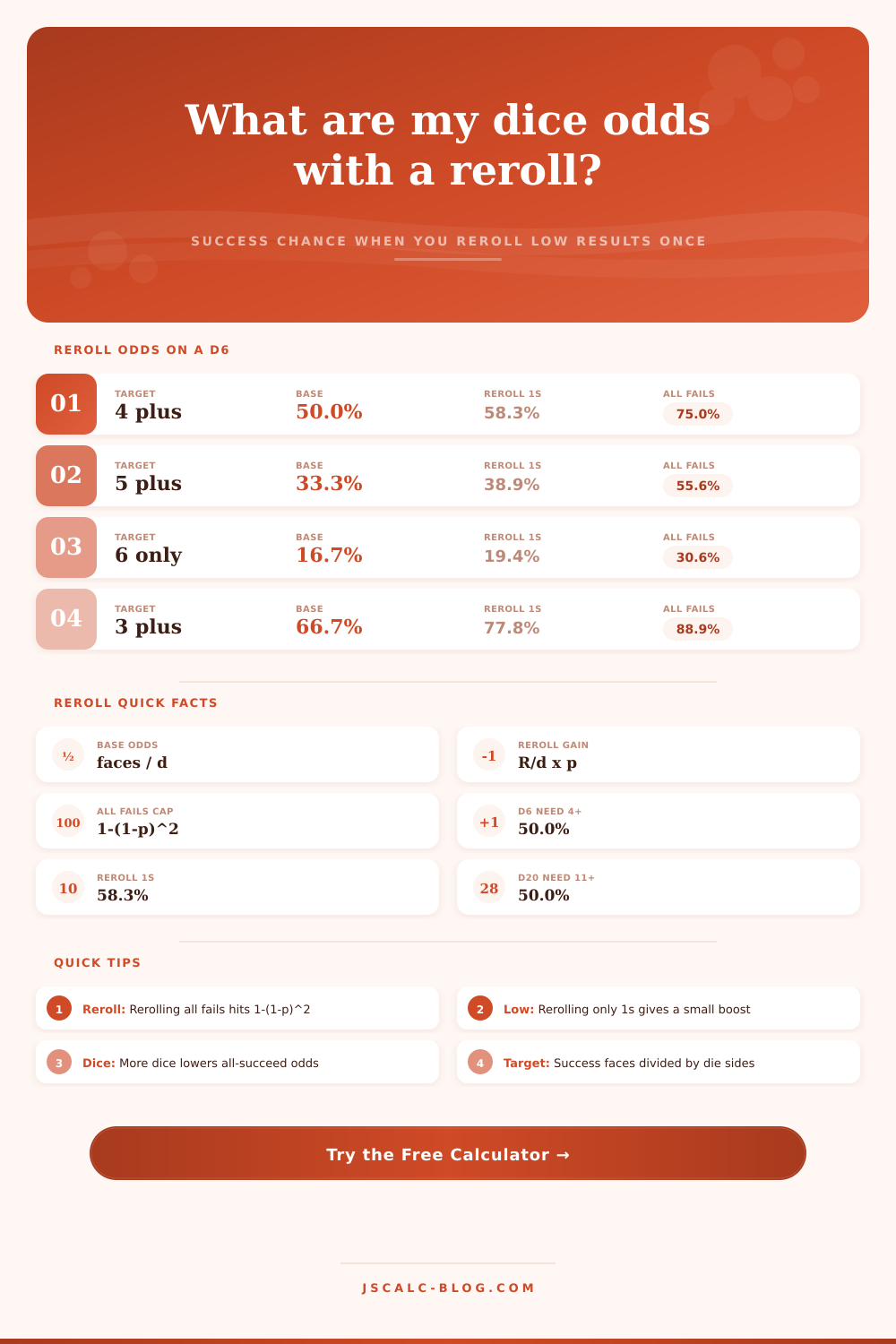
| 4+ | 50.0% | 58.3% | 66.7% | 75.0% | +25.0 pts |
| 5+ | 33.3% | 38.9% | 44.4% | 55.6% | +22.2 pts |
| 6 only | 16.7% | 19.4% | 22.2% | 30.6% | +13.9 pts |
🎲At Least One vs All Succeed
| Dice | Per-Die p | At Least One | All Succeed | Expected Hits |
|---|---|---|---|---|
| 1 die | 50.0% | 50.0% | 50.0% | 0.50 |
| 2 dice | 50.0% | 75.0% | 25.0% | 1.00 |
| 3 dice | 50.0% | 87.5% | 12.5% | 1.50 |
| 2d20 (11+) | 50.0% | 75.0% | 25.0% | 1.00 |
| 3 dice (4+ reroll 1s) | 58.3% | 92.8% | 19.8% | 1.75 |
📊Comparison Grid: Base vs Rerolls
| Case | Die | Target | P Base | P Reroll 1s | P Reroll All |
|---|---|---|---|---|---|
| Easy save | d6 | 2+ | 83.3% | 86.1% | 97.2% |
| Common hit | d6 | 3+ | 66.7% | 77.8% | 88.9% |
| To-hit 4+ | d6 | 4+ | 50.0% | 58.3% | 75.0% |
| Hard wound | d6 | 5+ | 33.3% | 38.9% | 55.6% |
| Crit only | d6 | 6 only | 16.7% | 19.4% | 30.6% |
| Coin-flip check | d20 | 11+ | 50.0% | 52.5% | 75.0% |
| Tough DC | d20 | 15+ | 30.0% | 31.5% | 51.0% |
| Near-impossible | d20 | 18+ | 15.0% | 15.8% | 27.8% |
| Pool success | d10 | 8+ | 30.0% | 33.0% | 51.0% |
| Big die hit | d12 | 7+ | 50.0% | 54.2% | 75.0% |
⚙Full Reroll Math Breakdown
📋Common Tabletop Reroll Cases
| Scenario | Die and Target | Reroll Rule | Success Chance |
|---|---|---|---|
| Warhammer to-hit | d6, need 4+ | Reroll 1s | 58.3% |
| Reroll all misses | d6, need 4+ | Reroll fails | 75.0% |
| Lucky nat 1 reroll | d20, need 11+ | Reroll 1s | 52.5% |
| Advantage-style check | 2d20, need 11+ | Keep best | 75.0% |
| Storyteller pool | d10, need 8+ | Reroll 1s | 33.0% |
| Reroll 1s and 2s | d6, need 4+ | Reroll 1–2 | 66.7% |
💡Reroll Strategy Tips
Dice rattle quietly in a silent room, and you sit on the other side of the table. You make a quick check to spot the hidden door, a save versus poison, or an attack roll. You’ve got your base chances memorized at this point. Fifty-fifty if you need a 4+ on a d6. It is a fair and simple coin-flip.
Then a special ability on your character sheet allow you to reroll any fails. Or a house rule modifies things so you get another attempt. Now the math becomes complex. Intuition tells you thats a better chance. But how much better? And would it be worth spending this precious resource for the round?
Understanding Dice Reroll Math
Plug in your own situation and the calculator does the math for you. This way you don’t have to guess at conversions and coefficients; it breaks down probability into easily understood chunks. And when you understand how the inputs work, you understand how the game works under the surface.
Different games handle rerolls wildly differently. For example, some will allow only the lowest results (e.g., ones, twos) to be rerolled. Other system might give a player one chance per failed die to reroll them all. Even though that may sound the same at first, the difference is huge.
With a threshold rule, the calculator will tell you the odds based on replacing some subset of the low faces with fresh rolls. The base chance of needing a four or better when you roll a d6? Fifty percent. Adding that little bit by rerolling the ones alone isn’t much, since only one in six face causes a reroll. But since those faces specifically have a second chance to hit their number, there’s an added chance there. It is a small boost for sure, but it is enough sometimes to keep you in position instead of out of the fight during a close round of combat.
With all the ones that didn’t work, we’re just going to reroll them. This is a straightforward mathematical function (your end result will always be 1, (your failure rate squared)). So if your initial odds are fifty-fifty and you reroll them, you’ll have a three quarters chance of succeeding next time. And that’s the best-case scenario for any die type for a single attempt at a reroll.
The chart in the tool makes it easy to see what the curve looks like: the further away from fifty-fifty you get, the faster the change starts to level off. When you begin with low base odds, rerolling everything give you the highest percentage increase.
Expected value is something that most people forget about a dice pool. It’s not always important for winning an encounter. It might be enough to get a single hit. But in terms of resources, you’d like to manage those in a smart way, and it would help to know what your average number of successes will be. For example, if you’re using up ammunition or action points, how many successes should you expect on average?
The calculator gives you the probability of getting at least one hit as well as the expected number of hits overall. These are useful for different planning scenarios. One: “Will I survive this turn?” The other: “Can I push ahead hard after this?”
This is a note on notation. For all these formulas, N represents the number of dice being rolled, S represents the success threshold (i.e., 10), and d represents the difficulty modifier.
Rerolls are common for tabletop games as well because they allow players to “re-roll” based on having superior skill or equipment that shifts probability distribution of the dice, maintaining the suspense but rewarding the choice of build. Perhaps your better-equipped character gets to re-roll ones when rolling a d20. Sounds like nothing? Well, if its half the time that becomes more than a 52% chance of succeeding. Nothing obvious except after a few dozen tries at a session it starts to feel like there’s something different about them.
It’s not so much about knowing the math as knowing what math you’re doing and how those fractions multiply over multiple tries. Also take into account the psychological impact of rerolling. The feeling that you watched a failed die dissapear and was replaced by a new one is more gratifying than simply swallowing it. Even if the stat gain is minimal, the emotional boost of seeing the change is enough that game designers build in this mechanism. It makes players feel like they have some control without completely breaking the system’s balance.
Having a sense of the actual probability allows you to make an informed choice as to whether or not you want to use your rerolls strategically (emotionally) or otherwise. Reserve them for when that extra 5% will make the biggest difference.
Every game becomes more interesting when it’s not about hoping for something to happen, but planning strategically with the odds in mind. It means less “Why did this fail?” and more “I understand now how all these pieces fit.” Whether it’s creating a character for a fantasy roleplaying game or making an optimal army list for Warhammer, having the numbers lets you make decisions that control the odds. The dice roll as they will, but we control the odds that decide the outcome. And that change of mindset changes random chance from an uncontrollable factor into a manageable one.