Dice Pool Probability Calculator
Roll a pool of dice, count each die that lands at or above your success threshold, and read the exact odds of meeting your target from the binomial distribution. Built for World of Darkness, Shadowrun, Exalted, and similar success-counting systems.
🎲Real System Presets
📝Pool Setup
How many dice you roll at once.
A die counts as a success when it shows this value or higher.
Core math stays binomial; this only adds an informational note.
🔢Binomial Snapshot
📊Success Count Distribution
| Successes k | P(exactly k) | P(at least k) | P(at most k) | Odds of exactly k |
|---|---|---|---|---|
| Enter values above to build the success-count distribution. | ||||
🎯Single-Die Success by Threshold
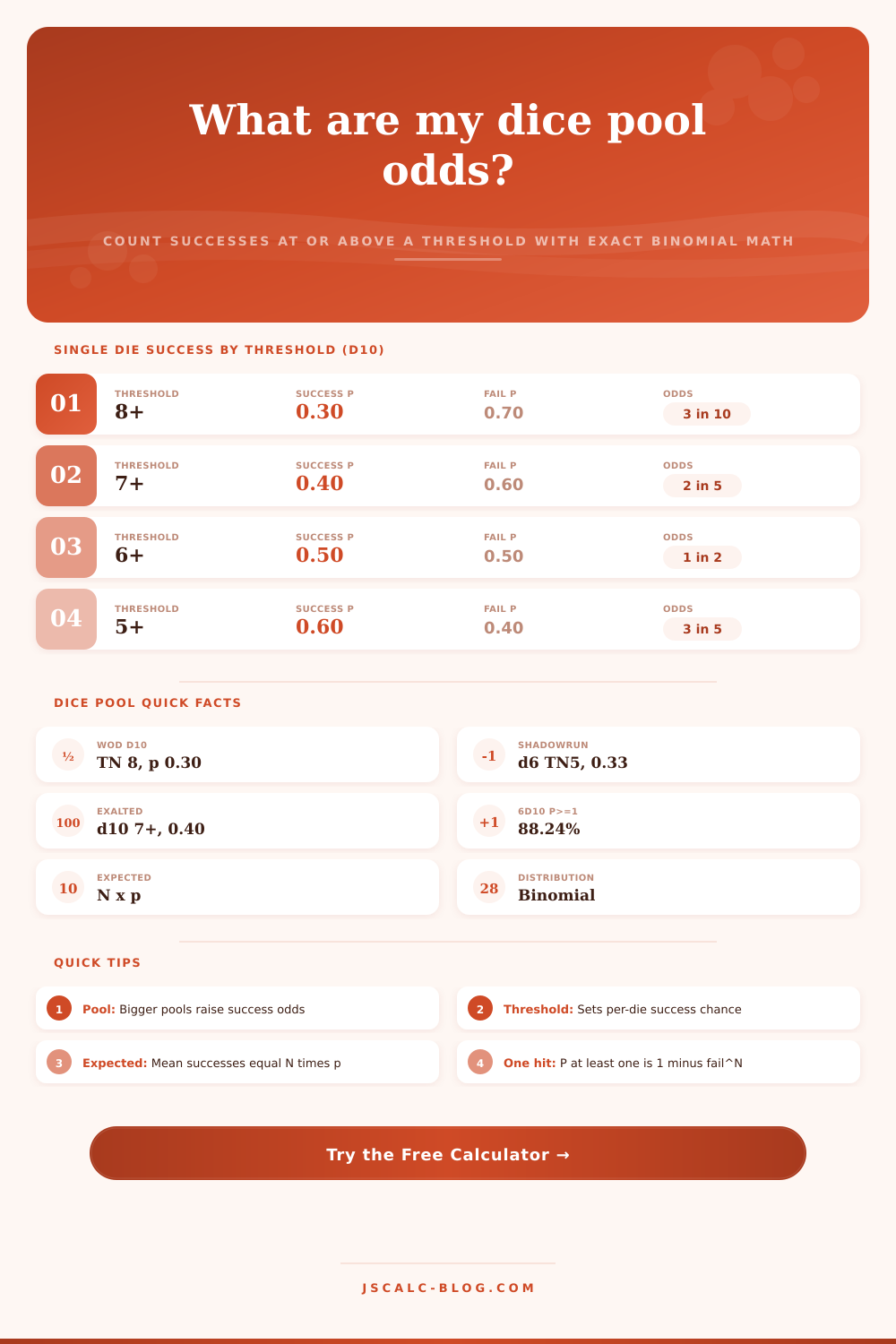
| Threshold (d10) | Success p | Success % | Fail % | Rough Odds |
|---|---|---|---|---|
| Roll 10+ (10 only) | 0.10 | 10% | 90% | 1 in 10 |
| Roll 9+ | 0.20 | 20% | 80% | 1 in 5 |
| Roll 8+ (classic WoD) | 0.30 | 30% | 70% | ~3 in 10 |
| Roll 7+ (Exalted) | 0.40 | 40% | 60% | 2 in 5 |
| Roll 6+ | 0.50 | 50% | 50% | 1 in 2 |
| Roll 5+ | 0.60 | 60% | 40% | 3 in 5 |
| Roll 4+ | 0.70 | 70% | 30% | 7 in 10 |
🎰P of At Least One Success by Pool Size
| Pool | p 0.30 (TN8) | p 0.40 (TN7) | p 0.50 (TN6) | p 0.33 (d6) |
|---|---|---|---|---|
| 1 die | 30.0% | 40.0% | 50.0% | 33.3% |
| 2 dice | 51.0% | 64.0% | 75.0% | 55.6% |
| 3 dice | 65.7% | 78.4% | 87.5% | 70.4% |
| 4 dice | 76.0% | 87.0% | 93.8% | 80.2% |
| 5 dice | 83.2% | 92.2% | 96.9% | 86.8% |
| 6 dice | 88.2% | 95.3% | 98.4% | 91.2% |
| 8 dice | 94.2% | 98.3% | 99.6% | 96.1% |
| 10 dice | 97.2% | 99.4% | 99.9% | 98.3% |
🗂Pool Comparison Grid (d10, TN8, p 0.30)
| Pool Size | P ≥ 1 | P ≥ 2 | P ≥ 3 | P ≥ 4 | Expected Hits |
|---|---|---|---|---|---|
| 2 dice | 51.0% | 9.0% | 0.0% | 0.0% | 0.6 |
| 3 dice | 65.7% | 21.6% | 2.7% | 0.0% | 0.9 |
| 4 dice | 76.0% | 34.8% | 8.4% | 0.8% | 1.2 |
| 5 dice | 83.2% | 47.2% | 16.3% | 3.1% | 1.5 |
| 6 dice | 88.2% | 58.0% | 25.6% | 7.0% | 1.8 |
| 7 dice | 91.8% | 67.1% | 35.3% | 12.6% | 2.1 |
| 8 dice | 94.2% | 74.5% | 44.8% | 19.4% | 2.4 |
| 10 dice | 97.2% | 85.1% | 61.7% | 35.0% | 3.0 |
⚙Full Binomial Breakdown
📋Expected Successes Reference
| Pool | p 0.30 | p 0.40 | p 0.50 | p 0.60 |
|---|---|---|---|---|
| 3 dice | 0.9 | 1.2 | 1.5 | 1.8 |
| 4 dice | 1.2 | 1.6 | 2.0 | 2.4 |
| 5 dice | 1.5 | 2.0 | 2.5 | 3.0 |
| 6 dice | 1.8 | 2.4 | 3.0 | 3.6 |
| 8 dice | 2.4 | 3.2 | 4.0 | 4.8 |
| 10 dice | 3.0 | 4.0 | 5.0 | 6.0 |
| 12 dice | 3.6 | 4.8 | 6.0 | 7.2 |
💡Dice Pool Tips
It’s the moment we all know: Your character has found himself looking down at a dragon and the music cuts out. Six ten-sided dice sits waiting in your palm. You flick them across the carpet and let them spin. Tabletop roleplaying games such as Shadowrun or World of Darkness are not simply about getting a number rolled high; it’s about stacking those chances together until the pile of them tips you over the top.
That’s where this calculator comes in. It makes math simple. It transforms the wild spray of tumbling plastic polygons into crisp chances.
Why You Should Use This Dice Calculator
But first, a little statistical intuition will help us understand what changes these numbers. That’s where binomial distribution comes in, the very core of this idea. Every die in your pool represent one independent trial: Either it succeeds (hitting required number) or it fails (not hitting). In the case of a die requiring an 8+ out of 10, there are only three faces that matter. So each die have a thirty percent chance of passing.
Even most players understand that instinctively; it’s the chance of rolling a specific result on a single die. However, trying to mentally multiply those odds several times over for multiple dice being thrown simultaneously is what trips people up. This tool allows them to tweak their pool size and see how basic percentage will translate into a more practical likelihood of success on their entire roll.
The strongest lever for these systems are adding additional dice. Doubling your dice pool from three to six is not simply twice as good, it’s transformative. If you’re rolling with a three dice pool and each die has a thirty percent chance of success, that means you’ve got a sixty-six percent shot at landing at least one. That sounds good, right? But then you remember that many challenging actions needs two or three hits. Suddenly, a slim pool is basically doomed.
Once you move up to six dice, however, your chances of landing at least one increase to eighty-eight percent. Not only does the spread open up, but it also becomes much likelier that you’ll score multiples versus barely getting a single success. This is the difference between failing dramatically and succeeding spectacularly.
Keep threshold in mind. Your personal chance of success is determined by this number. If you lower the threshold from 8+ to 6+, then your personal chance goes from thirty percent to fifty percent. That changes the whole shape of the curve. You don’t need as many dice to achieve the same results! In d10 systems specifically, they has a handy chart on the page showing exactly what happens: shifting the threshold one point either way swings the chances pretty wildly.
The calculator also gives you an expected value. That’s the average amount of successes across lots of rolls. For example, if each die have a thirty percent chance of working out, then your expected value is 1.8 successes when rolling six dice. Note that it doesn’t imply you’ll actually get two hits every time. Sometimes you’ll get five; sometimes you’ll get none. Expected value is simply the average you can expect in the long term, it helps you figure out your strategy.
Maybe the task needs to succeed three times and your pool averages only 1.8? You’re playing against the house. Sure, you might win because of variance now and again. But in the long run, you’ll lose more often then not. The gut-feeling approach will get you in trouble at the table.
Every time you roll, gamblers assume it’s going to follow their average result. The truth is: variance exists, and it sucks. Even if you have a good character who has been kicking ass and taking names, sometimes randomness conspires against you and you fail an easy test. Knowing about this spread allows you to manage expectations. When you see a low number happen, you no longer blame your dice for having rolled a statistically likely result from the beginning.
Finally, there’s nothing more important in learning dice pools than understanding when to take risks and when to play safe. On one hand, you need sufficient dice to give yourself a decent chance of success. But on the other hand, you don’t want so many that the game bogs down or you know what will happen too far ahead of time. The calculator removes the guesswork by showing you exactly what you’re trading off ahead of time. And it all happens without ever touching your dice bag.
So next time you face an intimidating challenge, look up the numbers first. Seeing the odds won’t change how well (or poorly) you roll, but it will change how you’ll feel when those dice hit the table. You should of checked the math earlier.