Sleep Time Cycle Calculator
Plan your night around 90-minute sleep cycles. Pick a wake time to see ideal bedtimes, or pick a bedtime to see ideal wake times, with a fall-asleep buffer so you rise at the end of a cycle feeling refreshed.
😴Quick Sleep Presets
📝Sleep Inputs
Hour, minute, and AM or PM for your target time.
Time it takes you to drift off after lights out.
Average is 90 minutes; range is 80 to 110.
🕑All Cycle Options
| Cycles | Bedtime | Total Sleep | Time in Bed | Feel |
|---|---|---|---|---|
| Enter a time above to see every cycle option. | ||||
📊Cycle Facts
📈Cycles to Hours
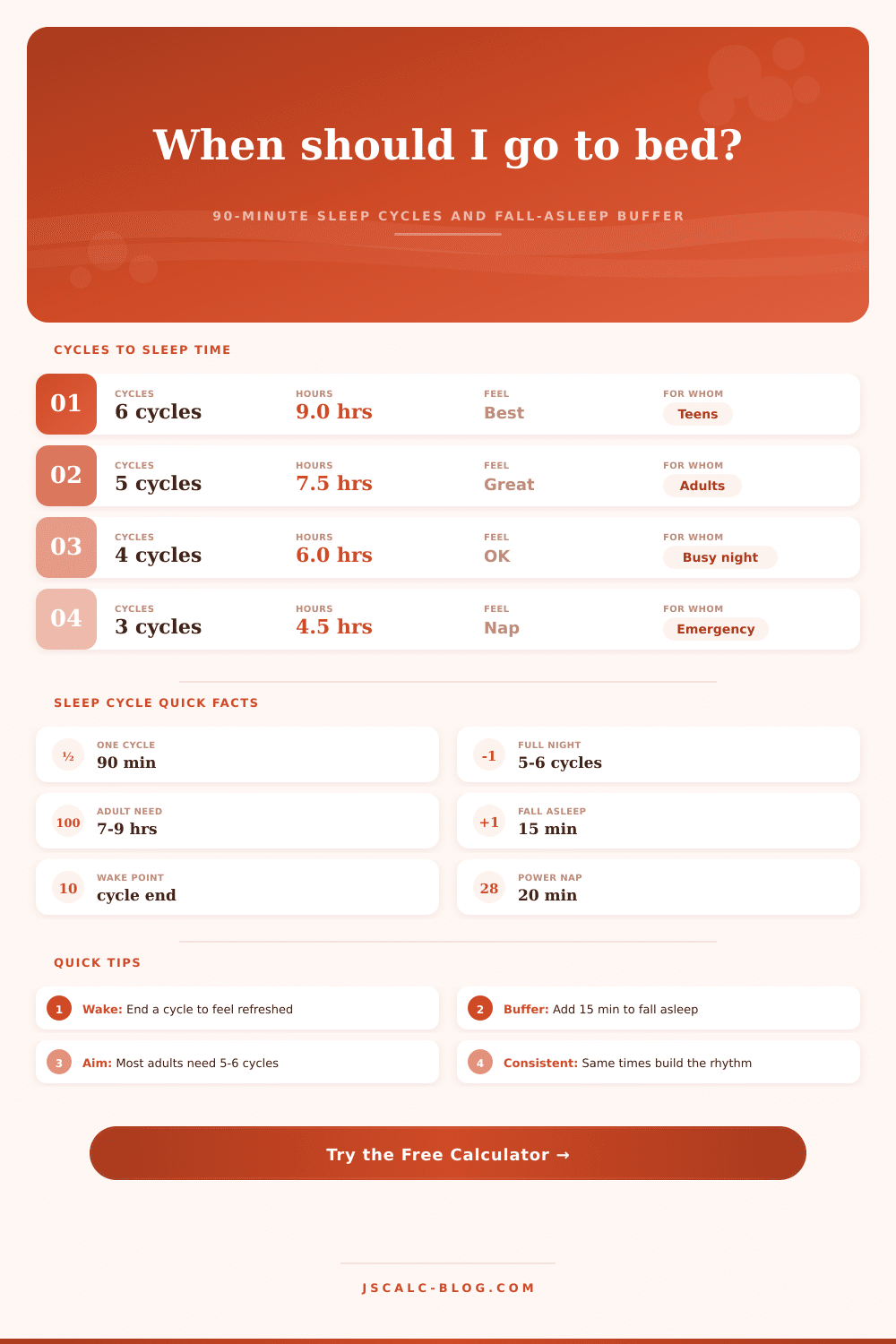
| Cycles | Minutes | Hours | Rating | Best For |
|---|---|---|---|---|
| 1 cycle | 90 min | 1.5 hrs | Short nap | Quick reset, jet lag |
| 2 cycles | 180 min | 3.0 hrs | Emergency | Split shift, on-call |
| 3 cycles | 270 min | 4.5 hrs | Minimum | Rough night, travel |
| 4 cycles | 360 min | 6.0 hrs | Acceptable | Busy weeknight |
| 5 cycles | 450 min | 7.5 hrs | Great | Most healthy adults |
| 6 cycles | 540 min | 9.0 hrs | Best | Teens, recovery, athletes |
👤Recommended Sleep by Age
| Age Group | Recommended | Cycles | Note |
|---|---|---|---|
| Toddler (1–2) | 11–14 hrs | 7–9 + naps | Includes daytime naps |
| Preschool (3–5) | 10–13 hrs | 7–8 + nap | Nap often still needed |
| School age (6–12) | 9–12 hrs | 6–8 | Steady bedtime helps |
| Teen (13–18) | 8–10 hrs | 5–7 | Later body clock is normal |
| Adult (18–64) | 7–9 hrs | 5–6 | Aim for 5 or 6 full cycles |
| Older adult (65+) | 7–8 hrs | 5–5 | Lighter, earlier sleep |
🌙Sleep Cycle Stages
| Stage | Type | Share of Cycle | What Happens |
|---|---|---|---|
| N1 | Light | About 5% | Drifting off, easy to wake |
| N2 | Light | About 45% | Body cools, heart slows |
| N3 | Deep | About 25% | Physical repair, hard to wake |
| REM | Dream | About 25% | Dreaming, memory sorting |
| End of cycle | Light | Transition | Best moment to wake up |
🗂Bedtime-for-Wake Comparison
| Wake Time | 6 cycles | 5 cycles | 4 cycles | 3 cycles | Feel at 5–6 |
|---|---|---|---|---|---|
| 6:00 AM | 8:45 PM | 10:15 PM | 11:45 PM | 1:15 AM | Refreshed |
| 6:30 AM | 9:15 PM | 10:45 PM | 12:15 AM | 1:45 AM | Refreshed |
| 7:00 AM | 9:45 PM | 11:15 PM | 12:45 AM | 2:15 AM | Refreshed |
| 7:30 AM | 10:15 PM | 11:45 PM | 1:15 AM | 2:45 AM | Refreshed |
| 8:00 AM | 10:45 PM | 12:15 AM | 1:45 AM | 3:15 AM | Refreshed |
| 8:30 AM | 11:15 PM | 12:45 AM | 2:15 AM | 3:45 AM | Refreshed |
Chart assumes a 15-minute fall-asleep buffer and 90-minute cycles. Use the calculator above to match your own buffer and cycle length.
⚙How the Math Works
💡Sleep Cycle Tips
You might think it’s all about the number of hours you slept. It isn’t always. It’s about which part of the sleep cycle you woke up in. You set your alarm clock and feel tired, even though you’ve had enough sleep. Why? This is because you woke in middle of a deep sleep period, not a light sleep period.
When we go to sleep, our bodies flows through cycles of about 90-minute periods. These include light sleep (when you’ll easily be woken), then deep sleep (where your body repairs itself) followed by REM sleep (the dreamy state). And then back to light sleep again… The trick is to learn to wake up in the final stages of one of these sleep cycles… While your mind is still in a light state. Waking up in deep sleep interrupt the restoration process, even if you’d been asleep for hours. That’s why you feel so groggy regardless of how much time you spent under the covers.
Why Waking Up in the Right Sleep Cycle Helps You Feel Rested
By entering your desired wakeup time, the calculator do the math for you. It keeps you from guessing if you’re landing in the right “zone” or not.
Sleep isn’t one solid chunk. It’s a set of stages, each lasting roughly 90 minutes. On average, most people needs between five and six such cycles to get amount of rest they want. So add them all together: seven and a half to nine hours.
When you lay down with your head on the pillow, you don’t just fall right asleep. To handle this, tool estimates an additional delay (or “buffer”) of around 15 minutes; allowing your mind to unwind. Without factoring in the buffer, you could choose a bed time that looks reasonable on paper yet still finds you lying awake while first half of the sleep cycle passes you by. That little tweak makes a bigger difference than you’d think.
Imagine you have an early morning wakeup call, say, seven o’clock in the morning. How would you know when it’s the correct time to go to sleep? Well, most ordinary alarm clocks don’t monitor your brain activity. But here’s how you calculate the appropriate bedtime: count backwards from the desired wakeup time, then subtract six cycles (which includes the extra 15 minutes required to fall asleep). You arrive at approximately ten fifteen at night. That suggests you should of go to bed around that time. You’ll probably wake up refreshed. Here’s what that looks like with other wake-up times:
So the takeaway? Rhythm matters. Consistency strengthens circadian cues; those signals that help your body run like a well-oiled machine. Jumping out of bed at different hours each day mucks up your inner clock, think of switching between time zones constantly.
But not every night can be a six-cycle night. Sometimes life just doesn’t work out that way. Four cycles, roughly six hours of sleep. Is all some people receives. It’s fine sometimes if you’re away from home or you have something pressing to attend to. But as a habit? Running on empty isn’t cool. Those additional ninety minutes can make the difference between feeling okay versus feeling great.
Teens typically need full nine hours because their brains is still developing. Elderly folks may need a little less. They tend to rise and shine even before the alarm goes off.
The same applies with napping. For example, a 20-minute power nap will put you into light sleep, where you’ll wake up feeling refreshed instead of groggy. Go for a whole 90 minutes if you can, but anything in-between runs the risk of waking you from deep rest. That’s not how you want to feel when you’re trying to recharge. It is better to have a short, quick reset than a broken attempt at a long sleep.
Without any bedtime anxiety, planning around cycles makes sense. Should I go to bed at 10:00 p.m.? What about 9:30? If I go to bed early, will I get up too late? Will I fall asleep if I go to bed later? You don’t have to fret over the details. You simply follow the natural cycle.
Based off what needs to happen during the day, you choose your wake time, and work back from there. Sleep becomes something you can manage within the context of a schedule. After a couple of weeks, those terrible mornings usually melt away. Now you’re waking up when your body’s ready, not when your alarm tells you to. That change of pace alters the beginning of each day.