Dehumidifier Power Consumption Calculator
Estimate the energy a dehumidifier draws from its wattage and run hours: kWh per day and month, running amps at your voltage, water removed in pints, and the energy factor in liters per kWh.
💧Real Dehumidifier Presets
📝Energy Inputs
Nameplate power draw while the compressor runs.
Energy Star units run about 1.2 to 1.9 L/kWh.
Humidistat cycling lowers real runtime.
🔢Formula Snapshot
📏Dehumidifier Sizes & Wattage
| Class | Capacity | Typical Watts | Amps at 120V | Best Use |
|---|---|---|---|---|
| Mini closet | 10 to 20 pt | 60 to 90 W | 0.5 to 0.75 A | Closet, small bath |
| Small room | 30 pt | 300 to 450 W | 2.5 to 3.75 A | Bedroom, office |
| Mid size | 50 pt | 450 to 600 W | 3.75 to 5.0 A | Basement, living |
| Large | 70 pt | 600 to 750 W | 5.0 to 6.25 A | Whole house |
| Commercial | 100 to 150 pt | 700 to 1100 W | 5.8 to 9.2 A | Crawlspace, jobsite |
| LGR unit | 120 to 150 pt | 900 to 1400 W | 7.5 to 11.7 A | Water damage drying |
💧Energy Factor Ranges
| Rating Tier | Energy Factor (L/kWh) | Water per kWh | Note |
|---|---|---|---|
| Older or budget | 0.8 to 1.1 | 1.7 to 2.3 pt | Draws more power |
| Standard new | 1.2 to 1.4 | 2.5 to 3.0 pt | Common baseline |
| Energy Star | 1.5 to 1.7 | 3.2 to 3.6 pt | Meets 2025 spec |
| Top efficiency | 1.8 to 2.0 | 3.8 to 4.2 pt | Best per kWh |
| Integrated EF (IEF) | Adds standby | Whole cycle | Includes off-mode |
📊kWh by Run Time (per day)
| Wattage | 4 h/day | 8 h/day | 12 h/day | 16 h/day | 24 h/day |
|---|---|---|---|---|---|
| 200 W | 0.80 | 1.60 | 2.40 | 3.20 | 4.80 |
| 300 W | 1.20 | 2.40 | 3.60 | 4.80 | 7.20 |
| 500 W | 2.00 | 4.00 | 6.00 | 8.00 | 12.00 |
| 700 W | 2.80 | 5.60 | 8.40 | 11.20 | 16.80 |
| 900 W | 3.60 | 7.20 | 10.80 | 14.40 | 21.60 |
| 1200 W | 4.80 | 9.60 | 14.40 | 19.20 | 28.80 |
🏠Pints Needed by Room Size
| Area | Damp | Very Damp | Wet / Musty | Suggested Class |
|---|---|---|---|---|
| 300 sq ft | 20 pt | 25 pt | 30 pt | Small room |
| 500 sq ft | 25 pt | 30 pt | 40 pt | Small to mid |
| 800 sq ft | 30 pt | 40 pt | 50 pt | Mid size |
| 1200 sq ft | 40 pt | 50 pt | 60 pt | 50 to 70 pt |
| 1500 sq ft | 50 pt | 60 pt | 70 pt | Large |
| 2500 sq ft | 60 pt | 70 pt | 90 pt | Large or dual |
🗂Wattage vs Hours Comparison Grid
| Scenario | Watts | Hours | kWh/day | kWh/month | Amps 120V |
|---|---|---|---|---|---|
| Closet mini | 80 W | 6 h | 0.48 | 14.4 | 0.67 |
| Small bedroom | 350 W | 8 h | 2.80 | 84.0 | 2.92 |
| Basement mid | 500 W | 10 h | 5.00 | 150.0 | 4.17 |
| Whole house | 700 W | 12 h | 8.40 | 252.0 | 5.83 |
| Crawlspace 24-7 | 600 W | 24 h | 14.40 | 432.0 | 5.00 |
| Garage summer | 450 W | 16 h | 7.20 | 216.0 | 3.75 |
| Commercial LGR | 1100 W | 24 h | 26.40 | 792.0 | 9.17 |
| Energy Star mid | 420 W | 10 h | 4.20 | 126.0 | 3.50 |
⚙Full Formula Breakdown
📋Reference Values
| Item | Common Entry | How It Is Used | Energy Effect |
|---|---|---|---|
| Running watts | 60 to 1400 W | Watts × hours / 1000 | Sets the kWh total |
| Hours per day | 4 to 24 h | Multiplies the watts | Longer runtime, more kWh |
| Duty cycle | 40% to 100% | Scales effective hours | Lower duty cuts kWh |
| Energy factor | 0.8 to 2.0 L/kWh | Liters per kWh used | Higher EF, more water per kWh |
| Voltage | 115 to 240 V | Divides into watts | Higher volts, fewer amps |
💡Practical Energy Tips
Basement air tends to be damp and thick. To get rid of musty odor, you purchased a dehumidifier. But the electric bill went up. A dehumidifier isn’t just something sitting in the corner; it’s also a compressor that sucks water out of the air at the cost off electricity. Price is less important then what it actualy does with all that juice.
How much does it cost? This page provides a calculator that lets you translate nameplate watts into dollars per month. But what are the right numbers to type in? In most cases, consumers thinks that if the unit has a “fifty-pint” capacity, then it will pull out fifty pints every single day. Not so. Depending on ambient humidity in the area where it sits, it turns itself on and off. When you leave the room dry most of the time, the compressor remain idle. The duty cycle changes things.
How Much Electricity Does A Dehumidifier Use?
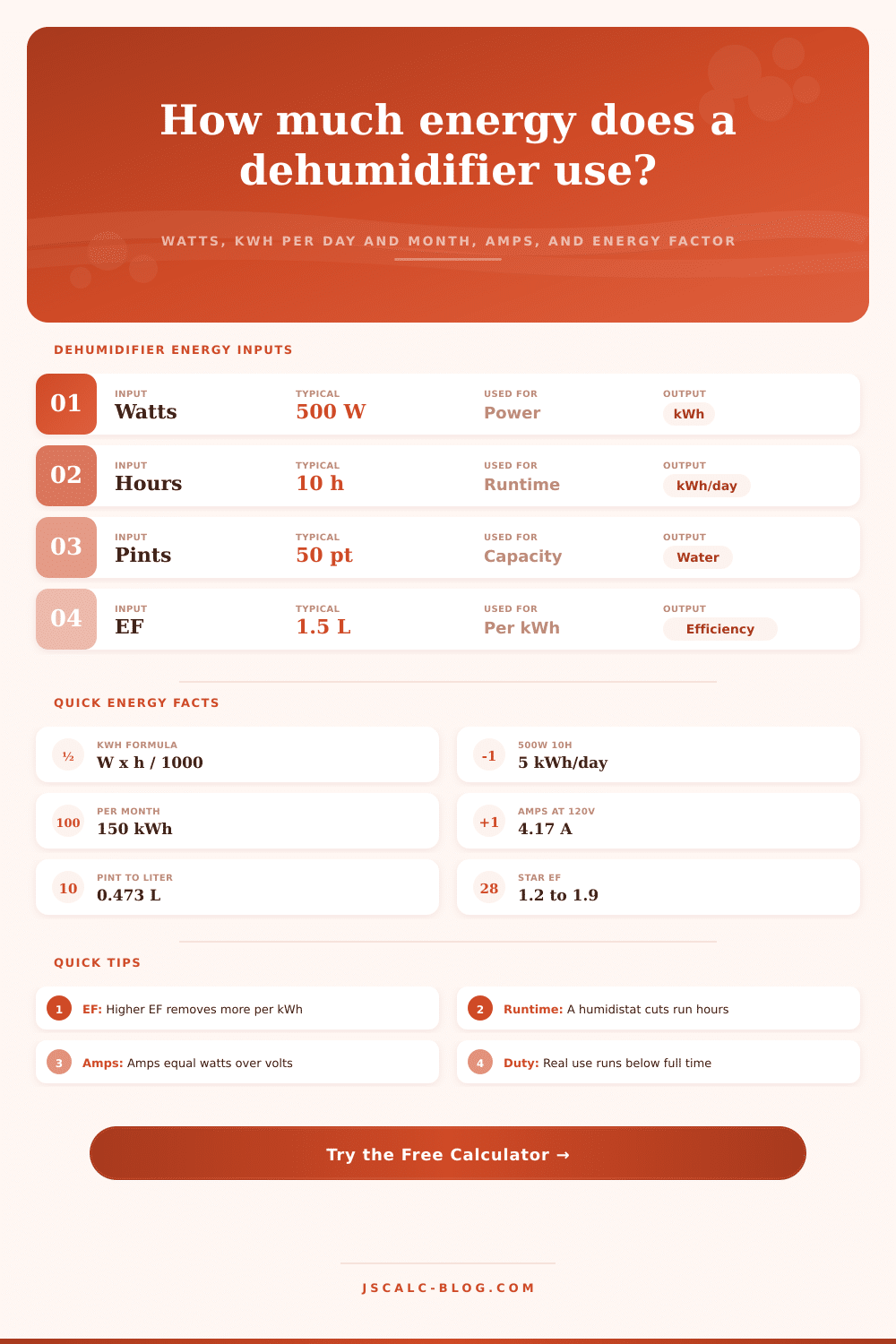
First, locate its running wattage on the label. That’s how many watts the dehumidifier draw with both the compressor and fan running. To convert to kilowatts (kW), simply divide that figure by 1,000. Multiply by the number of hours it run. If your dehumidifier is 500 watts and runs 10 hours a day, it’ll consume five kilowatt-hours. By current residential electricity rates, that adds up fast especially in the dog days of summer. The above calculator will do all this math for you: Convert between watts/hours, then total up amount of money spent each day or month. It will also calculate the amperage draw of your appliance.
If you live in an older house and worry that all these plugged-in electronics might trip the breaker (you’ve got thin wiring!), those figures becomes important. Higher wattage = higher amps. Those numbers matter when plugging multiple device into one circuit. There’s one more wrinkle: efficiency ratings. Higher-rated units has higher energy factors, which translates to pulling out more liters of water per kilowatt-hour spent. That means that the overall runtime required to achieve your desired humidity will be less.
Plug this value into the calculator and you’ll get an estimated number of liters removed based off the amount of energy consumed instead of just straight capacity. It tends to be a more realistic calculation since it considers how well a unit perform when it’s actually under a load as opposed to its maximum rated potential in a laboratory. So if you compare two units of the same rated capacity (measured in pints) but different energy factors, then the more efficient unit is likely to cost less over time. It may cost more initially, but its lower operating costs typically recoup the difference in a year or two of intense use.
A big factor in run time is room size. The larger the space, the longer the compressor must work and the higher your consumption climbs. For instance, a small closet require almost no power to dehumidify because there isn’t much air. On the other hand, a large basement has lots of concrete floors and walls which means the space will always have some amount of moisture intrusion. The compressor takes longer to do its job, and larger rooms increases your energy use. What about a crawlspace? You’re looking at nearly continuous use if it gets wet all year long. Even a relatively low-wattage unit will add up fast in terms of monthly charges.
To avoid unnecessary running when the air is already comfy, set your humidistat to a reasonable number such as fifty percent relative humidity. That alone cuts back on how often it run, the quickest method to reduce use without changing units. The other side of this is that performance depends on temperature: In cold weather, refrigerant based units are less effective as the cooling coils will start to ice over. A dehumidifier also works best in a humid environment with high heat, where moisture tends to hang in the air. If you’re trying to run one of these in a cool basement in the fall or spring, you’re going to get diminishing returns on every watt you put into it. Units with what are called low grain refrigerants does better at colder temperatures but still draw power. Knowing how things perform here is key to making a smart decision about whether you should run it or not.
Before you settle on your estimate, plug your numbers into the reference tables on the page. Compare them against typical ranges for various classes of machines, ranging from small closet-sized ones all the way to commercial water damage dryers. These benchmark values give you something to sanity check your numbers against. Size doesn’t matter. Being too big is wasteful, and being too small is useless.
Too-small units won’t be able to keep pace with humidity levels (they’ll run constantly but only make a dent when the air’s really wet). They also will “short cycle.” This means they turn on and off too often as they struggle to dry the air. This makes them inefficient and wastes energy in the process. At the same time, too-large units will turn on and off repeatedly because they would of waste energy trying to dehumidify more air than necessary. In a bedroom-sized space, you don’t need an industrial-size unit.
In other words, find one rated for your room size and its level of dampness. Ideally you’d like something that dries air moderately slowly rather than frantically fast, which conserves energy while keeping the compressor safe from damage. So all that stuff with the dehumidifiers is really just about being aware. Tinker with them. Monitor the numbers. Figure out how your house works. You may not ever be rid of that gross, heavy basement air entirely, but you’ll know how to control it, and make it livable without getting shocked when the meter reader comes around.
What used to feel like a vague sense of unease becomes something you can get your arms around: a real line item on your utilities bill.