Air Conditioner Power Consumption Calculator
Estimate the electrical power an air conditioner draws in watts, plus kWh per day, kWh per month, and running amps, from the BTU rating and EER or SEER efficiency, run hours, and compressor duty cycle.
❄Real AC Presets
📝AC and Run Inputs
Direct watts skips the BTU and EER step.
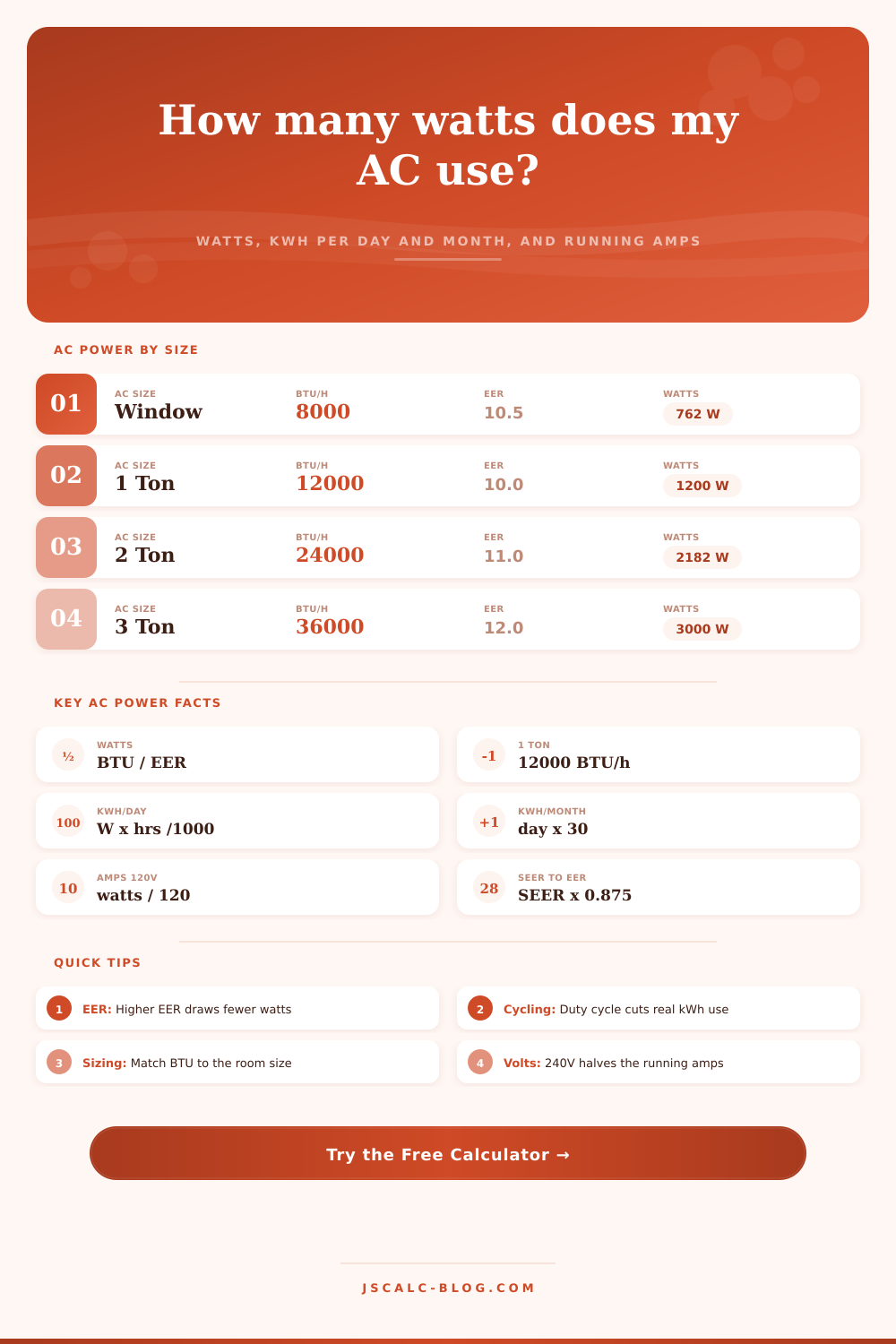
12000 BTU/h equals one ton of cooling.
Window units EER 9–12, high SEER 16–22.
Used only when method is enter watts directly.
Mild weather cycles the compressor near 60–70%.
🔢Formula Snapshot
📊BTU to Watts by EER
| BTU/h | EER 9 | EER 10.5 | EER 12 | EER 14 |
|---|---|---|---|---|
| 5,000 | 556 W | 476 W | 417 W | 357 W |
| 8,000 | 889 W | 762 W | 667 W | 571 W |
| 10,000 | 1,111 W | 952 W | 833 W | 714 W |
| 12,000 | 1,333 W | 1,143 W | 1,000 W | 857 W |
| 18,000 | 2,000 W | 1,714 W | 1,500 W | 1,286 W |
| 24,000 | 2,667 W | 2,286 W | 2,000 W | 1,714 W |
| 36,000 | 4,000 W | 3,429 W | 3,000 W | 2,571 W |
🗂AC Sizes and Power Comparison
| AC Size | BTU/h | Watts | kWh/day 8h | kWh/month | Amps 120V |
|---|---|---|---|---|---|
| Bedroom window | 5,000 | 500 W | 4.0 kWh | 120 kWh | 4.2 A |
| Window unit | 8,000 | 762 W | 6.1 kWh | 183 kWh | 6.4 A |
| Mini split 3/4 ton | 9,000 | 500 W | 4.0 kWh | 120 kWh | 4.2 A |
| Portable AC | 10,000 | 1,111 W | 8.9 kWh | 267 kWh | 9.3 A |
| 1 ton central | 12,000 | 1,200 W | 9.6 kWh | 288 kWh | 10.0 A |
| 1.5 ton | 18,000 | 1,500 W | 12.0 kWh | 360 kWh | 12.5 A |
| 2 ton | 24,000 | 2,182 W | 17.5 kWh | 524 kWh | 18.2 A |
| 3 ton central | 36,000 | 3,000 W | 24.0 kWh | 720 kWh | 25.0 A |
| 5 ton central | 60,000 | 5,000 W | 40.0 kWh | 1,200 kWh | 41.7 A |
⚖EER vs SEER Efficiency
| SEER | Approx EER | Watts at 12k BTU | Class |
|---|---|---|---|
| 13 | 11.4 | 1,053 W | Older minimum |
| 14 | 12.3 | 979 W | Base efficiency |
| 16 | 14.0 | 857 W | Mid inverter |
| 18 | 15.8 | 762 W | High efficiency |
| 20 | 17.5 | 686 W | Premium inverter |
| 22 | 19.3 | 623 W | Top tier |
⏱kWh by Run Time (1200 W Unit)
| Hours/day | kWh/day | kWh/week | kWh/month |
|---|---|---|---|
| 2 h | 2.4 kWh | 16.8 kWh | 72 kWh |
| 4 h | 4.8 kWh | 33.6 kWh | 144 kWh |
| 6 h | 7.2 kWh | 50.4 kWh | 216 kWh |
| 8 h | 9.6 kWh | 67.2 kWh | 288 kWh |
| 12 h | 14.4 kWh | 100.8 kWh | 432 kWh |
| 24 h | 28.8 kWh | 201.6 kWh | 864 kWh |
⚙Full Formula Breakdown
📋Reference Values
| Item | Typical Range | How It Is Used | Effect on Power |
|---|---|---|---|
| EER rating | 8 to 15 | Divides BTU/h to get watts | Higher EER lowers watts |
| SEER rating | 13 to 22 | Times 0.875 for EER | Higher SEER lowers watts |
| Run hours | 2 to 24 per day | Multiplies kW for kWh/day | More hours add kWh |
| Duty cycle | 50% to 100% | Scales the running watts | Lower duty cuts kWh |
| Voltage | 120, 208, 240 V | Divides watts for amps | Higher volts lower amps |
💡Practical AC Power Tips
You don’t notice summer air conditioning until you get the bill, and the bill always comes after you feel it. There’s something comfortabley about being cool; the money part doesn’t appear until the next month electric bill. Most folks think using an A/C deplete cash at a constant level; they view their electricity meter as a sort of black box.
In fact, the real-time power consumption vary according to the outside temperature, how well your house is insulated, and what kind of compressor has been installed. Get schooled on the math of cooling, so you can adjust your energy spending to match.
How to Calculate Your AC Energy Cost
The size of the air conditioning unit doesn’t tell you anything useful; what you want to know is how efficient it is converting electricity to cold air. When manufacturers tout a system as “x BTU,” they’re marketing the system based off its size, but they aren’t telling you anything about power usage. You might have a huge central system rated for a dozen-thousand BTUs an hour, which also happens to use a lot of power, but you might have a tiny window unit, also rated for a dozen-thousand BTUs an hour, which uses hardly any.
That’s where the Energy Efficiency Ratio (or SEER for seasonally rated appliance) comes into play. The higher this number, the fewer watts of electricity it takes to produce that amount of cooling. On the spec sheet, it’s a small number, but it will determine everything about your experience with that appliance. Running watts are a direct reflection of higher efficiency ratings. An old air conditioning unit rated at nine EER means it draw more electricity to move heat than a newer model with an EER of twelve. Once you input both your efficiency rating and BTU rating into the calculator, it does all the math for you (so no need to divide by hand and risk a wrong answer).
Now you know how much the unit will put out, but you also want to know its duty cycle. What’s that? That’s how much time, expressed as a percent, your compressor cycles on to keep things cold. When it’s brutally hot in August, that number gets closer to one hundred percent, meaning the system has to work hard to counteract the hot exterior air. But on a milder spring night, the unit will run for only about forty percent of the hour.
This is why simple wattage numbers are so misleading. Fifteen hundred watts doesn’t sound like much. But what if that device draw 1500W continuously for eight hours a day in the middle of a heatwave? Now multiply that times 30 days and the prevailing price-per-kWh on your local electric grid, and suddenly your electric bill is pretty darn big. By adjusting this duty cycle, the tool lets you arrive at a realistic range (not a best case/and-or-worst case guess) which bridges the gap between technical specs and actual use cases. And most home-owners miss this because they presume their machine run all day like clockwork. They don’t.
How does it connect to the rest of your house? Here we get into the importance of voltage, although exact numbers are fairly unimportant. Higher voltage systems, like those found in central air conditioning units, draw fewer amps for the same amount of power. So the wiring doesn’t have to be as heavy. This is very important if you’re retrofitting old houses where breakers might not hold up well to heavy load. Of course you can’t alter the voltage of a current install, but knowing what the amp draw is lets you know just how much juice you’re pulling off of the wall so you don’t blow anything.
The last part of the puzzle is behavior. Even if an air conditioner is super-efficient, no number-crunching machine can capture that you left the window open. It also cannot account for setting your thermostat to cool the house extra fast by turning it too far down. Either way, that wastes energy. The information gives you a baseline, but then you add in your own behaviors, which will vary different than that baseline.
By using correct efficiency ratings and making good guesses about how long and at what level the device runs (its duty cycle), you will understand what your monthly bill means. It’s not a mysterious fee anymore; it’s something you can control as a changing amount. And that change in mindset makes it easier when you’re back in the dog days of summer.