Decimal to Fraction Calculator
Convert any terminating or repeating decimal into an exact fraction, a mixed number, and a fully simplified form. See the place-value math, the repeating-decimal algebra, and the greatest common divisor reduction step by step.
🔢Real Decimal Presets
📝Decimal Inputs
Enter a number like 0.375, 2.25, or -0.6. A leading minus is allowed.
Only used when type is repeating. 0.333 with 3 repeating means 0.3 recurring.
Only used when type is round to nearest denominator, ideal for inches.
🧮Method Snapshot
📊Common Decimal to Fraction Reference
| Decimal | Fraction | Mixed / Notes | Type |
|---|---|---|---|
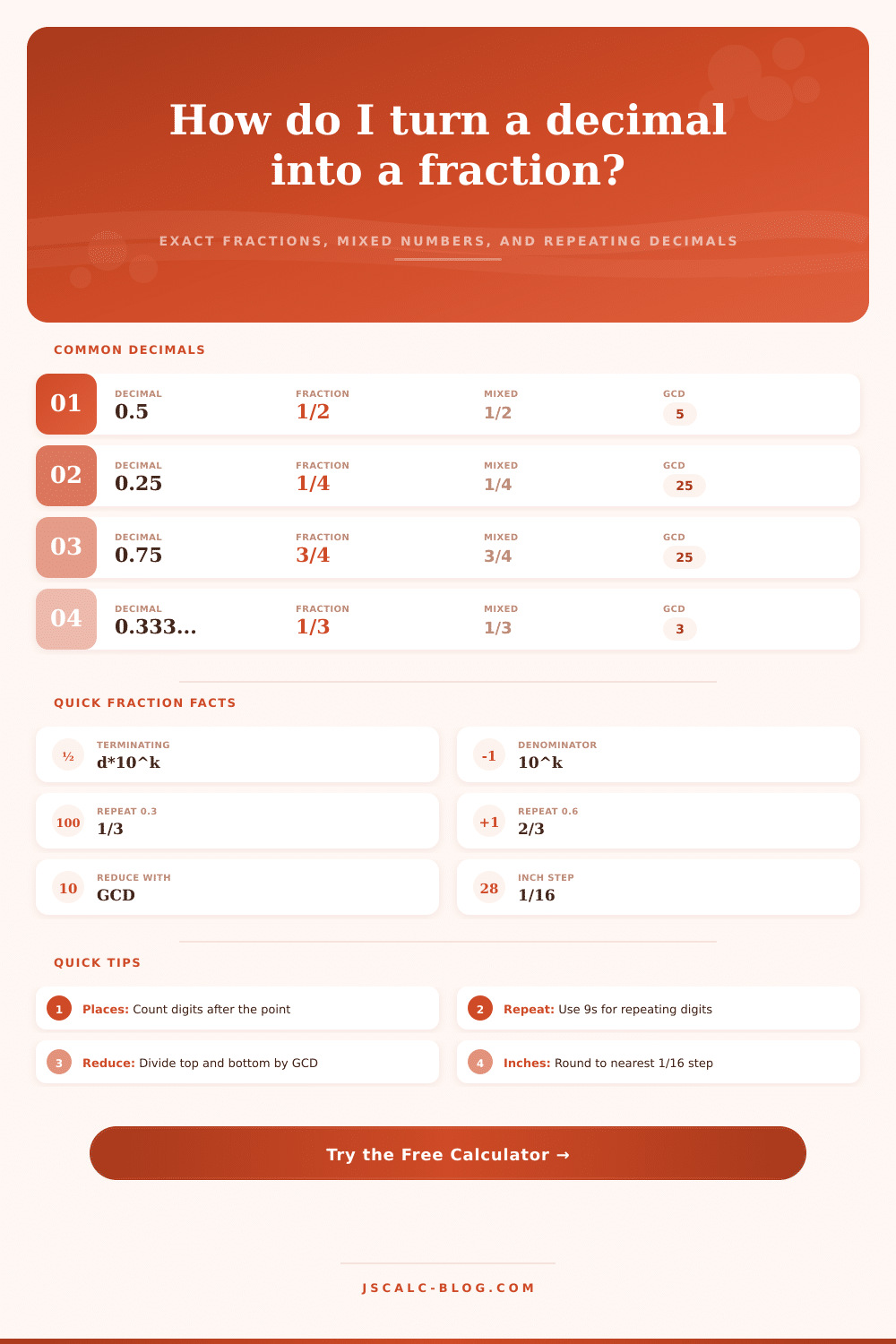
| 0.5 | 1/2 | Half, exact | Terminating |
| 0.25 | 1/4 | Quarter, exact | Terminating |
| 0.75 | 3/4 | Three quarters | Terminating |
| 0.125 | 1/8 | One eighth | Terminating |
| 0.2 | 1/5 | One fifth | Terminating |
| 0.1 | 1/10 | One tenth | Terminating |
| 0.333... | 1/3 | 0.3 recurring | Repeating |
| 0.666... | 2/3 | 0.6 recurring | Repeating |
| 0.1666... | 1/6 | 0.16 with 6 recurring | Repeating |
📏Inch Fraction Reference
| Sixteenths | Simplified | Decimal Inch | Millimeters |
|---|---|---|---|
| 1/16 | 1/16 | 0.0625 | 1.588 mm |
| 2/16 | 1/8 | 0.125 | 3.175 mm |
| 3/16 | 3/16 | 0.1875 | 4.763 mm |
| 4/16 | 1/4 | 0.25 | 6.350 mm |
| 6/16 | 3/8 | 0.375 | 9.525 mm |
| 8/16 | 1/2 | 0.5 | 12.700 mm |
| 10/16 | 5/8 | 0.625 | 15.875 mm |
| 12/16 | 3/4 | 0.75 | 19.050 mm |
| 15/16 | 15/16 | 0.9375 | 23.813 mm |
🔁Repeating Decimal Examples
| Repeating Decimal | Repeat Block | Algebra | Fraction |
|---|---|---|---|
| 0.3 recurring | 3 | 3 / 9 | 1/3 |
| 0.6 recurring | 6 | 6 / 9 | 2/3 |
| 0.9 recurring | 9 | 9 / 9 | 1 |
| 0.09 recurring | 09 | 9 / 99 | 1/11 |
| 0.12 recurring | 12 | 12 / 99 | 4/33 |
| 0.142857 rec. | 142857 | 142857 / 999999 | 1/7 |
| 0.16 (6 rec.) | 6 | (16-1) / 90 | 1/6 |
| 0.83 (3 rec.) | 3 | (83-8) / 90 | 5/6 |
🗂Denominator Rounding & Comparison Grid
| Decimal | Nearest 1/2 | Nearest 1/4 | Nearest 1/8 | Nearest 1/16 | Nearest 1/32 |
|---|---|---|---|---|---|
| 0.10 | 0 | 1/8 (0.125) | 1/8 | 2/16 | 3/32 |
| 0.30 | 1/2 | 1/4 | 2/8 | 5/16 | 10/32 |
| 0.44 | 1/2 | 1/2 | 3/8 | 7/16 | 14/32 |
| 0.51 | 1/2 | 1/2 | 4/8 | 8/16 | 16/32 |
| 0.63 | 1/2 | 5/8 (0.625) | 5/8 | 10/16 | 20/32 |
| 0.77 | 1 | 3/4 | 6/8 | 12/16 | 25/32 |
| 0.88 | 1 | 7/8 (0.875) | 7/8 | 14/16 | 28/32 |
| 0.96 | 1 | 1 | 8/8 | 15/16 | 31/32 |
⚙Full Formula Breakdown
📋Denominator Family Reference
| Denominator | Step Size | Best For | Terminates? |
|---|---|---|---|
| 2, 4, 8, 16, 32 | 0.5 down to 0.03125 | Inches, wrenches, wood | Yes, powers of 2 |
| 10, 100, 1000 | 0.1, 0.01, 0.001 | Money and metric | Yes, powers of 10 |
| 3, 6, 9 | Thirds and sixths | Repeating decimals | No, they recur |
| 7, 11, 13 | Long repeat blocks | Number theory | No, long cycles |
| 5, 20, 25, 50 | Fifths and cleaner tenths | Percent style values | Yes, factor of 10 |
💡Practical Fraction Tips
Here you are, standing in home improvement aisle with a length of lumber in hand. You want it cut exactly to size. The design involve a fraction. But your digital tape measure returned a decimal. Now, your brain must quickly perform some math to determine which tick mark on your physical saw blade map to this series of digits.
The two systems don’t naturaly speak the same language and this is a common source of frustration among DIYers. One system is continuous and smooth; the other is discrete and chunky. Crossing that divide isn’t a matter of guesswork. You need a trustworthy way of translating from one language to the other, retaining precision during the process.
How to Switch Between Decimals and Fractions
But this is all the problem: Fractions versus decimals describe numbers different. Ratios (fractions) feel inherently more intuitive in the way they’re constructed, especially in cooking or construction when it makes physical sense to half or quarter a measurement. Powers of ten (decimals) work well because they align with our base-ten number system, but make for awkward denominators when translated direct.
Once you type in your value, the calculator does the math for you, spare yourself the hard work of having to find common denominator by hand. It just shows you exactly how many parts go into the whole. This eliminate the confusion. The simple ones are terminating decimals, which stop at some point with a finite number of places in them. Their denominators is made up entirely of prime factors of either two or five.
For example 0.25 or 0.5 represent quarters and halves respectively. This makes sense because those values match common ruler markings. Just count the numbers after the decimal place and know that each represents one less power of ten and then simplify what you get. That’s mechanical, it always works out the same way. Those denominators divides equally into powers of ten, so it is not by accident.
Now, if there are any other prime numbers besides two and five in the denominator, such as seven, eleven, or three, it’s going to have a repeating decimal. This say something completely different. It means you’re looking at an infinite loop in decimal notation that’s pretty ugly to write out but is really beautiful from a math perspective. One third is simply expressed as a repeating number like 0.3333. You can’t divide ten into three cleanly, so it keeps looping forever.
Knowing this will help you select the right input type. This ensures you get an accurate result instead of a rounded one that could slightly mess up your calculations.
Most folks err and rush here: simplifying. Yes, turning.25 into 25/100 is technically correct. But what if you’re attempting to measure wood? In that case, 1/4 is what you really need…because it tells you exactly which line to cut on. Reducing a fraction requires dividing the top number (numerator) and the bottom number (denominator) by their greatest common divisor, until no further reduction occurs.
Why? Because simpler fractions is more easily applied and visualized in the real world. Sure, maybe there’s a mathematically-sound, complex improper fraction, but when you’re holding a tape measure with shaking hands, it can be practicaly hard to use.
And finally, right depends on context. When baking, for example, precision can be critical; rounding 1/3 up to a decimal makes all the difference in the world to the final texture. But in carpentry, we frequently round to the closest sixteenth of an inch because our tools aren’t precise enough to go any further. Rounding appropriately to the denominator that suits your project avoids over-engineering your measurements.
If your saw blade is half an inch wide, why bother with thousandths? Precision in your calculations should matches the capabilities of your tools. It is a smart way to save time and wasted materials.
On the page, there are also reference tables that you can use as a quick lookup for commonly used conversions. You can use them if you’re double-checking your own work or if you just want to get a feel for how things go together without having to do the math from scratch each time. If you see 0.125 over and over again and it keeps turning into 1/8, you’ll be able to remember that in the future without needing to grab your calculator (or perhaps you won’t have one nearby).
There is nothing like seeing numbers related to real things we experience everyday. That’s when those patterns last. And when you can easily switch between these two forms, you begin to perceive quantity different. What were once abstract digits become real quantities you can hold in your hands. Instead of dreading those long chains of zeroes and the recurring triples, they becomes nothing more than easily digestible relationships with one another.
This ability will give you confidence with all calculations… Whether you are building a shelf, splitting a bill, or simply wondering why some numbers act strangely. It’s about control. If you know how numbers work, you don’t need blind faith to ensure your cuts is accurate; you know exactly where to draw the line because you should of put in the effort to discover its location.