DC Voltage Drop Calculator
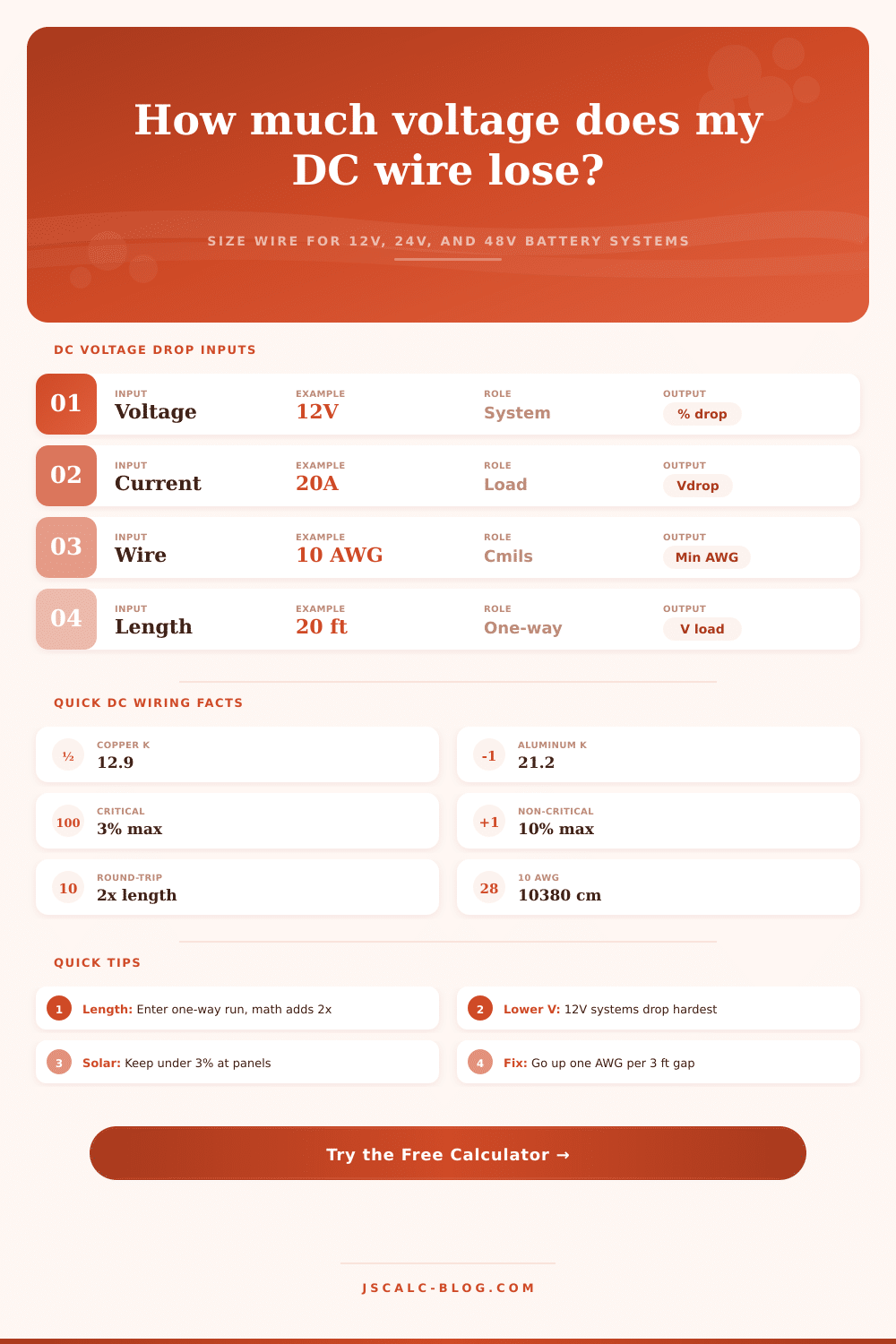
Size wire for low-voltage DC systems like 12V, 24V, and 48V solar, RV, marine, automotive, and battery bank circuits. Find voltage drop, percent loss, voltage at the load, and the minimum AWG that keeps your run under target.
🔋Real DC Wiring Presets
📝Circuit Inputs
Continuous DC amps drawn by the load.
Value stored is circular mils (CM) for that gauge.
Distance one direction; the math doubles it for the round trip.
3% for critical solar or charging, up to 10% for non-critical.
🔢Formula Snapshot
📏AWG Circular Mils and Resistance
| AWG | Circular Mils | Copper Ω/1000ft | Aluminum Ω/1000ft | Typical Use |
|---|---|---|---|---|
| 14 | 4,107 | 2.525 | 4.140 | Small 12V loads, LED |
| 12 | 6,530 | 1.588 | 2.610 | Lights, small pumps |
| 10 | 10,380 | 0.999 | 1.640 | Fridges, 30A branches |
| 8 | 16,510 | 0.628 | 1.030 | Inverter feeds, solar |
| 6 | 26,240 | 0.395 | 0.648 | Longer solar runs |
| 4 | 41,740 | 0.248 | 0.407 | Battery to bus bar |
| 2 | 66,360 | 0.156 | 0.256 | Large inverters |
| 1/0 | 105,600 | 0.098 | 0.161 | Battery banks, winch |
| 2/0 | 133,100 | 0.078 | 0.128 | High-amp 12V loads |
| 4/0 | 211,600 | 0.049 | 0.080 | Bank interconnects |
✅Recommended Max Drop for DC
| Circuit Type | Max % Drop | Why | Example Loads |
|---|---|---|---|
| Critical / charging | 3% | Protects charge rate and sensitive gear | Solar array, charger, DC-DC |
| Sensitive electronics | 2% to 3% | Radios and controls dislike low volts | VHF, MPPT sense, fridge |
| General branch | 3% to 5% | Balances copper cost and performance | Pumps, fans, lighting |
| Non-critical / motor | Up to 10% | Tolerant loads accept more loss | Winch, trolling motor, heater |
| Total system budget | 5% typical | Sum of feeder plus branch drop | Panel to battery to load |
🔌Copper Wire Size for 12V Runs (3% Target)
| Current | 10 ft | 20 ft | 30 ft | 40 ft | 50 ft |
|---|---|---|---|---|---|
| 5 A | 14 AWG | 14 AWG | 12 AWG | 12 AWG | 10 AWG |
| 10 A | 14 AWG | 12 AWG | 10 AWG | 10 AWG | 8 AWG |
| 15 A | 12 AWG | 10 AWG | 8 AWG | 8 AWG | 6 AWG |
| 20 A | 12 AWG | 10 AWG | 8 AWG | 6 AWG | 6 AWG |
| 30 A | 10 AWG | 8 AWG | 6 AWG | 4 AWG | 4 AWG |
| 40 A | 8 AWG | 6 AWG | 4 AWG | 4 AWG | 2 AWG |
| 50 A | 8 AWG | 6 AWG | 4 AWG | 2 AWG | 2 AWG |
⚡Ampacity and Voltage Reference Grid
| AWG | Copper Ampacity | Drop 12V/20A/20ft | Drop 24V/20A/20ft | Drop 48V/20A/20ft | Copper vs Aluminum |
|---|---|---|---|---|---|
| 12 | 25 A | 1.58 V (13.2%) | 1.58 V (6.6%) | 1.58 V (3.3%) | Al drops ~64% more |
| 10 | 35 A | 0.99 V (8.3%) | 0.99 V (4.1%) | 0.99 V (2.1%) | Al needs 1 size up |
| 8 | 50 A | 0.63 V (5.2%) | 0.63 V (2.6%) | 0.63 V (1.3%) | Common inverter feed |
| 6 | 65 A | 0.39 V (3.3%) | 0.39 V (1.6%) | 0.39 V (0.8%) | Good for long 12V |
| 4 | 85 A | 0.25 V (2.1%) | 0.25 V (1.0%) | 0.25 V (0.5%) | Battery main runs |
| 2 | 115 A | 0.16 V (1.3%) | 0.16 V (0.6%) | 0.16 V (0.3%) | Heavy 12V loads |
⚙Full Formula Breakdown
💡Practical DC Wiring Tips
Think of it like this: Your camp fridge goes dead. Why? Because voltage dropped as the battery’s voltage sagged under the load. There was still juice in the battery, but the wire wouldn’t allow it through to the appliance. This is what happens on both DC systems. It’s also what cause your trolling motor to lose juice at wide open throttle or why your solar panels just don’t feel powerful enough.
Once you put your specs into the calculator above, it will do the math for you. This helps you know if your wire gauge is enough for the length. Resistance is the problem. All of those feet of copper wire are little resistors. It take energy to push current along them.
Why Wire Size Matters for Low Voltage Systems
This isn’t a big deal with high-voltage AC circuits common in houses, but it’s hugely significant in 12-volt setups. What might be a small voltage drop on a 48-volt bank are a doomsday scenario on a 12-volt system. That’s why the same amount of power require heavier wire in a low-voltage system. The math is unforgiving.
A common error many people make with their wiring is measuring from the battery to the item they are installing and then only considering that measurement when sizing out their wire. Remember current has to flow to where you want it go and then back to the battery. If you have a 50 foot long run, there is actualy 100 feet of electrical wire between the battery and item as you require 2 conductor per circuit. That means if you don’t consider the round trip, you half your effective capacity and end up with dim lights and inefficient charging. Don’t consider one but rather always pair up.
Another consideration is material. Copper is still tops here. Because of its lower resistance, it can conducts electricity with less loss than aluminum. You could use aluminum and go up a couple or three size gauges to get the equivalent performance, but that added girth may not fit into your boat’s bilge or your RV floor. In this case stick to copper if there isn’t much room. If you have ample space and weight is the key factor, then aluminum is fine as long as you realize it loses more than copper.
Know your target percentage. For most things, that’s below 3%. This is especially true for sensitive electronics like new refrigerators and MPPT charge controllers. These devices needs minimal voltage drop so they don’t have to throttle down or reboot to save themselves. They’ll be more efficient this way too. Less forgiving is something with a motor, which can take more drop before failing (though you will lose a bit of maximum torque). You could get away with a smaller size on a trolling motor or a winch different than you would an LED strip light.
That last option might work with a single strand of #18 wire. However, once you see the length and amp rating, you know exactly how big a cable you should of use to stay in the green zone. I love having those reference tables to check against right out of the box. Without running through the numbers each time, I can see what the current ratings is for various sizes, as well as their circular mil areas. That grounds the abstract into something real. There is a reason a ten-gauge wire isn’t called a ten-gauge; it has a certain cross-sectional area that tells you how free flowing the current will be. And bigger numbers on an AWG chart aren’t necessarily better: thicker is better. So you won’t order wrong because you assumed bigger was better (a frequent trap for newbies).
While we tend to think of temperature as just affecting resistance, most simple calculators won’t account for that factor. Higher temperatures will raises the resistance a bit more. This can make the problem worse if you’re dealing with a run underneath a solar array on your roof or down inside your engine compartment. Are you running wire close to heat generators? A good rule is to go up a gauge size; it doesn’t cost much more and assures you’ll have reliable performance in bad conditions.
So what’s it all mean? It means good DC wiring is about respect for voltage. Voltage is a finite resource that gets lost over distance. Plan out your runs, select conductors that reduce loss, and double check yourself before making it permanent. Your appliances will perform as designed, run cooler, and last longer. And the power will stay in the battery where it belongs… until you want to use it.