Capacitor Charge Time Calculator
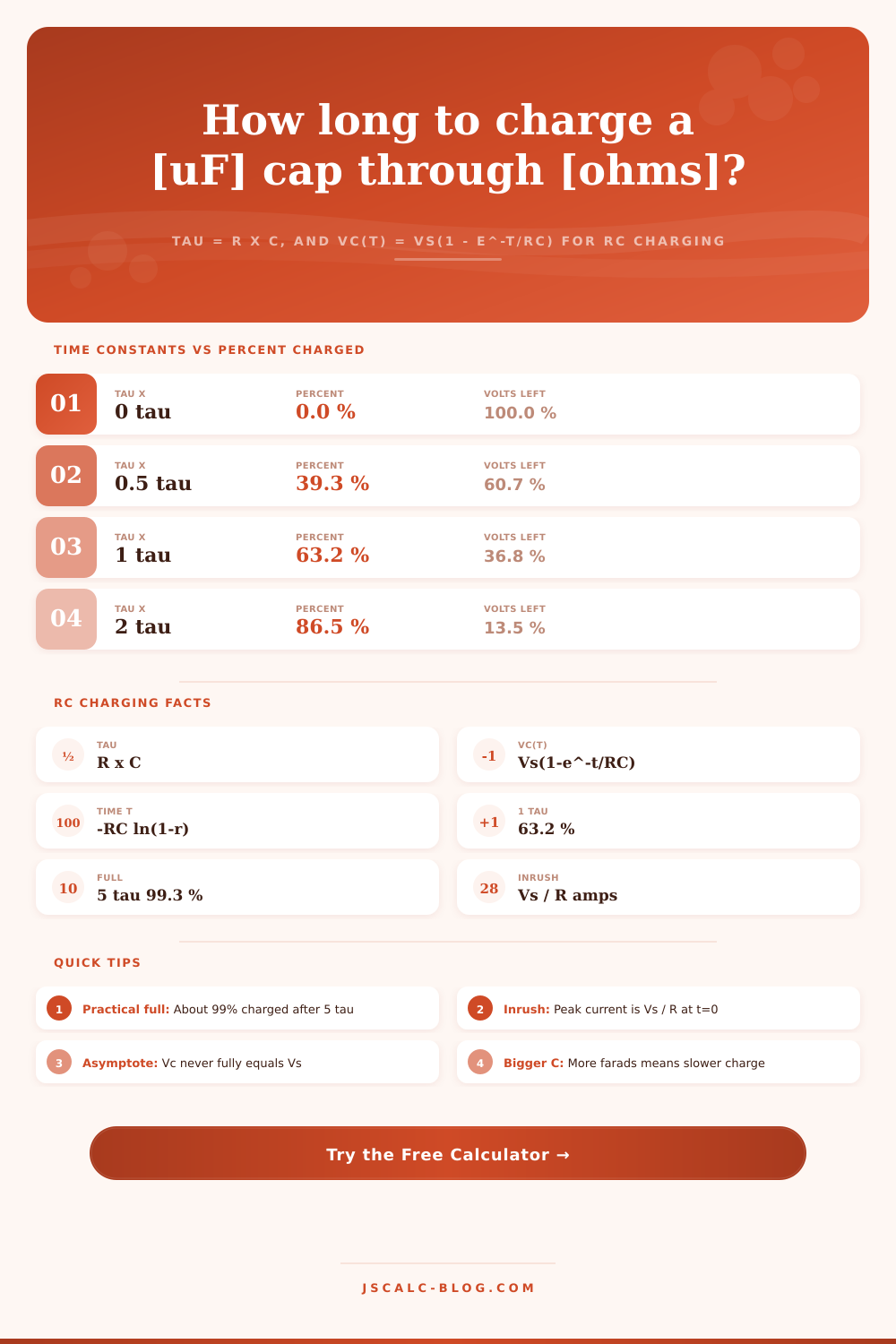
Work out how fast a capacitor charges through a series resistor. Find the RC time constant tau = R x C, the time to reach any target voltage with t = -RC ln(1 - Vc/Vs), or the voltage a cap reaches after a set time using Vc(t) = Vs(1 - e^-t/RC), complete with a percent-charged breakdown in multiples of tau.
⚡Real RC Charging Presets
🔌Charging Circuit Inputs
Switch between solving for time or for voltage.
The resistor in series with the capacitor.
Capacitor value; choose its unit to the right.
Applies to the capacitance field above.
The source the cap charges toward.
The cap voltage you want to reach. Must be below Vs.
How long the cap has been charging.
Unit for the time input and reported times.
🔢Formula Snapshot
📋Time Constants vs Percent Charged
| Elapsed Time | Percent Charged | Vc as Fraction of Vs | Voltage Remaining |
|---|---|---|---|
| 0 tau | 0.0 % | 0.000 Vs | 100.0 % |
| 0.5 tau | 39.3 % | 0.393 Vs | 60.7 % |
| 1 tau | 63.2 % | 0.632 Vs | 36.8 % |
| 2 tau | 86.5 % | 0.865 Vs | 13.5 % |
| 3 tau | 95.0 % | 0.950 Vs | 5.0 % |
| 4 tau | 98.2 % | 0.982 Vs | 1.8 % |
| 5 tau | 99.3 % | 0.993 Vs | 0.7 % |
| 7 tau | 99.9 % | 0.999 Vs | 0.1 % |
📊Common RC Pairs and Time Constants
| Resistance R | Capacitance C | tau = R x C | Time to 63.2% | Typical Use |
|---|---|---|---|---|
| 1 kohm | 100 nF | 0.1 ms | 0.1 ms | Signal filter |
| 10 kohm | 100 nF | 1 ms | 1 ms | Switch debounce |
| 10 kohm | 100 uF | 1 s | 1 s | Timer / delay |
| 1 kohm | 1000 uF | 1 s | 1 s | Soft start |
| 100 kohm | 10 uF | 1 s | 1 s | Slow ramp |
| 47 kohm | 47 uF | 2.209 s | 2.209 s | Relay delay |
| 22 ohm | 1 F | 22 s | 22 s | Supercap charge |
| 10 ohm | 2200 uF | 22 ms | 22 ms | Bulk cap inrush |
📏Capacitance and Time Unit Conversions
| Unit | Equals | In Base Unit | Note |
|---|---|---|---|
| 1 F | 1 farad | 1 F | Base capacitance |
| 1 mF | 0.001 F | 1e-3 F | Millifarad |
| 1 uF | 0.000001 F | 1e-6 F | Microfarad |
| 1 nF | 1e-9 F | 1e-9 F | Nanofarad |
| 1 pF | 1e-12 F | 1e-12 F | Picofarad |
| 1 s | 1000 ms | 1 s | Second of charge time |
🗃Charge Time Comparison Grid
| Resistance R | Capacitance C | tau | Time to 90% | Time to 99% | 5 tau (99.3%) |
|---|---|---|---|---|---|
| 1 kohm | 100 nF | 0.1 ms | 0.230 ms | 0.461 ms | 0.5 ms |
| 10 kohm | 100 nF | 1 ms | 2.303 ms | 4.605 ms | 5 ms |
| 10 kohm | 100 uF | 1 s | 2.303 s | 4.605 s | 5 s |
| 1 kohm | 1000 uF | 1 s | 2.303 s | 4.605 s | 5 s |
| 100 kohm | 10 uF | 1 s | 2.303 s | 4.605 s | 5 s |
| 47 kohm | 47 uF | 2.209 s | 5.086 s | 10.17 s | 11.04 s |
| 22 ohm | 1 F | 22 s | 50.66 s | 101.3 s | 110 s |
| 100 kohm | 470 uF | 47 s | 108.2 s | 216.4 s | 235 s |
| 10 ohm | 2200 uF | 22 ms | 50.66 ms | 101.3 ms | 110 ms |
| 470 ohm | 10 uF | 4.7 ms | 10.82 ms | 21.64 ms | 23.5 ms |
⚙Formula Breakdown
💡Practical Charging Tips
Here’s the calculator for computing how long a capacitor takes to charge up. Plug in some values and the tool will show you which volts and what amount of time it took. That makes your circuit designs more precise different than guesses. And nope, capacitors do not just spring to their full voltage. They creep there. And that creeping occurs predictably and smoothly.
That’s because it takes resistance in series with the capacitor for create the ramping effect. Until you see it calculated or on a scope, it seem counterintuitive. You think it should of been a straight line. But it’s not. Charging is logarithmic:
How Capacitors Charge Up
What’s the primary variable? The time constant are also known as tau. Think of that as resistance in ohms times capacitance in farads. It’s a single number. Tau determines how fast a circuit operate. If you have a one microfarad capacitor and a one kilohm resistor, then the time constant is one millisecond.
To slow down the rate of charge flow use a bigger resistor. The bigger capacitor require more charge before reaching full voltage. Each change raise the time constant. This stretches out the charging curve. It can range from nanoseconds to seconds. Microseconds are critical to success or failure for a timing application.
For example, when you’re thinking about how fast a capacitor will charge you can consider multiples of tau. Tau is the amount of time it takes for a capacitor to reach 63.2 percent of its full voltage. So if I give a capacitor one tau then I’ll have it charged to 63.2 percent of its full voltage. If I wait an additional tau that number becomes 86.5 percent. If I wait another three taus, then I’m essentially done, with 99.3 percent of the full capacitor.
These numbers are easy to remember and remain constant regardless of the size of your capacitors or filters. That percentage ladder helps you guess at what’s going on without having to crunch any numbers yourself. The more practical problem is “solve for time given some target voltage.” Delay the microcontroller for x amount of time before enabling the motor. Use a soft-start circuit to limit inrush current to a safe level. Rearrange the formula to get the natural log form that solves for t. This reverses the exponential relationship. Plug in the supply voltage and your desired threshold and let the tool do the heavy lifting.
It also imposes a real-world constraint: there’s no way to hit 100 percent of the supply voltage within any finite period of time. Sure, the curve gets close but it won’t touch it. Ask it to go to a target that equals the supply voltage and it will sit there waiting forever. That catches a lot of novices.
The other thing that’s often left out of the timing equation is inrush current. When you turn on power an uncharged capacitor behave as if it were a short circuit. Depending on the series resistance, the first rush will be equal to the supply voltage over the resistance. That spike can ruin connections or pop fuses. To reduce it, you add a resistor. And it just stretches the overall charging time a bit. It is a trade-off between safety and speed. It take a fraction of a second to save the day for your hardware.
The tool ties this back to practice with preset scenarios. For instance, if you want to build a debounce circuit for a switch, use a 100-nanofarad capacitor with a 10-kilohm resistor. The result is a millisecond-scale delay to filter out mechanical chatter. If you want a soft-start rail instead try a large bulk capacitor with a 1-ohm resistor. It’ll take seconds to gently raise the voltage on the power line. These examples show how the same physics operates at different scales. You’re tuning resistance and capacitance to match your timing needs.
To master the charge of an RC component, one must understand the exponential curve. It is not some formula but a repeatable behavior pattern ranging from nanoseconds within logic circuits to minutes with energy storage systems. After grasping the time constant and the percentage milestones, you are seeing rates of change rather than raw numbers. Resistance guides the capacitor towards its limit. It’s subject to physical laws, predictable enough to make electronic devices reliabel.