How to Payoff Credit Card Debt Calculator
Enter your card balance and APR, then either set a fixed monthly payment to see the months to payoff and total interest, or set a target payoff time to find the exact monthly payment you need. It also shows the minimum-payment trap and avalanche vs snowball order for two cards.
💳Choose What to Solve
🎯Real Debt Payoff Presets
📝Your Debt Details
Current statement balance you owe on the card.
Annual rate. Monthly rate r = APR / 12.
Used in fixed-payment mode to find months to payoff.
Used in target mode to find the required payment.
Added on top of the payment above every month.
For the minimum-only trap comparison, often 1% to 3%.
Issuers require at least this much, commonly $25 to $35.
Add a second card below to compare payoff order.
Second card balance for the two-card strategy.
Second card annual rate for avalanche ordering.
🔢Payoff Formula Snapshot
📉Payoff Time by Monthly Payment
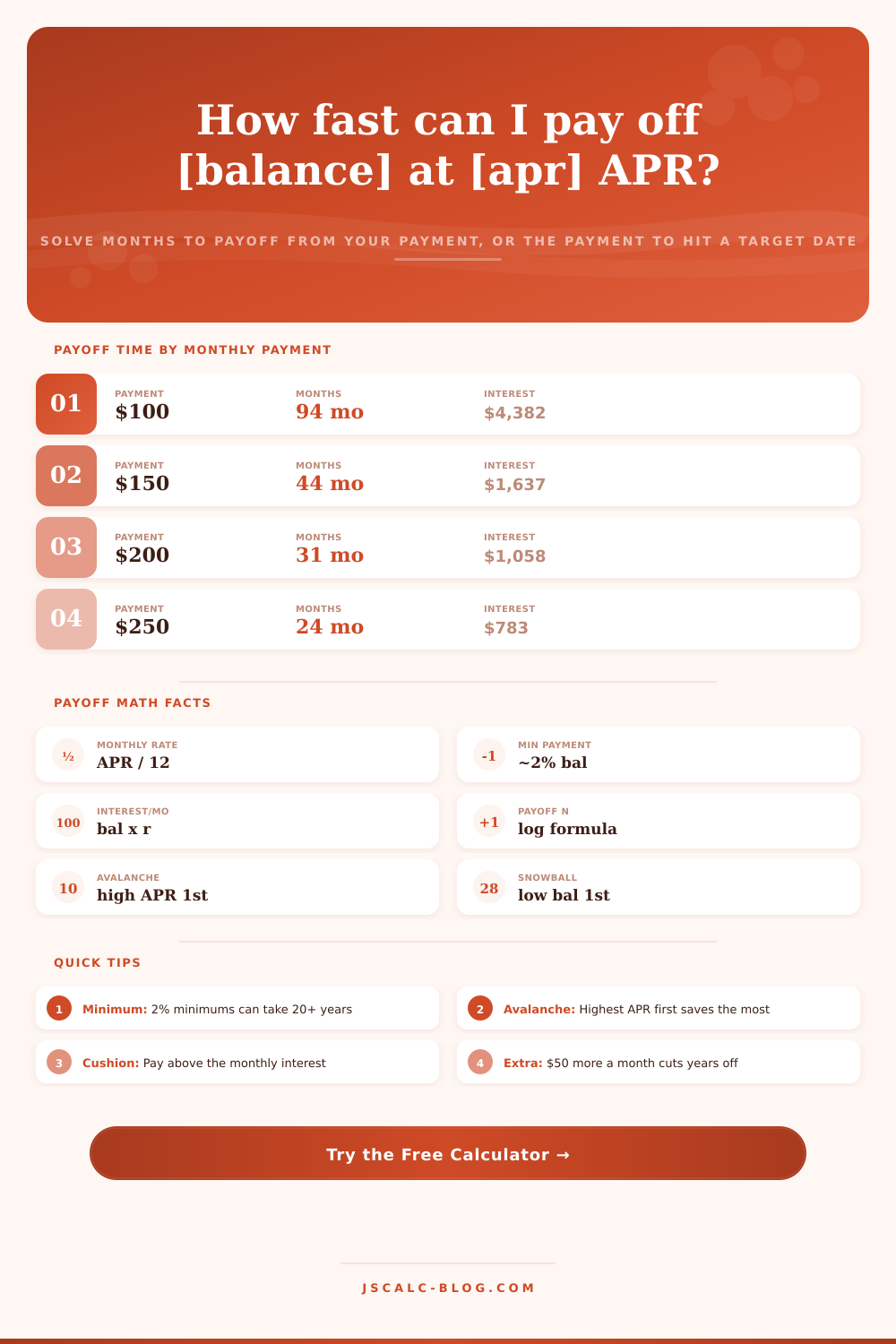
Sample card: $5,000 balance at 22% APR (monthly rate r = 1.833%). Larger payments crush both the time and the interest.
| Monthly Payment | Months to Payoff | Years | Total Interest | Total Paid |
|---|---|---|---|---|
| $100 | 94 months | 7.8 yrs | $4,382 | $9,382 |
| $150 | 44 months | 3.7 yrs | $1,637 | $6,637 |
| $200 | 31 months | 2.6 yrs | $1,058 | $6,058 |
| $250 | 24 months | 2.0 yrs | $783 | $5,783 |
| $300 | 20 months | 1.7 yrs | $618 | $5,618 |
| $400 | 14 months | 1.2 yrs | $425 | $5,425 |
| $500 | 12 months | 1.0 yrs | $322 | $5,322 |
| $750 | 7 months | 0.6 yrs | $194 | $5,194 |
📊Total Interest by APR
Sample: $5,000 balance paid with a fixed $200 every month. A higher APR stretches the payoff and stacks up interest fast.
| APR | Monthly Rate r | Months to Payoff | Total Interest | Total Paid |
|---|---|---|---|---|
| 0% (intro) | 0.000% | 25 months | $0 | $5,000 |
| 12.00% | 1.000% | 28 months | $556 | $5,556 |
| 15.99% | 1.333% | 29 months | $770 | $5,770 |
| 18.99% | 1.583% | 30 months | $948 | $5,948 |
| 21.99% | 1.833% | 31 months | $1,145 | $6,145 |
| 24.99% | 2.083% | 33 months | $1,367 | $6,367 |
| 27.99% | 2.333% | 34 months | $1,617 | $6,617 |
| 29.99% | 2.499% | 35 months | $1,806 | $6,806 |
⚠The Minimum-Payment Trap
Paying a shrinking 2%-of-balance minimum (with a $25 floor) at 22% APR keeps you in debt for decades. A flat fixed payment is dramatically cheaper.
| Balance | Minimum Only (2%) | Min Interest | Fixed $200/mo | Fixed Interest |
|---|---|---|---|---|
| $2,000 | ~14 years | $2,506 | 11 months | $347 |
| $3,000 | ~17 years | $4,092 | 17 months | $586 |
| $5,000 | ~21 years | $7,412 | 31 months | $1,058 |
| $8,000 | ~24 years | $12,733 | 60 months | $3,124 |
| $10,000 | ~26 years | $16,443 | 93 months | $8,459 |
| $12,000 | ~28 years | $20,214 | - | never |
📈Payment vs Months vs Interest Grid
A $6,000 balance at 20% APR (r = 1.667%). Every extra dollar per month clears the card faster and slices the interest bill.
| Payment | Months | Years | Interest | Total Paid | Interest % |
|---|---|---|---|---|---|
| $150 | 61 months | 5.1 yrs | $3,096 | $9,096 | 34% |
| $200 | 39 months | 3.3 yrs | $1,741 | $7,741 | 22% |
| $250 | 29 months | 2.4 yrs | $1,214 | $7,214 | 17% |
| $300 | 24 months | 2.0 yrs | $929 | $6,929 | 13% |
| $400 | 17 months | 1.4 yrs | $628 | $6,628 | 9% |
| $500 | 13 months | 1.1 yrs | $470 | $6,470 | 7% |
| $600 | 11 months | 0.9 yrs | $372 | $6,372 | 6% |
| $750 | 9 months | 0.7 yrs | $278 | $6,278 | 4% |
| $1,000 | 6 months | 0.5 yrs | $194 | $6,194 | 3% |
⚖Avalanche vs Snowball
| Method | Order | Best For | Pro | Con |
|---|---|---|---|---|
| Avalanche | Highest APR first | Least interest | Cheapest overall | Slower first win |
| Snowball | Smallest balance first | Motivation | Fast early wins | Costs a bit more |
| Highest balance | Largest debt first | Big worries | Cuts risk sooner | Usually pricier |
| Even split | Equal to all | Simplicity | Easy to run | Least efficient |
| Balance transfer | 0% intro card | Good credit | Pauses interest | Transfer fee 3-5% |
| Consolidation loan | Fixed term loan | Many cards | One fixed payment | Needs approval |
⚙Formula Breakdown
💡Payoff Strategy Tips
Each month, interest builds up on outstanding balance, and the credit card debt grow too. You finally send in a check, the balance dwindles … and then it increases again. By the time you has the chance to repay some more, the balance have risen again.
The beauty of a credit card payoff calculator is that it turns the uncertainty into black-and-white figures. Plug in the balance plus interest rate and suddenly you know: How much do I need to pay each month? How many months until I’m done? No more wondering whether a little extra helps; you’ll know exactly what paying off the balance cost.
How a Credit Card Payoff Calculator Helps You
The monthly interest cost are the primary issue with any card that isn’t zero percent. Issuers will give you a yearly rate, but they’ll apply it every single month. If your APR is twenty-two percent, for example, this translates into roughly 1.83 percent of your balance per month, even before you make a payment. At five thousand dollars, that’s almost ninety-two dollars worth of raw interest for a single billing cycle. That means you have to account for that much… And anything extra go toward reducing the principal!, or your balance won’t drop at all. The rest goes toward reducing the principal.
This explains why small payments that look helpful don’t seem to do anything when applied against big balances: Much of the time, they’re simply paid back as interest charges. Most folks don’t realize that when they pay the minimum, it cost them. Why? Banks set their minimum payments at roughly 2% of your outstanding balance. That doesn’t sound so bad, does it? Until you see the time frame. If you owe $5,000 on your credit card and pay only the minimum, it’ll take you 21 years; and cost you more interest than the principal!
This is clearly illustrated using the calculator’s comparison between your fixed monthly payment vs. What happens if you just pay the minimum. It illustrates the savings from making a commitment to a fixed monthly payment rather than allowing bank to decide the timing.
There are two modes: 1) Time Mode: Enter your fixed monthly payment and the tool tell you how long it will take to pay down your debt. 2) Date Mode: Enter your desired number of months (e.g., I want to be paid off by my new job), and the tool tells you exactly how much you need to pay each month to reach that goal.
It helps you force yourself into a realistic assessment of whether you’re capable of it. Maybe the payment are too high for you. That tells you it is time to reduce the rate or stretch out the timeline.
It warns you if you’re paying too little. When you make a payment, it’ll alert you if you paid less than the interest amount. You’ll never be reducing the principal; instead, you will keep paying and building up interest forever. That’s why the tool quickly highlights this to avoid wasting time on small payments that won’t make a difference.
As long as you pay one penny over the interest rate, eventually you’ll pay it off, but higher-than-interest-rate payments create real progress.
With more than one card, it’s not just about math (it’s also about strategy). With the snowball method, you pay off the lowest balance first to get a fast psychological victory. It doesn’t save you money; it saves your motivation.
With the avalanche method, you target the card with the highest interest rate to minimize your total interest payments. It is the most efficient approach and saves you money. You can try out both methods in the calculator to see which order make sense for you.
Time vs. Money: The time you have left is against the amount of cash flow you’re earning. This race determine how long it takes to pay off your debt. The results are very sensitive to small changes. Paying an extra $50/month or moving that balance to a 0% intro APR card can knock years off the clock. These moves can also save you thousands in interest payments.
To find out where you stand, start with calculator above, and plug in your real-life figures. As you step by step raise your payment, watch the payoff-date migrate toward today. It will transform this big mess of a debt into something attainable, one solid step at a time.
You should of looked at these numbers sooner. Actualy, it can make things much more comfortabley. This moddern method works better then others based off how you plan.