Conduit Fill Percentage Calculator
Add up the cross-sectional area of every THHN, THWN, or XHHW conductor, compare it against the internal area of EMT, PVC Schedule 40, or RMC conduit, and instantly see the fill percentage checked against the NEC Chapter 9 limits of 53 percent for one wire, 31 percent for two, and 40 percent for three or more.
🔌Real Wiring Job Presets
🔩Conduit and Conductor Inputs
Raceway material sets the internal cross-sectional area.
Nominal trade size, not the wire outside diameter.
Areas below follow NEC Chapter 9 Table 5 approximate values for insulated conductors.
🔗Wire Groups in the Raceway
Add a second or third wire size when the run carries mixed conductors.
📉NEC Fill Limit Snapshot
📏THHN Conductor Areas (Chapter 9 Table 5)
| Wire Size AWG/kcmil | Area in2 | Wires to Fill 1/2in EMT | Typical Use |
|---|---|---|---|
| #14 | 0.0097 | 12 | 15A lighting |
| #12 | 0.0133 | 9 | 20A general |
| #10 | 0.0211 | 5 | 30A dryer, AC |
| #8 | 0.0366 | 3 | 40A feeder |
| #6 | 0.0507 | 2 | 55A subpanel |
| #4 | 0.0824 | 1 | 70A feeder |
| #2 | 0.1158 | 1 | 95A service |
| 1/0 | 0.1855 | 0 | 125A service |
| 2/0 | 0.2223 | 0 | 145A service |
| 4/0 | 0.3237 | 0 | 195A service |
🗄Conduit Internal Area Comparison Grid
| Trade Size | EMT Area in2 | PVC40 Area in2 | RMC Area in2 | EMT 40% in2 | PVC40 40% in2 |
|---|---|---|---|---|---|
| 1/2 in | 0.304 | 0.285 | 0.314 | 0.122 | 0.114 |
| 3/4 in | 0.533 | 0.508 | 0.549 | 0.213 | 0.203 |
| 1 in | 0.864 | 0.832 | 0.887 | 0.346 | 0.333 |
| 1-1/4 in | 1.496 | 1.453 | 1.526 | 0.598 | 0.581 |
| 1-1/2 in | 2.036 | 1.986 | 2.071 | 0.814 | 0.794 |
| 2 in | 3.356 | 3.291 | 3.408 | 1.342 | 1.316 |
| 2-1/2 in | 5.858 | 5.793 | 5.751 | 2.343 | 2.317 |
| 3 in | 8.846 | 8.688 | 8.846 | 3.538 | 3.475 |
📋Max Same-Size THHN per Conduit at 40 Percent
| Conduit | #14 THHN | #12 THHN | #10 THHN | #8 THHN |
|---|---|---|---|---|
| 1/2in EMT | 12 | 9 | 5 | 3 |
| 3/4in EMT | 22 | 16 | 10 | 6 |
| 1in EMT | 35 | 26 | 16 | 9 |
| 1-1/4in EMT | 61 | 45 | 28 | 16 |
| 1-1/2in EMT | 84 | 61 | 38 | 22 |
| 2in EMT | 138 | 101 | 63 | 36 |
⚙Formula Breakdown
💡Conduit Fill Field Tips
Packed in too tightly, wires is hard to pull, will trap heat, and can nick insulation during installation. Before pulling wire, check how many conductors the National Electrical Code (NEC) allows in a given raceway. This thing looks at cross-sectional area of each conductor you put in and compares it to internal area of the conduit you’re using. It then displays fill percentage alongside specific NEC limit so you can see whether or not run is legal.
The fill number is an area ratio. Conduit fill is the percentage of the conduit’s inside cross section that is occupied by multiple wires. You can see that if you look at the cut end of some conduit, there is a set area (square inches) inside pipe and then each round conductor are taking up its little circle inside that area. Total wire area/pipe area x 100 = Fill %. The lower the number, the less space conductors use. That free space is required by the Code so that it is possible to pull something through conduit and also so heat can dissipates from it. Never should a conduit ever be stuffed completely full.
How to Check Conduit Wire Fill Limits
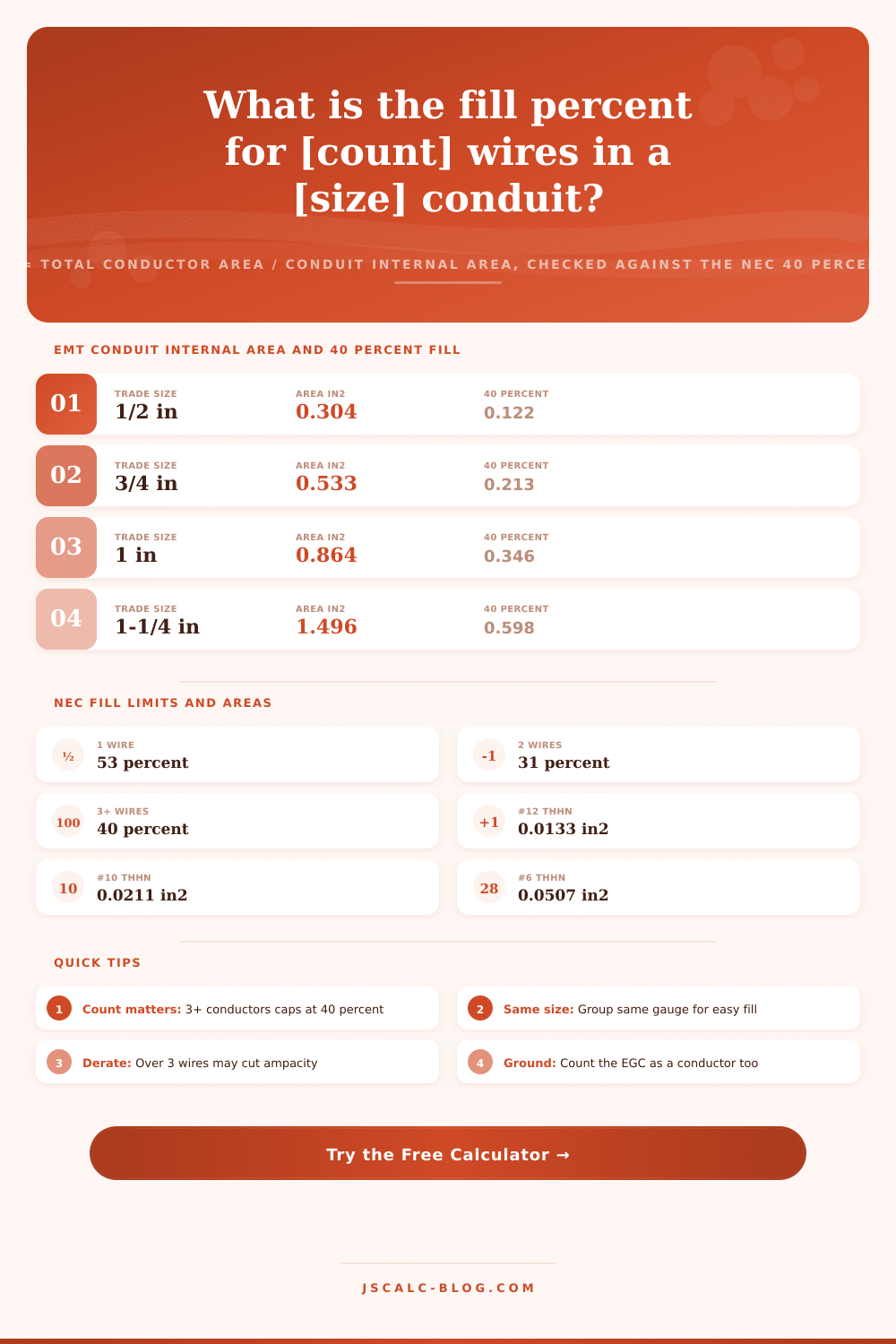
The National Electric Code (NEC) defines fill limits in Chapter 9 Table 1 as a function of number of conductors in the raceway. Fill can be up to 53 percent if there is only one conductor. However, two conductors leave uneven spaces between them that make them difficult to pull, so the limit is 31 percent fill. If there are three or more, which is typical, then they can be filled to a maximum of 40 percent fill. The calculator take into account all the conductors (and even grounds) you list, and chooses the appropriate limit without your having to guess which one applies.
To calculate wire area correctly, you require actual area of each insulated conductor, not merely the area of the bare copper. Wire insulation makes a real contribution to its thickness; so, the Code provides estimated areas in Table 5 of Chapter 9. This device relies on the THHN and THWN numbers from Table 5, which dominate today’s branch and feeder work. A #12 is given as 0.0133 square inch, whereas a #6 is 0.0507. Bigger wires scale fast: 4/0 is 0.3237 square inch. Select your gauges and the number of each type of wire. The calculator multiplies each conductor area by its quantity and adds the groups together for total area of all conductors.
Even within one trade size, different materials has different internal areas in the conduit. Half-inch EMT is thin-walled, with only 0.304 square inch of area. This is a little more than PVC Schedule 40 at 0.285 square inch and a little less than Rigid Metal Conduit (RMC) at 0.314 square inch. Even that small difference is significant when filling out your run at the margin. With one click, you can instantly change the pipe area and its fill percentage. This avoids guesswork over whether using tighter-fitting PVC might require a larger pipe size.
Four unambiguous digits result from every calculation. The “total conductor area” card presents the sum of all your wires’ square inches. The “conduit internal area” card presents the full area of the pipe at 100 percent. The “actual fill percentage” card is the first number divided into the second. And the “NEC allowable” card presents the limit for how many conductors are allowed in this situation and the square inches of usable space that number represents. A bold “PASS” or “FAIL” banner appears below the cards, while a formula breakdown below shows you which wire groups is on the brink of the limit.
In reality, no one runs just one gauge on their raceway. More likely, there is a big feeder containing three or more phase conductors along with a small neutral conductor and maybe an even smaller ground conductor as well. The calculator accommodates this by allowing up to three different wire groups, all with separate counts and gauges, making it simple to see if swapping one of the larger wires for a smaller ground maintains the overall run below 40 percent. There are also convenient presets for commonly used pulls such as three #12 THHN in half-inch EMT. You can use these as quick checks against your own design adjustments.
Filling limits are no busy work. Overfilled conduits concentrate heat, forcing ampacity derating when there is more than three current carrying conductors per raceway (NEC 310.15). They also create tension during pulling that scrapes insulation. Fill checks assure thermal integrity, inspectability and pullability of an install. Design with this calculator early in the process before conduit purchase so you do the conduit size correctly the first time. Confirm you have enough space in the conduit to add more later without violating code. This saves you the expense of pulling wire through a conduit that simply would of take it.