Cable Weight Calculator
Estimate the mass of a wire or cable run from conductor material, gauge in AWG or area in mm2, number of conductors, run length, and a jacket allowance. Reports bare conductor weight, total jacketed weight, and weight per meter and per foot in both kilograms and pounds.
🔄Real Cable Run Presets
📝Cable Inputs
Sets the conductor density used for mass.
Used only when material is set to Custom.
Choose gauge lookup or a direct area.
Area is derived from the AWG standard.
Cross section of a single conductor.
Cores or wires in the cable run.
Total length of the cable pull.
Applies to the run length above.
Multiplier for insulation and jacket mass.
Bare weight is multiplied by this value.
Controls rounding on the result cards.
🔢Weight Snapshot
📋Copper Conductor Weight by AWG
| Gauge | Area mm2 | kg per km | lb per 1000 ft |
|---|---|---|---|
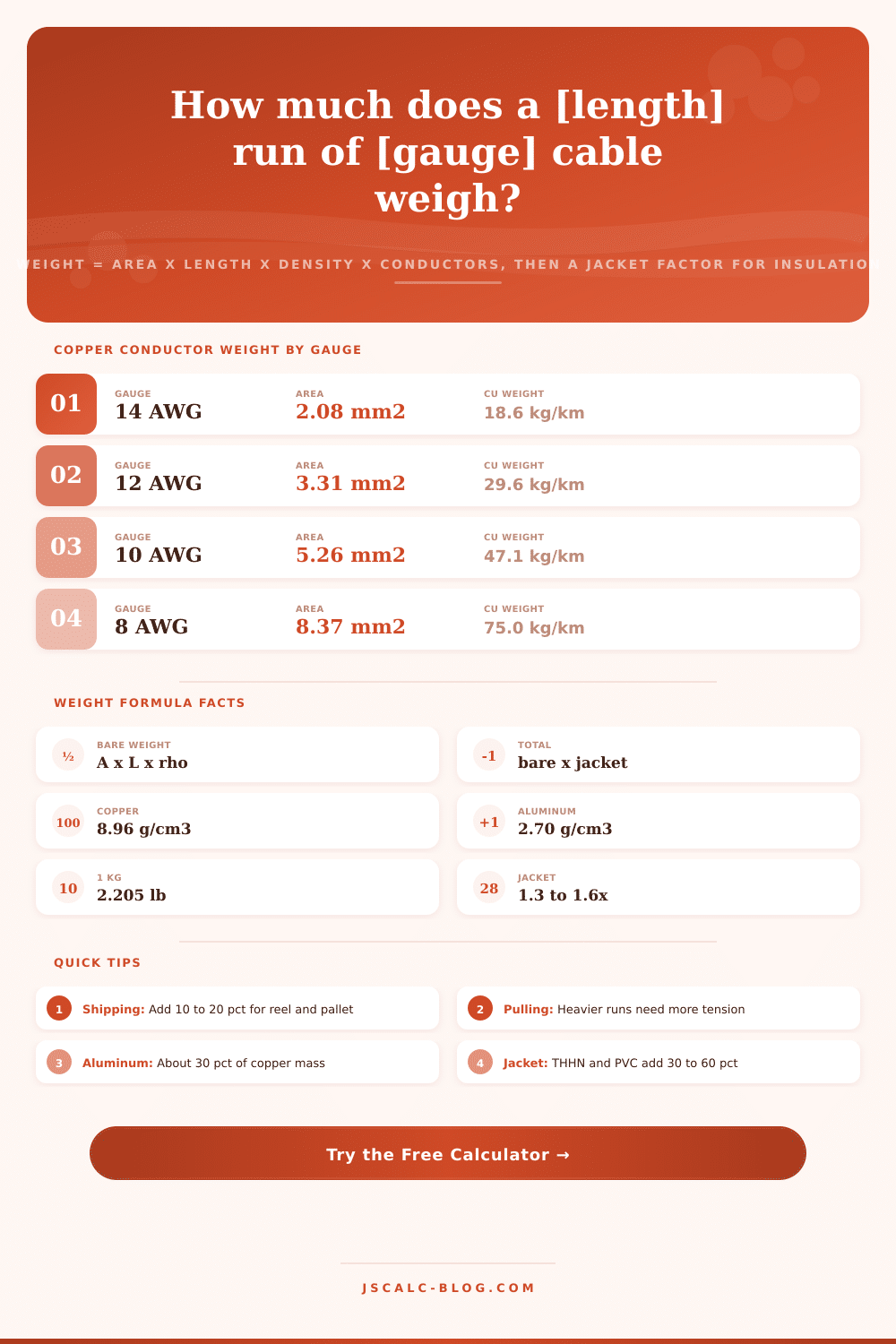
| 14 AWG | 2.08 | 18.6 | 12.5 |
| 12 AWG | 3.31 | 29.6 | 19.9 |
| 10 AWG | 5.26 | 47.1 | 31.7 |
| 8 AWG | 8.37 | 75.0 | 50.4 |
| 6 AWG | 13.30 | 119.2 | 80.1 |
| 4 AWG | 21.15 | 189.5 | 127.3 |
| 2 AWG | 33.63 | 301.3 | 202.5 |
| 1/0 AWG | 53.48 | 479.1 | 322.0 |
🧭Material and Density Reference
| Material | Density g/cm3 | Density kg/m3 | Vs Copper |
|---|---|---|---|
| Copper (Cu) | 8.96 | 8960 | 100 pct |
| Aluminum (Al) | 2.70 | 2700 | 30 pct |
| Silver (Ag) | 10.49 | 10490 | 117 pct |
| Tinned copper | 8.90 | 8900 | 99 pct |
| Aluminum alloy | 2.71 | 2710 | 30 pct |
| PVC jacket | 1.40 | 1400 | 16 pct |
📏Length and Mass Unit Conversions
| Unit | Equals | In Base Unit | Note |
|---|---|---|---|
| 1 ft | 0.3048 m | 0.3048 m | Run length |
| 1 m | 3.281 ft | 1 m | Metric length |
| 1 kg | 2.20462 lb | 1 kg | Mass |
| 1 lb | 0.45359 kg | 0.45359 kg | Imperial mass |
| 1 mm2 | 0.01 cm2 | 0.000001 m2 | Conductor area |
| 1 kcmil | 0.5067 mm2 | 0.5067 mm2 | US large gauge |
🗃Copper vs Aluminum Weight Comparison Grid
| Gauge | Area mm2 | Cu kg/km | Cu lb/1000ft | Al kg/km | Al lb/1000ft |
|---|---|---|---|---|---|
| 14 AWG | 2.08 | 18.6 | 12.5 | 5.6 | 3.8 |
| 12 AWG | 3.31 | 29.6 | 19.9 | 8.9 | 6.0 |
| 10 AWG | 5.26 | 47.1 | 31.7 | 14.2 | 9.5 |
| 8 AWG | 8.37 | 75.0 | 50.4 | 22.6 | 15.2 |
| 6 AWG | 13.30 | 119.2 | 80.1 | 35.9 | 24.1 |
| 4 AWG | 21.15 | 189.5 | 127.3 | 57.1 | 38.4 |
| 2 AWG | 33.63 | 301.3 | 202.5 | 90.8 | 61.0 |
| 1/0 AWG | 53.48 | 479.1 | 322.0 | 144.4 | 97.0 |
| 2/0 AWG | 67.43 | 604.2 | 406.0 | 182.1 | 122.3 |
| 4/0 AWG | 107.22 | 960.7 | 645.5 | 289.5 | 194.5 |
⚙Formula Breakdown
💡Cable Handling Tips
Before you begin installing cable, plan ahead so that your crew doesn’t haul more than necessary. It’s a safety issue for your guys. And it makes sense to figure out how much cable mass you’re dealing with.
The calculator will do the math for you… Converting volume into mass based off its density. Save that part for later when it comes time to actualy install. Wire weight has simple physics: Weight equals density (mass) times volume (length x cross section). So copper weigh approximately eight grams per cubic cm. Aluminum is significantly less dense, only around two point seven grams per cc. This is why feeder cables tend to be aluminum when large: They’re heavier than copper but their greater diameter are needed anyway due to lower ampacity.
How to Calculate Cable Weight
You can change material types immediately with the tool. It also provides a jacket factor that adds thirty to sixty percent to bare conductor weight, representing the additional mass of PVC or THHN insulation.
The gauge calculation is also where a lot of estimates go awry. In the United States, we count up when wires gets smaller. So a 14AWG is much, much smaller then an eight AWG. It’s not linear though it’s exponential. The calculator turns those gauges into square millimeter equivalents on the fly. Whether you’re using metric or imperial terms, this keeps the volume calculation accurate.
You can even type your area directly if that’s what you’re used to. This is helpful if you work with IEC cable sizes given as square millimeters. This make the calculator useful for both North American building wire and European-style flexible cord while maintaining accuracy.
A thousand-foot drum is different than a fifty-foot run; storage space and freight cost are affected by that difference. Twelve AWG house wire may weigh too little to notice on a handheld scale during a short pull. But it adds up quickly, thirty circuits in a new commercial building affects both storage space and freight cost. Knowing how heavy a cable is per foot/ per meter gives insight into whether your cable tray will support the load without sagging.
Total mass appears along with weights per foot and per meter. And those weights per foot and meter is what you need when figuring out tension limit during a lengthy conduit pull. Pulling too much will damage the conductor or rip insulation off inside of the jacket.
That said, material calculations don’t take into account shipping. It only tell you how much the cable weighs, not weight of the wooden reel, the steel flanges, or the pallets used for shipping. To account for packaging overhead, add another 10-20% to whatever you calculate to make sure industry-standard practices is followed. Otherwise, you’ll book the wrong freight class and risk underestimating forklift capacity needs. A little tweak avoids headaches when the carrier balks over declared weight at the loading dock.
The interface shows common situations using its presets which are quick reference points. It illustrates the big impact conductor count and insulation type has on mass. A multi-core control cable is far heavier then a simple ground wire. You get a sense of scale intuitively when comparing these two side by side. By comparing these side by side, you gain an intuitive sense of scale that spreadsheets often obscur.
It’s about moving from guesswork to verification in your planning. Knowing precisely the amount of mass you will be working with allows accurate pricing of the job and selection of the right equipment. You would of no longer have failures because your equipment cannot handle the load it was given. There is only one variable that you cannot negotiate with on the jobsite and that’s weight. Taking the time to calculate always pays off an extra minute.