Concrete Calculator
Pick a shape – slab, footing, wall, round column or tube, or stairs – and get the cubic yards, cubic feet, cubic meters, and number of bags you need, with a full formula breakdown and waste allowance.
🎯Real Pour Presets
📝Project Inputs
Flat landing at the top, same width and thickness as the steps.
Extra concrete for spillage, uneven subgrade, and overdig.
🔢Volume Snapshot
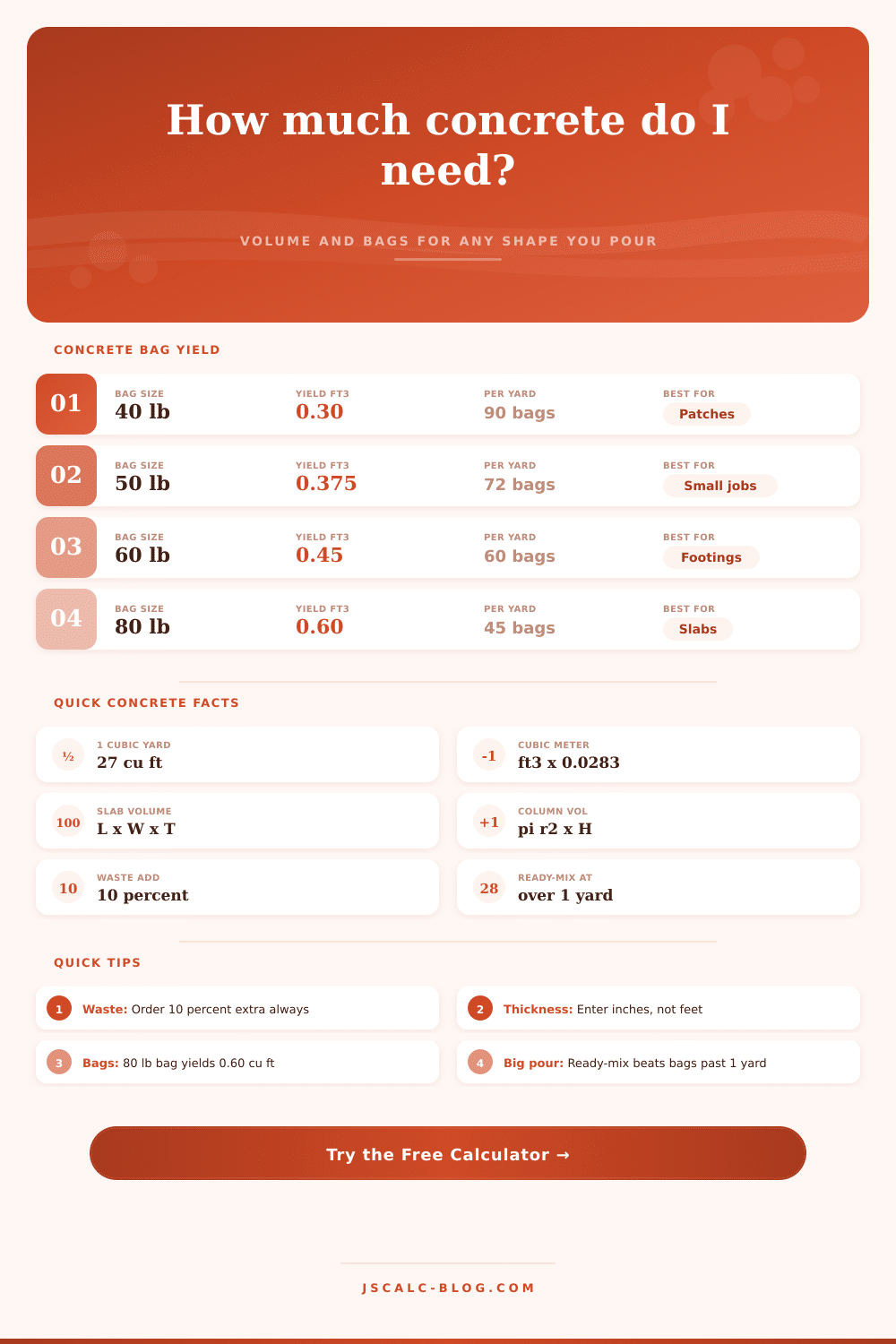
📦Bag Yield By Size
| Bag Size | Yield (ft³) | Bags / yd³ | Bags / m³ | Best For |
|---|---|---|---|---|
| 40 lb | 0.30 | 90 | 118 | Patches, small posts |
| 50 lb | 0.375 | 72 | 95 | Small footings |
| 60 lb | 0.45 | 60 | 79 | Footings, piers |
| 80 lb | 0.60 | 45 | 59 | Slabs, driveways |
📏Slab Volume Per 100 Sq Ft
| Thickness | Cubic Feet | Cubic Yards | Cubic Meters | 80 lb Bags |
|---|---|---|---|---|
| 2 in | 16.7 | 0.62 | 0.47 | 28 |
| 3 in | 25.0 | 0.93 | 0.71 | 42 |
| 4 in | 33.3 | 1.23 | 0.94 | 56 |
| 5 in | 41.7 | 1.54 | 1.18 | 70 |
| 6 in | 50.0 | 1.85 | 1.42 | 84 |
| 8 in | 66.7 | 2.47 | 1.89 | 112 |
🗂Volume Comparison Grid
| Project Size | Cubic Feet | Cubic Yards | Cubic Meters | 60 lb Bags | 80 lb Bags |
|---|---|---|---|---|---|
| Slab 8x8x4in | 21.3 | 0.79 | 0.60 | 48 | 36 |
| Slab 10x10x4in | 33.3 | 1.23 | 0.94 | 75 | 56 |
| Slab 12x16x4in | 64.0 | 2.37 | 1.81 | 143 | 107 |
| Driveway 20x20x6in | 200.0 | 7.41 | 5.66 | 445 | 334 |
| Footing 1x1x20ft | 20.0 | 0.74 | 0.57 | 45 | 34 |
| Wall 8x20x0.67ft | 106.7 | 3.95 | 3.02 | 238 | 178 |
| Column 12in x 8ft | 6.3 | 0.23 | 0.18 | 14 | 11 |
| Sonotube 10in x 8ft | 4.4 | 0.16 | 0.12 | 10 | 8 |
| Stairs 3-step 4ft wide | 11.0 | 0.41 | 0.31 | 25 | 19 |
📐Shape Formulas
| Shape | Volume Formula | Key Dimensions | Notes |
|---|---|---|---|
| Slab | L × W × T | Length, width, thickness | Thickness entered in inches |
| Footing | L × W × D | Length, width, depth | Continuous strip footing |
| Wall | L × H × T | Length, height, thickness | Same math as a vertical slab |
| Round column | π × (D/2)² × H | Diameter, height | Also covers Sonotube forms |
| Stairs | Σ(rise × run × W) + platform | Rise, run, width, steps | Solid steps plus top landing |
⚙Full Formula Breakdown
📋Cubic Yard Coverage
| Thickness | Sq Ft / yd³ | Sq M / m³ | Approx Slab | Use |
|---|---|---|---|---|
| 2 in | 162 | 50.0 | 12 × 13 ft | Overlay, mud slab |
| 3 in | 108 | 33.3 | 10 × 11 ft | Walkway |
| 4 in | 81 | 25.0 | 9 × 9 ft | Patio, shed slab |
| 5 in | 65 | 20.0 | 8 × 8 ft | Light driveway |
| 6 in | 54 | 16.7 | 7 × 8 ft | Driveway, garage |
💡Practical Concrete Tips
So here’s your dilemma: like most people doing a patio job, you’re standing there looking at some dirt and wondering if you has enough concrete for the patio. No, this isn’t a simple hole-digging exercise. It involves geometry and volume. It also includes waste and the expense of that waste. A unit converter won’t get you through. You need to know how your inputs will impact your budget.
Once you input your measurements, it crunches the numbers through its calculator (above). You don’t need to struggle with fractions or remember how to use pi. First you choose the shape you are casting. Then you type in the numbers. For columns, footings, and slabs, the formula are different. With a slab, you type in width, length and thickness.
How to Use the Concrete Calculator
Here’s where folks get tripped up: thickness is measured in inches, not feet. When we picture pouring a four-inch concrete pad, few of us think about it as half a foot. That is why this is a rare moment when we work with inches rather than feet. The computer assumes you entered inches when you typed in a number that actualy represents feet. That means it’ll give you an order 12 times smaller then what you wanted. Big trouble on delivery day.
There’s also waste. That said, you don’t get EXACTLY what the math say. There are differences due to gravity and human error. The calculator has a place for a waste allowance. By default it’s set at 10%. Don’t overlook that. Some spots will be deeper than others based off uneven ground. Truck hoses drip a little as they go over edge; there’s spillage. If you order exactly what the calculator says you need, you’ll likely run out near the end of the pour. Running out results in a cold joint. A cold joint is a visible line between two batch. Not only is it ugly, it’s weak. Ten percent guarantees extra material.
Bag sizes count on small jobs. One cubic yard of material equals these numbers of bags (see reference table). Each eighty-pound bag is about 0.60 cubic feet. That doesn’t sound like much but hauling those sacks is backbreaking work, fifty bags. On anything more than a cubic yard, forget the bags. Have it delivered as ready-mix concrete. It will save you both time and money. Wheelbarrowing a driveway isn’t recommended.
Columns are another type of vertical structure and a whole other level of mathematics. There’s radius squared and pi involved. Without checking work it’s simple to get wrong. To make it easier, the calculator requests height and diameter as input. Letting the calculator do the geometry for us. You’ll notice that the height must be the same as the units set up. Switching from meters means that diameter and thickness will update to centimeters automatically. That way there’s no messing with mixing metric and imperial. That leads to trouble if you’re working on an international project or trying to convert an existing plan.
Now stairs are tricky because stairs aren’t a block, but stairs is a series of stacked treads. So the calculator adds up the volume of every tread and then adds on the volume of the top platform. The calculator assumes it’s pouring concrete into solid steps. Pouring solid is durable. For most projects, that’s what you want in your steps, which is why this tool continues to assume that. Hollow steps require less concrete (because they’re framed by rebar), but hollow steps are weaker. A majority of do-it-yourselfers pour solid just for safety reasons. That is still a correct assumption from the tool.
It’s not an exact science; it’s preparation. The numbers are there to help you know what to purchase. Visualizing the waste and planning out where the pour will be in order of placement is really the trick. You don’t want gaps, lumps or bumps. You want a nice even layer of concrete that is perfectly flat. You want to have plenty to cover the space without having to stop midway. This means knowing exactly how many cubic yards you need ahead of time, which can be a lot of heavy lifting for your brain if you don’t have the right tools to do the math. Once you has your measurement, add 10% for overage then let the calculator figure it out for you. You should of used this earlier.
What is the result? You get a rock-solid foundation and more confidence.