Percentage Calculator
Calculate percent of a number, what percent one value is of another, percent change, add or subtract percent, reverse percent, markup, and discount.
Used for percent of number, add/subtract percent, markup, and discount.
Use a negative rate for reverse discounts, such as -20.
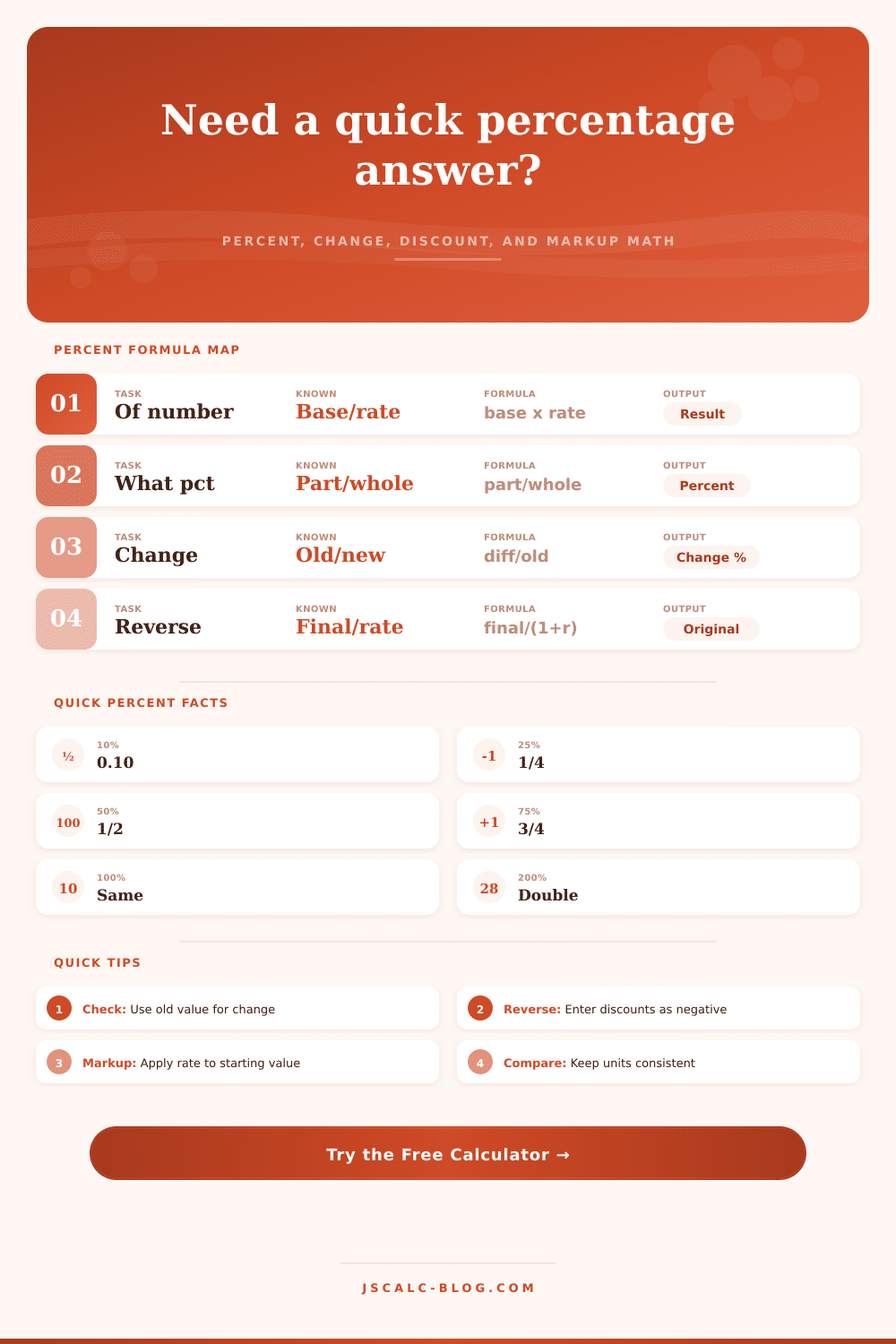
| Task | Known values | Exact formula | Answer type | Example |
|---|---|---|---|---|
| Percent of number | Base and percent rate | result = base*rate/100 | Part amount | 15% of 80 = 12 |
| X is what percent of Y | Part and whole | percent = part/whole*100 | Percent rate | 18 of 24 = 75% |
| Percent change | Old and new values | change=(new-old)/old*100 | Increase or decrease | 50 to 60 = 20% |
| Add/subtract percent | Base, rate, action | base +/- base*rate/100 | Adjusted total | 80 + 10% = 88 |
| Reverse percent | Final and signed rate | reverse=final/(1+rate) | Original base | 80 after -20% = 100 |
| Markup/discount | Starting value and rate | base*(1 +/- rate/100) | New price or value | 50 markup 40% = 70 |
| Percent | Decimal | Fraction | Per 100 | Fast mental check |
|---|---|---|---|---|
| 1% | 0.01 | 1/100 | 1 per 100 | Move decimal left twice |
| 5% | 0.05 | 1/20 | 5 per 100 | Half of 10% |
| 10% | 0.10 | 1/10 | 10 per 100 | Move decimal left once |
| 20% | 0.20 | 1/5 | 20 per 100 | Double 10% |
| 25% | 0.25 | 1/4 | 25 per 100 | Divide by 4 |
| 50% | 0.50 | 1/2 | 50 per 100 | Divide by 2 |
| 75% | 0.75 | 3/4 | 75 per 100 | Half plus quarter |
| 100% | 1.00 | 1 | 100 per 100 | Same as the whole |
| Rate | Markup multiplier | Discount multiplier | Base 100 markup | Base 100 discount |
|---|---|---|---|---|
| 5% | 1.05 | 0.95 | 105 | 95 |
| 10% | 1.10 | 0.90 | 110 | 90 |
| 15% | 1.15 | 0.85 | 115 | 85 |
| 20% | 1.20 | 0.80 | 120 | 80 |
| 25% | 1.25 | 0.75 | 125 | 75 |
| 40% | 1.40 | 0.60 | 140 | 60 |
| Old value | New value | Difference | Formula | Change result |
|---|---|---|---|---|
| 100 | 110 | +10 | (110-100)/100*100 | 10% increase |
| 100 | 90 | -10 | (90-100)/100*100 | 10% decrease |
| 80 | 100 | +20 | (100-80)/80*100 | 25% increase |
| 60 | 45 | -15 | (45-60)/60*100 | 25% decrease |
| 25 | 50 | +25 | (50-25)/25*100 | 100% increase |
| 200 | 150 | -50 | (150-200)/200*100 | 25% decrease |
I’m sure you’ve been out to dinner with your friends only to realize you don’t know how much to tip or how much each person should pay. It’s embarrassing and we all do it. Although the percentage calculator up top will crunch numbers for you, it’s equally important to grasp what trips people up about this problem.
Because most people learn fractions in school, they assume percentages is easy. Until they try using them outside of school. What people need to understand is that percentages aren’t separate pieces of a whole; they’re multipliers which change the number. This brings us to the trick: knowing what we’re realy measuring.
Why Percentages Can Be Tricky
For example, let’s say you measure in percent change. Sounds simple enough. You might realize that moving from 100 to 80 is a 25% drop, but returning to 80 is only a 20% increase. See? Base number alters everything. People make the mistake of assuming symmetry where there isn’t any. Because when you do this yourself, it’s simple to accidental choose the wrong denominator. Your brain will play tricks on you. Even though math may feel odd, use old number as your anchor and math will be honest with you.
The same principle applies based off discounts (though usually more difficult in practice, since it requires reverse thinking). For instance: when an item has been discounted thirty percent, and you’re curious what the original price was, you can’t simply add thirty percent to the sale price. Because we started with a lower number after the discount, that means adding too much. In this case, the calculator’s doing something similar: it takes a signed rate, sort of working backward through the process to figure out where it started given the final result. It seems complex, until you remember that it’s realy just some basic algebra disguised as shopping tips.
The page’s reference table presents these multipliers in plain view for anyone who wants to understand exactly how multiplying by zero point eight corresponds direct to a twenty percent discount. But then there’s the markup beast. For those new to pricing their products (small business in particular), this can get pretty hairy. Taking X% off of your selling price and adding X% on top of your cost are two very different things. A lot of people gets them confused, and wind up with slimmer-than-expected margins as a result. To avoid that expensive mistake, the tool doesn’t let you add a discount to list price or a markup to the cost; instead, you must decide exactly where to apply the rate before any calculations happen. When you’re looking to keep your business out of break-even zone and into profitability, it makes all the difference.
But beyond all math equations, it’s the deeper message of thinking proportionally: we exist in a society where everything is said in percentages, whether it’s on an election poll, an interest rate, or a nutrition label. Knowing what ten percent looks like in your head (i.e., divide by ten or move decimal point) gives you advantage of fast estimation. It lets you know when a deal is a good one without pulling out the calculator. Or sometimes even seeing if something is wrong, because you know twenty-five percent are one quarter. These are simple roots for these numbers, and mental check columns in this tool help us remember that.
At the end of the day, percentage math isn’t realy about knowing equations; it’s about recognizing the foundation from which those percentages will come. Whether you’re estimating amount of paint needed, deciding whether a stock has risen or falls, or planning to leave a tip for your server, if you can locate where that starting point lies then the rest of the equation tends to follow suit. And when it all works out just right, with no nagging question as to whether you’ve added or subtracted incorrectly, there’s nothing quite like that feeling of security, the kind of confidence that reinforces your choice. If you learn how to achieve it once, I think you’ll find it worth while.