GPA Calculator
Credit-weighted term GPA, Honors/AP weighting, cumulative projection, and required future GPA in one calculator.
Choose the policy closest to your transcript.
Transcript offices often use 2 or 3 decimals.
Use 0 if this is your first term.
Past attempted credits, not future credits.
Used for the required future GPA projection.
Credits remaining after the courses below.
| Course | Letter Grade | Credit Hours | Course Level | Include |
|---|---|---|---|---|
Formula Breakdown
| Letter | Common Percent | 4.0 Points | Plus/Minus Points |
|---|---|---|---|
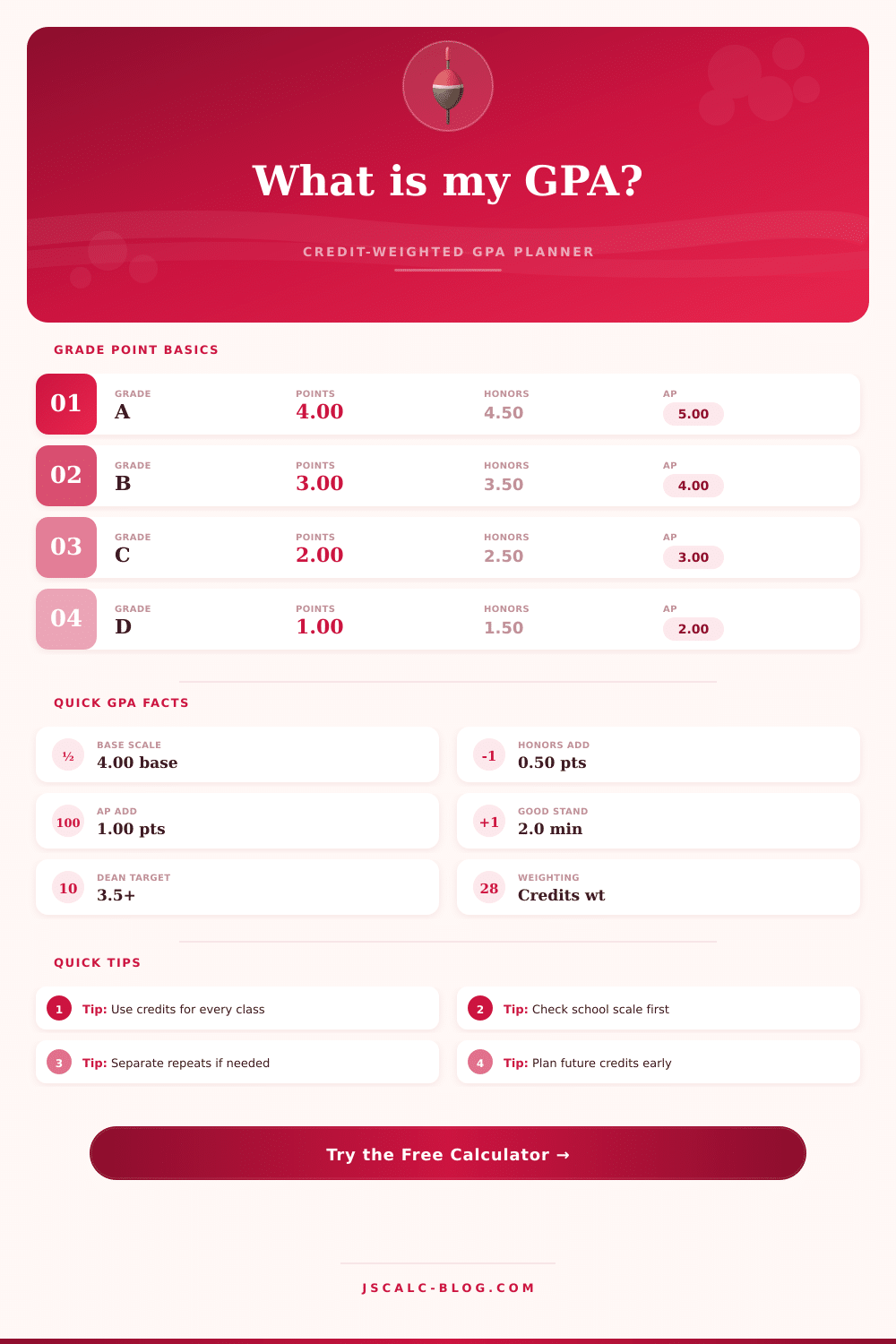
| A+ | 97-100 | 4.00 | 4.00 or 4.30 by policy |
| A | 93-96 | 4.00 | 4.00 |
| A- | 90-92 | 4.00 | 3.70 |
| B+ | 87-89 | 3.00 | 3.30 |
| B | 83-86 | 3.00 | 3.00 |
| B- | 80-82 | 3.00 | 2.70 |
| C+ | 77-79 | 2.00 | 2.30 |
| C | 73-76 | 2.00 | 2.00 |
| C- | 70-72 | 2.00 | 1.70 |
| D+ | 67-69 | 1.00 | 1.30 |
| D | 60-66 | 1.00 | 1.00 |
| F | 0-59 | 0.00 | 0.00 |
| Course Level | College 4.0 | Weighted High School | How Credits Count |
|---|---|---|---|
| Regular | No adjustment | No adjustment | Included if graded |
| Honors | No adjustment | Add 0.50 point | Credits multiply adjusted points |
| AP/IB | No adjustment | Add 1.00 point | Credits multiply adjusted points |
| Dual enrollment | Usually college scale | Policy-specific | Verify transcript treatment |
| Pass/Fail | Often excluded | Often excluded | No grade points in this calculator |
| Goal | Typical GPA | Credit Strategy | Planning Note |
|---|---|---|---|
| Good standing | 2.00+ | Protect required courses | Retakes may help where allowed |
| Major entry | 2.50-3.20 | Prioritize prerequisite credits | Some majors recalc separately |
| Dean's list | 3.50+ | Balance high-credit courses | Minimum term credits may apply |
| Scholarship | 3.00-3.75 | Track renewal threshold | Use cumulative projection early |
| Graduate school | 3.30+ | Raise upper-level grades | Last 60 credits can matter |
| Med prerequisites | 3.50+ | Separate science GPA | Labs and repeats may be reviewed |
| Scenario | Starting GPA | Past Credits | Term Credits | Term GPA | Projected GPA |
|---|---|---|---|---|---|
| First-year STEM | 0.00 | 0 | 15 | 3.43 | 3.43 |
| Dean's push | 3.34 | 45 | 15 | 3.80 | 3.46 |
| Recovery term | 2.15 | 36 | 12 | 3.20 | 2.41 |
| AP weighted | 3.72 | 18 | 7 | 4.57 | 3.96 |
| Transfer mix | 3.10 | 60 | 13 | 3.54 | 3.18 |
| Capstone term | 3.48 | 102 | 12 | 3.92 | 3.53 |
| Med prereqs | 3.42 | 54 | 16 | 3.69 | 3.48 |
| Quarter sprint | 3.00 | 90 | 12 | 3.75 | 3.09 |
Think of your GPA, then, less like a final number and more like a rate. Specificly, your average speed. Just like you don’t always have to drive at max speed when driving a car, so too shouldn’t you expect yourself to get all As throughout college. Simply ensure that you’re keeping up just enough speed so that you can arrive at the finish line (or wherever else you hope to go).
The biggest error is for most student to believe each class carries same weight. They don’t. For example, a one credit seminar will impact your GPA far less than a four-credit calculus class. I’ve seen students stress out about getting a C in a small elective while forgetting that their B in a high-credit major course are starting to slip.
How to Use a GPA Calculator Wisely
This site uses a weighted GPA calculator, which take into account credit hours when computing grades. Why does that matter? Because scholarship committees and colleges don’t just look at each transcript in isolation; they’re trying to see the bigger picture. Plug in your existing GPA and courses completed, and it will estimate where your final GPA will fall at the end of this term. Then, it estimates how high your GPA must be moving forward so you can achieve any given goal. Depending on your ambitions, that might be a scary realization, or a relief. At least now you’ll know exactly what’s mathematically feasible. You won’t wonder if one great semester will balance out a couple of poor ones.
High school students may be thrown by how weighted grades makes calculations more complicated. For example, many districts grade AP courses with a five-point A rather then a four-point A. This additional point boosts your weighted GPA above typical 4.0 cap without bringing down your overall unweighted GPA. Because admissions officers evaluate thousands of applications, they require this differentiation so they can distinguish applicants who opted for rigorous classes from those who took easy road. If you set the right scale options on the calculator, it will take these changes into account for you.
It will change how you handle your grades by letting you plan ahead. Students typically respond to their grades with an “Oh crap!” reaction once they’ve already damaged themselves. Wise planners make predictions based off their grades (by using this tool), and decide which classes to drop, or where to apply more effort… Sooner rather than later. For example, if you want a 3.5 GPA and the tool informs you that you’ll require a 4.0 from here on out, you know instantly that your plans are unrealistic. Adjust accordingly by dropping some of your lower-credit classes, or look for ways to replace grades.
While some colleges let you repeat classes so the new grade replaces the old one when calculating GPA, other institutions retains both grades. Know which category your school falls into because there’s no point hoping otherwise. However, the one thing you do have power over is credit hours. Getting As in four-credit classes nets you sixteen more quality points toward your total GPA (whereas Bs grants you only 12). Over several semesters, this makes a huge impact. Protecting your grades in high-credit classes should of been your top priority. Ace that heavy science module, don’t sweat that minor elective with a bare-A, which won’t change your grade very much. By doing this, you’ll keep your overall average steady while stumbling elsewhere.
The page also has reference tables that break down point conversions for each letter grade in each system, as well as typical GPA requirements for common educational milestones. “How high does my GPA have to be to get into grad school?”). It gives some context to your number. One person may think their 3.2 is great, while someone else might think it’s not great at all since they need a 3.6 to renew their scholarship with strict terms. Knowing this help you adjust your own effort and put things in perspective.
Your GPA is a resource problem, and it’s also about setting expectations. There is only a limited amount of energy available to you every semester. Invest that energy wisely in the “right” classes (i.e., the ones that will give you the most bang for your buck). That’s where the calculator takes away the anxiety: It puts the raw math behind what’s happening with your academics into your face. When you clearly see the numbers, then you can relax from all of the hypotheticals and focus on what actualy matters. Watch out for the credit weight, which is when the real story is told.