Concrete Slab Calculator
Estimate cubic yards, cubic feet, 40, 60, and 80 lb bags, a two-way rebar grid, and a compacted gravel sub-base for any flat rectangular slab such as a patio, driveway, shed floor, or equipment pad.
📐Real Slab Presets
📏Slab Dimensions
4 in patios – 5 in floors – 6 in driveways.
Covers spillage, uneven subgrade, and over-dig.
🔢Formula Snapshot
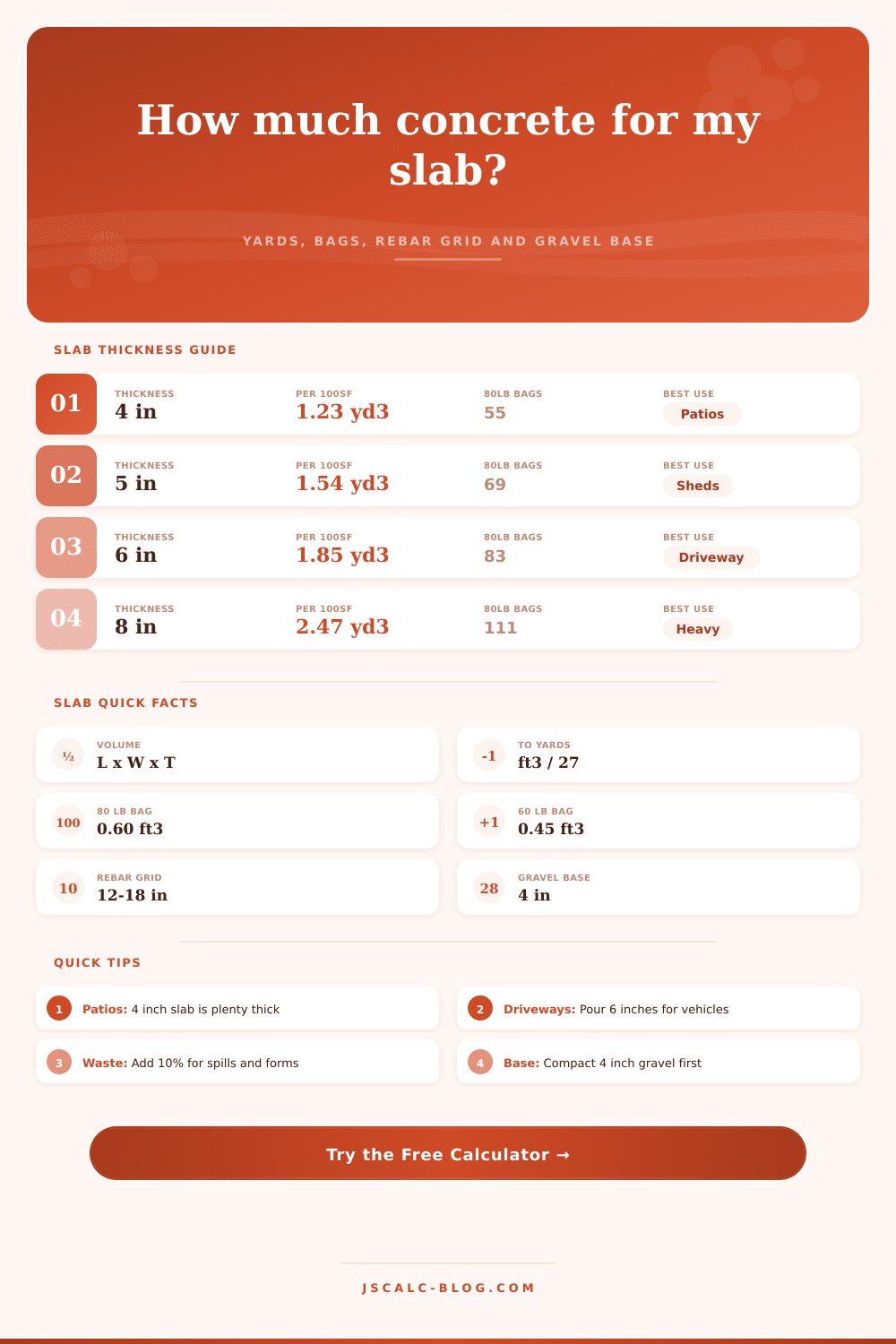
📊Thickness to Cubic Yards (per 100 sq ft)
| Thickness | ft³ / 100 sq ft | yd³ / 100 sq ft | 80 lb Bags | 60 lb Bags |
|---|---|---|---|---|
| 3 in | 25.0 ft³ | 0.93 yd³ | 42 | 56 |
| 4 in | 33.3 ft³ | 1.23 yd³ | 56 | 74 |
| 5 in | 41.7 ft³ | 1.54 yd³ | 70 | 93 |
| 6 in | 50.0 ft³ | 1.85 yd³ | 84 | 112 |
| 8 in | 66.7 ft³ | 2.47 yd³ | 112 | 149 |
🧱Slab Size Comparison Grid
| Slab Size | Thickness | Area | ft³ | yd³ | 60 lb Bags | 80 lb Bags |
|---|---|---|---|---|---|---|
| 3 × 3 ft | 4 in | 9 sq ft | 3.0 | 0.11 | 7 | 5 |
| 8 × 8 ft | 6 in | 64 sq ft | 32.0 | 1.19 | 72 | 54 |
| 10 × 12 ft | 4 in | 120 sq ft | 40.0 | 1.48 | 89 | 67 |
| 12 × 12 ft | 4 in | 144 sq ft | 48.0 | 1.78 | 107 | 80 |
| 16 × 20 ft | 5 in | 320 sq ft | 133.3 | 4.94 | 297 | 223 |
| 20 × 30 ft | 5 in | 600 sq ft | 250.0 | 9.26 | 556 | 417 |
| 24 × 24 ft | 6 in | 576 sq ft | 288.0 | 10.67 | 640 | 480 |
| 30 × 40 ft | 4 in | 1200 sq ft | 400.0 | 14.81 | 889 | 667 |
🛠Bag Yield & Rebar Spacing Guide
| Bag Size | Yield | Bags / yd³ | Mixing Water |
|---|---|---|---|
| 40 lb | 0.30 ft³ | 90 | ~3 qt |
| 50 lb | 0.375 ft³ | 72 | ~4 qt |
| 60 lb | 0.45 ft³ | 60 | ~5 qt |
| 80 lb | 0.60 ft³ | 45 | ~6 qt |
| Rebar Spacing | Grid Density | Bar Size | Typical Slab Use |
|---|---|---|---|
| 12 in O.C. | Heavy | #4 (1/2 in) | Driveways, heavy loads |
| 16 in O.C. | Medium | #4 (1/2 in) | Garage and shop floors |
| 18 in O.C. | Standard | #3 or #4 | Patios, general slabs |
| 24 in O.C. | Light | #3 (3/8 in) | Sidewalks, small pads |
📋Slab Thickness Use Cases
| Thickness | Best For | Base Depth | Reinforcement |
|---|---|---|---|
| 4 in | Patios, walkways, shed floors | 4 in gravel | Wire mesh or #3 grid |
| 5 in | Garage floors, workshop pads | 4 in gravel | #4 rebar at 16 in |
| 6 in | Driveways, RV and hot tub pads | 4 to 6 in gravel | #4 rebar at 12 in |
| 8 in | Heavy equipment, truck loads | 6 in gravel | Double #4 mat |
⚙Full Formula Breakdown
💡Practical Slab Tips
Determine the amount of concrete to purchase: You don’t want to end up with less than you need (running dry) or more than you actualy use. Generally speaking, most folks underestimates the amount of area that solid material will cover spread out as a thin layer. While a cubic yard may appear small piled up, pressed into a four-inch thick layer it will covers a surprisingly large amount of area. Volume is often what separates success from failure on these projects not skill.
It will take your measurements and tell you exactly how much concrete to order and what number bag you will have in that amount. And it factors in those sneaky variables that trip up most people such as gravel underlayment and potential rebar grid inside. Knowing how to enter this information makes all the difference.
How to Plan Your Concrete Project
And that waste allowance isn’t a buffer zone to protect yourself from miscalculations, it’s the real deal. Forms gets bulgy, concrete spills over, and I don’t care how hard you tamp the earth, it is never completely level. Ten percent for waste covers gaps you forgot to measure. It also protects against running out of concrete with two feet left on the edge.
Most projects fail due to thickness. When trying to cut costs people pour less than they should of. For example, a four inch slab is fine for a patio that gets no more than foot traffic, but if you drive your car onto it, its going to crack within a year. Six inches is what driveways require; and six inches plus some kind of reinforcement are required for hot tub pads.
By toggling through the thicknesses in the calculator, you’ll be able to see how rapidly the material requirement increase. Moving up one inch from four to six inches completely transforms structural integrity of the entire slab. It’s not just about covering something, you’re paying for durability.
Rebar is another element that feels optional until first hard freeze arrives. Input your preference into the tool depending on space between your joists or slab. Typical home slabs are 18 inches apart, which is what two-way grid is calculated for. The steel cage doesn’t strengthen the concrete in tension…it keeps the cracks in one piece as the concrete want to crack up. If there is no rebar, cracks develops from shrinkage while it cures and they’re jagged and just ugly….and will also trip you in the future.
The rebar length output gives you an exact number of how much bar stock to purchase…you don’t have to guess about how long to cut them on site. Tying the wire is tedious, but it pay off each and every time.
Don’t neglect the base: Without a solid gravel base, the concrete will float in mud when it rains and settle unevenly over time. Standard base thickness is four inches of compacted gravel to spread the weight and allow for drainage. This volume will be accounted for by calculator and you’ll know exactly how much wheelbarrow-fulls of rock to carry home before mixing your cement. Skipping the gravel base saves money today, but it means cracks tomorrow if you skip this step.
If you’re doing this by hand, the size of the bags matters. Sixty-pound bags offer a compromise for those with limited strength or smaller wheelbarrow. With 80-pound bags, you get more concrete per bag and you’ll need fewer trips from the truck to the form (which your back will thank you for). For patching jobs, we’re talking 40-pound bags here, not slabs. It figures out how many bags is required based off the amount of yield in each size. It rounds up so you don’t come up short.
The pour itself turns into a rhythm, not a crisis once the math is figured out. Use the right amount of material. Waste accounted for. The grid is tied down. The gravel is in place. Planning was first. The slab hold up. And that quiet panic recedes, leaving behind the satisfaction of knowing just what it is that you’re building.