Quadratic Equation Calculator
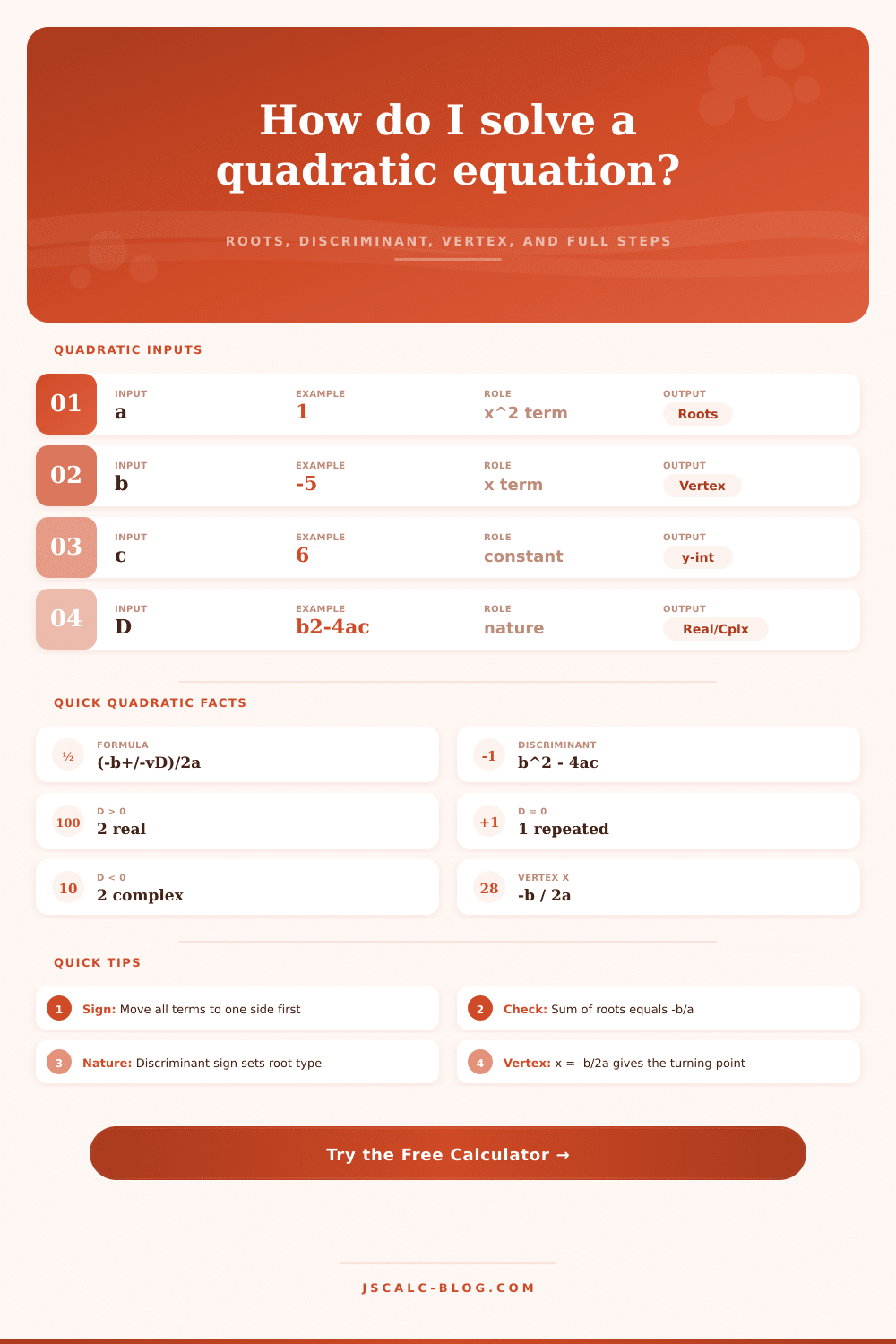
Solve any equation of the form ax² + bx + c = 0. Get the two roots (real or complex), the discriminant with its meaning, the vertex and axis of symmetry, Vieta relationships, a plotted set of points, and the full step-by-step working.
📌Worked Example Presets
🔢Coefficients and Options
1x² – 5x + 6 = 0
If a = 0 the equation is not quadratic; it is handled as linear.
🧮Parabola Snapshot
🔍Discriminant Interpretation
| Discriminant D | Number of Roots | Type of Roots | Graph Meaning |
|---|---|---|---|
| D > 0 | Two roots | Distinct real | Crosses x-axis twice |
| D = 0 | One root | Repeated real | Touches x-axis once |
| D < 0 | Two roots | Complex conjugates | Never meets x-axis |
📈Parabola Key Features
| Feature | Formula | Value | Notes |
|---|---|---|---|
| Enter coefficients above to compute the parabola features. | |||
📐Standard, Factored and Vertex Form
| Form | General Shape | Your Equation | Best Used For |
|---|---|---|---|
| The three algebraic forms of your equation appear here. | |||
📍Points To Sketch The Curve
| Point | x | y = ax² + bx + c | Position |
|---|---|---|---|
| A symmetric set of points around the vertex appears here. | |||
🗂Method Comparison Grid
| Method | Works When | Speed | Gives Complex Roots | Best For |
|---|---|---|---|---|
| Factoring | Roots are rational | Fast | No | Neat integer answers |
| Quadratic formula | Always | Medium | Yes | Any coefficients |
| Completing the square | Always | Slower | Yes | Deriving vertex form |
| Square root method | b = 0 | Very fast | Yes | ax² + c = 0 |
| Graphing | Real roots | Visual | No | Estimating and checking |
| Vieta relations | Checking | Fast | Yes | Verifying sum and product |
⚙Formula and Method Breakdown
📋Reference Values
| Symbol | Meaning | How It Is Used | Effect On Roots |
|---|---|---|---|
| a | Leading coefficient | Divides in the formula and sets 2a | Sign sets opening; scales spread |
| b | Linear coefficient | Appears as -b and in b² | Shifts the axis of symmetry |
| c | Constant term | Enters -4ac and is the y-intercept | Raises or lowers the curve |
| D | Discriminant b² - 4ac | Sits under the square root | Sign decides the root type |
| 2a | Denominator | Divides -b ± √D | Controls root magnitude |
💡Practical Solving Tips
Parabolas are everywhere, and they’re used to describe everyday scenarios. They represent how satellites dish. They track the trajectory of a tossed ball. They predict startup profit curves. The parabola is a U-shaped curve. Its equation appears straightforward (but sometimes not easy to solve for x). Fortunately, there’s a quadratic equation calculator that will do the math for you. Then it’s up to you to interpret its results in your own specific context.
The Quadratic Formula is something most of us learned in school. What we often forget is what the discriminant is for. The discriminant refers to the portion of the equation beneath the radical. In other words, it’s just “b squared minus four times a times c.” Before you even draw the curve, this piece of equation tells you how it will behave.
What Is a Quadratic Equation?
When it’s positive, parabola intersects horizontal axis twice. That indicates two distinct real solution. Zero? The curve touches the axis in exactly one place. Usually this represent maximum capacity or peak efficiency. Is it negative? The curve doesn’t touch the ground at all. Instead, you get complex roots. The calculator spits out this calculation in an instant. Knowing that sign change make numbers come to life.
Get it right, Entering your coefficients properly is essential. Your equation should of be in standard form. Make sure that everything gets moved over to one side and all terms is equal to 0. Yes, this is easy. However, people still make this mistake by not switching the sign when they move a term over the equals sign. That’s going to mess up your answer. Any real number values for a, b, and c are accepted. Negatives and decimals is also fine.
The site will break down the results with symmetry lines, vertex coordinates, and roots. If you’re trying to minimize cost or find out how much area something has, the turning point can be even more important than finding roots. Where is the extreme value? That would be at the vertex. For an upward opening parabola, this are the minimum point. For a downward-opening one, it’s the maximum point. When building bridges, engineers is interested in this. For creating buildings that stay strong, architects do as well.
The vertical line drawn through the vertex is called the axis of symmetry. It divide the curve into two mirrored pieces. If you know this, you can sketch graph pretty fast. Then you won’t have to solve out the entire equation to estimate values. Here Vieta’s formulas are used. These tell you that your two roots adds up to negative b over a. Why does this matter? This matters if you’re checking your hand calculations against your digital ones.
Students are often frightened by complex numbers. They’re simply coordinates on a different plane. When there’s a negative under the radical (a less than zero discriminant), the calculator presents them as conjugates with an imaginary number component. In an electrical engineering or physics context, that represents a phase shift or some sort of oscillation. It is not a position in space at all. You may not be able to find a crossing point on a regular graph. Yet it can model the behavior of waves, or currents in an alternating current circuit. The results pane show you the step-by-step work and how those imaginary numbers appears from the negative square root.
If you’re aiming to use it, pick a decimal approximation or an exact form. An exact form will retain enough accuracy for later algebraic manipulation. A decimal is more suitable for constructing something or measuring straight away. Some preset examples demonstrate how this works in practice. These range from simple difference-of-squares to messy projectile motion problems. These range from simple difference-of-squares to gnarly projectile motion problems. Both types transforms the parabolic curve. The constant term move the apex. The leading coefficient increases or decreases the spread.
I think solving quadratics is not so much a matter of remembering some kind of formula. It is more like understanding how to read the shape of this curve. Why do you use it? You use it to see when a ball hits ground. You can use it to calculate break-even points in your business model. The shape will tell you everything. After a while, after you figure out what the discriminant and the vertex can tell you, the arithmetic fades into the background. And you no longer see simply a collection of numbers. You begin to see the path.