Clash Royale Deck Win Rate Calculator
Turn your wins and losses into a real win rate, the games needed to reach a target rate, a net trophy estimate for the ladder, and an optional matchup-weighted expected win rate.
👑Deck Presets
📝Record And Goal Inputs
Ladder gains and losses average near 30 per game.
Shares are normalized to 100%. Expected rate = sum of share × matchup win rate.
🔢Formula Snapshot
📊Win Rate Benchmarks
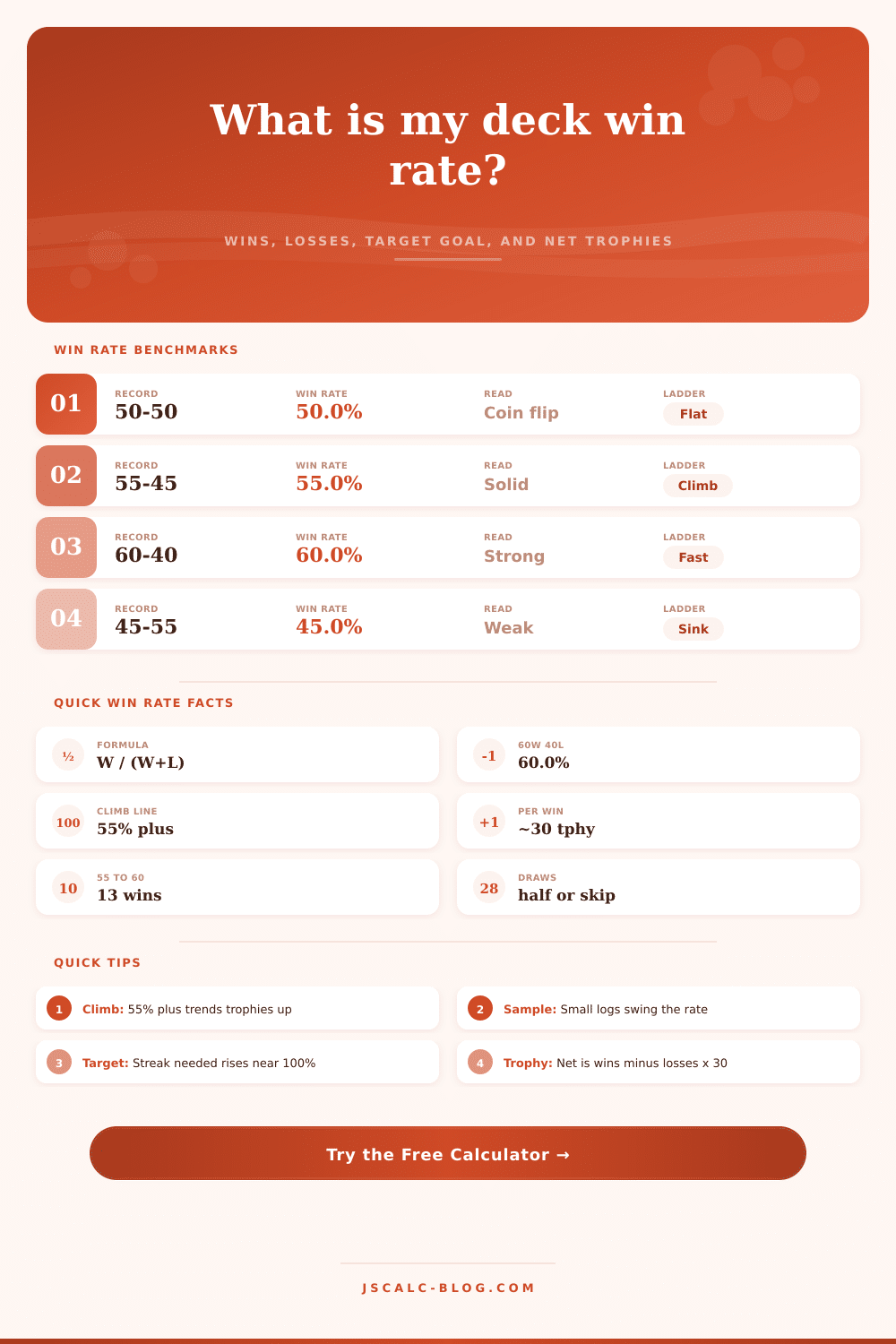
| Record | Win Rate | Read | Ladder Trend | Feel |
|---|---|---|---|---|
| 40W / 60L | 40.0% | Losing deck | Trophies sink fast | Rework or drop it |
| 45W / 55L | 45.0% | Below even | Slow bleed down | Bad matchups hurt |
| 50W / 50L | 50.0% | Coin flip | Flat, no gain | Skill decides it |
| 55W / 45L | 55.0% | Solid climb | Steady trophies up | Good ladder deck |
| 60W / 40L | 60.0% | Strong deck | Fast climb | Push while hot |
| 65W / 35L | 65.0% | Dominant | Rapid climb | Rare, ride it |
🎯Games To Reach A Target
| Current Record | Current Rate | Target | Straight Wins | New Record |
|---|---|---|---|---|
| 55W / 45L | 55.0% | 60% | 13 | 68W / 45L |
| 50W / 50L | 50.0% | 55% | 12 | 62W / 50L |
| 48W / 52L | 48.0% | 50% | 4 | 52W / 52L |
| 30W / 20L | 60.0% | 65% | 8 | 38W / 20L |
| 18W / 22L | 45.0% | 55% | 10 | 28W / 22L |
| 70W / 30L | 70.0% | 75% | 21 | 91W / 30L |
Games needed rises steeply as the target nears 100%. The math assumes you win every one of the next games.
🏆Trophy Math By Record
| Wins | Losses | Win Rate | Net Wins | Net Trophies |
|---|---|---|---|---|
| 60 | 40 | 60.0% | +20 | +600 |
| 55 | 45 | 55.0% | +10 | +300 |
| 50 | 50 | 50.0% | 0 | 0 |
| 45 | 55 | 45.0% | -10 | -300 |
| 70 | 30 | 70.0% | +40 | +1200 |
| 35 | 25 | 58.3% | +10 | +300 |
Net trophies use 30 per game. Ladder swings vary by rank, but the sign follows wins minus losses.
⚖Matchup Weighting Example
| Matchup | Field Share | Your Win Rate | Weighted Points | Note |
|---|---|---|---|---|
| Beatdown | 40% | 62% | 24.8 | Favored bracket |
| Cycle | 35% | 55% | 19.25 | Slight edge |
| Control / siege | 25% | 48% | 12.0 | Skill matchup |
| Weighted total | 100% | 56.05% | 56.05 | Expected rate |
| Flat average | even | 55.0% | 55.0 | Ignores share |
Expected win rate = sum of each field share × that matchup win rate, so common matchups count more.
⚙Full Formula Breakdown
📋Reference Values
| Item | Common Entry | How It Is Used | Ladder Effect |
|---|---|---|---|
| Sample size | 30 to 200 games | Bigger W+L, steadier rate | Trust rate over ~50 games |
| Break-even rate | 50.0% | Wins equal losses | Trophies hold flat |
| Climb line | 52% to 55% | Wins outpace losses | Slow steady trophy gain |
| Trophies per win | 25 to 32 | Scales net trophy swing | Higher rank, smaller gains |
| Draws | 0 to a few | Excluded or half a win | Little ladder impact |
💡Practical Win Rate Tips
Forty games in and your trophy count isn’t budging. You’ve been cycling cards and timing perfect elixir spends. You’ve been playing the game for hours, only to wonder where it’s all going wrong. The problem? Gut feeling is not reliable. Remember those three wins back-to-back? What about the four losses in a row that followed? Memory bias is not a good stat for Clash Royale decks. It relies on raw emotion which simply isn’t enough to tell whether your deck is dragging you down ladder or carrying you up it. Cold numbers do.
Once you enter your wins/losses into the calculator above (it will save you some integer division when you’re distracted by next match), it do all the math for you. It calculates your win rate percentage, then tells you how many games you need to win straight to reach target. It also converts that win rate into practical ladder results by estimating how many net trophy this equates to. Assuming you earn 30 trophies per game. This is important because a five percent win rate swing might sound small but it can add up to hundreds of trophies over a season.
Stop Guessing, Start Tracking Your Stats
But first you has to understand the sample size. Your first ten games will not reveal anything meaningful about the strength of your deck or yourself. It will only show that you were lucky this day. Typically it take around fifty to one-hundred games before random lag spikes, bad matchmaking, and other variance are smoothed out. Any wins make you feel dominant, any losses makes you feel punished. Instead of focusing on immediate results from the previous game, the tool can help tie those expectations to something that is actualy a true representation of your record over time.
A sixty percent win rate feels dominant and that’s where most player are trying to get. And if the meta aligns with their archetype, that’s a good thing. But if you’re playing strictly to climb ladder, winning at least half of your games is bare minimum to keep getting trophies. So if you’re on a fifty-five percent win rate, then you’re consistently picking up trophies.
Often times the difference between a deck that gets you a 60-percent win-rate versus one that gets you a 55-percent win-rate isn’t anything related to fundamental design flaws, but instead favorable matchups and quality of execution. Constantly swapping decks for the sake of chasing perfection will reset your learning curve each time you pick up new comp.
We talk about matchups too little. Maybe that high win rate is coming from a beatdown deck crushing cycle users but melting to control strategies that play perfect. To account for this, the calculator has a matchup weighted mode which shows how you do vs certain archetypes such as control or siege. It’ll break out your win percentage not into a single flat number but instead show the breakdown across various archetype types. These will reveal hidden weaknesses that a generalized win rate can hide entirely. Perhaps you’re doing okay overall but getting stomped on every ten minutes by some common strategy.
Don’t ignore draw results either, because they can play tricks with how you see handling too. You’ll have some who don’t include it at all and those who will put a half win in for it. As long as you remain consistent, either way is fine. What you should of realize is a draw is a neutral result, meaning neither player was able to break through the other one’s defenses convincingly enough. It doesn’t realy impact your trophy count much, but does gobble up your time and energy.
At the end of the day, that’s why we track this stuff, to take the emotion out of getting better. If you don’t measure things accuratly, you can’t fix them. Once you see your actual performance trend line, you’ll know if you want to grind the same deck or if you need to switch things up. Your ego might want it to say one thing but the data doesn’t lie. And that clarity is worth all the minutes you spend livig logging stats.