Centrifugal Force Calculator
Compute centrifugal force with Fc = m v squared / r = m omega squared r in newtons, then read angular velocity in rad/s, g-force in multiples of gravity, and the centrifuge relative centrifugal force RCF from your radius and RPM. Enter mass and either a linear speed, an RPM value, or an angular rate.
🎡Choose Input Mode
🎯Real Spin Scenario Presets
📝Spin Inputs
Mass of the rotating body or sample.
Converted to kilograms internally.
Distance from the spin axis to the mass.
Centrifuge rotors are usually quoted in cm.
Tangential speed of the mass along its path.
Revolutions per minute of the rotor or wheel.
Angular rate omega in radians per second.
Controls rounding on every result card.
🔢Formula Snapshot
📏Centrifugal Force Formula Variants
| Formula | When You Know | Gives | Notes |
|---|---|---|---|
| Fc = m v^2 / r | Mass, linear speed, radius | Force in newtons | Tangential speed form |
| Fc = m w^2 r | Mass, angular rate, radius | Force in newtons | Angular form, w in rad/s |
| w = 2 pi RPM / 60 | Rotation in RPM | Angular velocity rad/s | Converts RPM to omega |
| v = w r | Angular rate and radius | Linear speed m/s | Links angular and linear |
| a = v^2 / r | Speed and radius | Acceleration m/s^2 | Centripetal acceleration |
| g-force = a / 9.81 | Acceleration | Multiples of gravity | Divide by 9.81 m/s^2 |
| RCF = 1.118e-5 r RPM^2 | Radius in cm and RPM | Relative force x g | Standard centrifuge form |
🔄RPM to Angular Velocity Reference
| RPM | Revs per Second | Angular Velocity w | v at r = 0.1 m |
|---|---|---|---|
| 60 | 1.00 | 6.28 rad/s | 0.63 m/s |
| 300 | 5.00 | 31.4 rad/s | 3.14 m/s |
| 600 | 10.0 | 62.8 rad/s | 6.28 m/s |
| 1000 | 16.7 | 104.7 rad/s | 10.5 m/s |
| 3000 | 50.0 | 314.2 rad/s | 31.4 m/s |
| 6000 | 100 | 628.3 rad/s | 62.8 m/s |
| 14000 | 233 | 1466 rad/s | 146.6 m/s |
| 60000 | 1000 | 6283 rad/s | 628.3 m/s |
🏎Everyday G-Force Examples
| Scenario | Typical Radius | Speed or RPM | G-Force | What You Feel |
|---|---|---|---|---|
| Gentle highway curve | 200 m | 25 m/s | 0.32 g | Light lean sideways |
| Sharp car cornering | 25 m | 17 m/s | 1.2 g | Body pushed to door |
| Roller coaster loop | 6 m | 18 m/s | 5.5 g | Heavy, pinned down |
| Washing machine spin | 0.25 m | 1200 RPM | 402 g | Water forced out |
| Fighter jet hard turn | varies | 9 g pull | 9 g | Near g-suit limit |
| Lab centrifuge | 0.08 m | 4000 RPM | 1431 g | Pellets solids |
| Ultracentrifuge | 0.06 m | 60000 RPM | 241000 g | Separates molecules |
🧪Centrifuge RCF at Common Settings
| Rotor Radius | 1000 RPM | 3000 RPM | 6000 RPM | 10000 RPM |
|---|---|---|---|---|
| 5 cm | 56 x g | 503 x g | 2012 x g | 5590 x g |
| 8 cm | 89 x g | 805 x g | 3220 x g | 8944 x g |
| 10 cm | 112 x g | 1006 x g | 4025 x g | 11180 x g |
| 12 cm | 134 x g | 1207 x g | 4830 x g | 13416 x g |
| 15 cm | 168 x g | 1509 x g | 6037 x g | 16770 x g |
| 18 cm | 201 x g | 1811 x g | 7245 x g | 20124 x g |
🗃Spin Scenario Comparison Grid
| Scenario | Typical Radius | Speed or RPM | G-Force | Force Feel | Main Use |
|---|---|---|---|---|---|
| Playground roundabout | 1.5 m | 30 RPM | 1.5 g | Slides outward | Play and fun |
| Salad spinner | 0.1 m | 500 RPM | 28 g | Flings water | Drying greens |
| Washing machine spin | 0.25 m | 1200 RPM | 402 g | Water expelled | Removing water |
| Hammer throw | 1.7 m | 28 m/s | 47 g | Huge arm pull | Track and field |
| Angle grinder disc | 0.06 m | 11000 RPM | 8114 g | Extreme edge load | Cutting metal |
| Clinical centrifuge | 0.08 m | 4000 RPM | 1431 g | Packs pellets | Blood separation |
| Microfuge | 0.07 m | 14000 RPM | 15340 g | Hard pelleting | DNA and protein |
| Ultracentrifuge | 0.06 m | 60000 RPM | 241500 g | Molecular scale | Density gradients |
⚙Formula Breakdown
💡Practical Spin Tips
When the washing machine goes round, or car swerves out of control, you feel a push across your ribs. When something rotate, that’s called centrifugal force: it appears as if there’s an outward push. But it isn’t some magical thing, nor has anyone discovered a new kind of physics. It’s simply your own inertia fighting against changing direction as the rest of the world whirls by.
Once you know your speed, radius and mass, plugging them into calculator does the math for you. It converts complex formulas into real-world numbers. Knowing about this force will change your perspective on everything from lab instruments to a ride at the park. It’s an elegant and simple equation. But it’s also deceptively prone to misuse.
How to Calculate Centrifugal Force
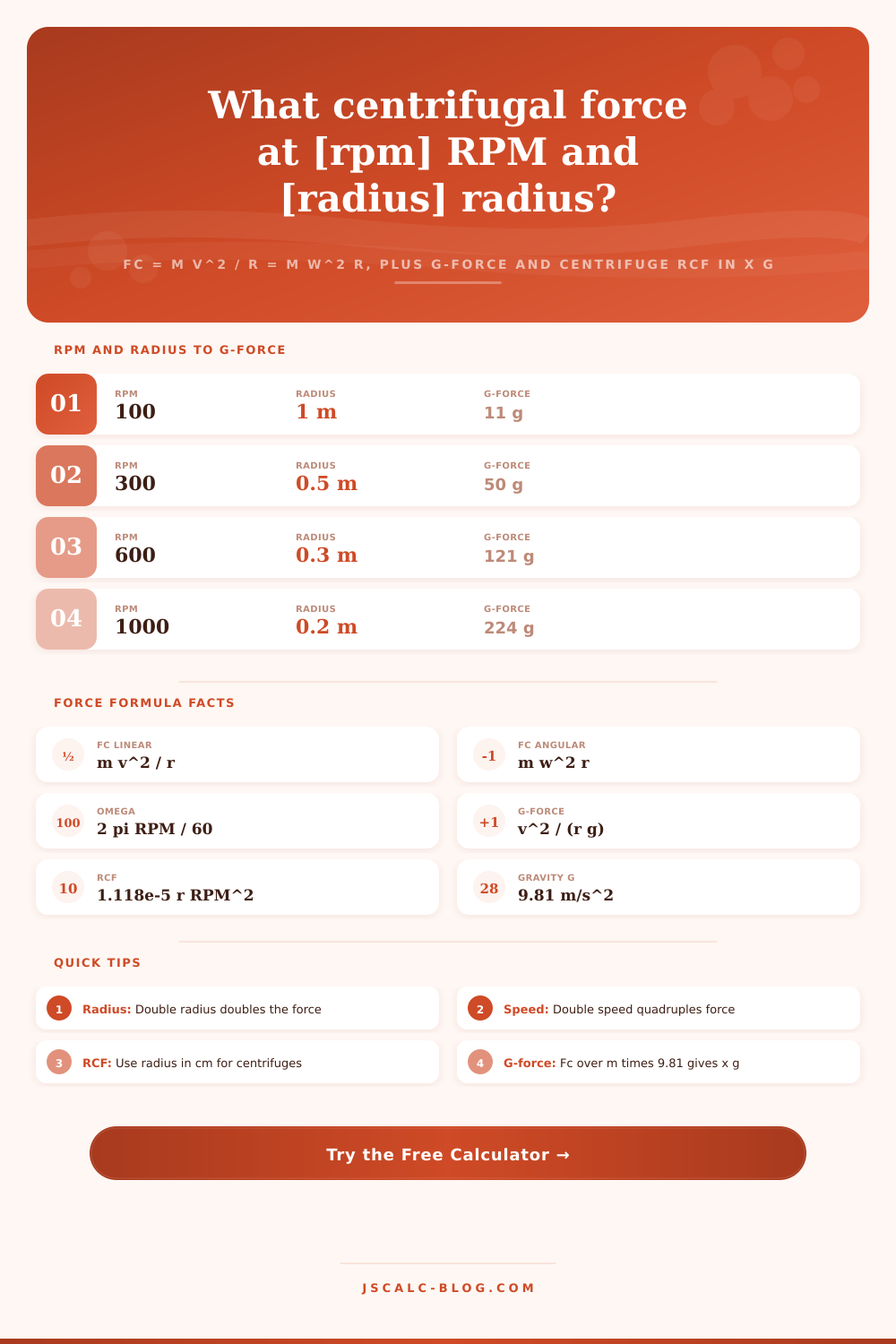
It goes like this: Centrifugal force = (mass x velocity²) ÷ radius. Or (mass x angular velocity²) x radius. Most people goes wrong at this point, with the speed squared part. Double your rate of rotation? You get four times the force. It is not linear. Moving a centrifuge from 3000 to 6,000 RPM doesn’t double stress on tubes; it increases it four-fold.
Here’s where the calculator comes in. It automaticly compensates for this. It saves you from doing any math in your head that might cost you an experiment; or even crack your instrument.
This calculation depends heavily off the radius. When you fix speed, a smaller radius translate into higher g-force. Typicaly, however, RPM are controlled by some form of rotational machinery, not linear speed. Then force increases proportionally to radius. That means a point farther out along the radius will feel more force than a point close to center, despite having equal rotational periods.
Laboratory protocols states it in terms of relative centrifugal force, or RCF, stated as multiples of gravity. Why? Because RPM alone is like giving someone driving directions but never telling them what kind of road. With this tool you can switch easily between revolutions per minute and radians per second… And know you haven’t lost touch with physical reality.
That’s an acceleration expressed as g-force. A normal earthbound weight is one g. A fighter pilot making a hard turn experience nine g, which means that blood pools out of his brain. Separating DNA requires thousands of g inside a microcentrifuge. To do so, the calculator provides two numbers: the raw force in newtons and the g-force times the value of gravity.
G-forces express the actual structural or physiological effect. Newtons indicates the absolute push. For example, knowing that a given spin applies 1400 newtons let you make engineering calculations. Knowing that it applies 1400 g tells you whether your sample will shatter its container or form a proper pellet.
But calculations are only part of it; context is important too. So the page has some reference tables for common experiences. From ultracentrifuges spinning at 60,000 RPM to gentle curving roads on highway, these compare how different things feel. They ground the numbers into something we can experience. Instead of just numbers, we begin to understand what kind of strain they mean. If your calculated g-force is somewhere between that of a washing machine drum and salad spinner, then you have an idea of the rough amount of strain you’re experiencing.
Geometry is key. Mastering centrifugation require an understanding of the forces involved. A lot is determined by speed, which multiplies stress exponentially, and radius, which spreads stress out linearly. A tool can help make translation easier. Free up your mind to consider only the question before you. Is this rotor safe? Does this protein precipitate here? Is the turn too sharp for tires to hold?
The calculation is straightforward and consistent. Now just use your best judgment to apply it to the actual situation. You should of used math that way, what goes around comes around… but doesn’t break things getting there.