CC to Horsepower Calculator
Estimate engine horsepower from displacement in cubic centimeters using rule-of-thumb cc-per-HP factors by engine type, plus liters, specific output, kilowatts, and a reverse horsepower-to-cc mode. Results are rough estimates only.
🏍Real Engine Presets
📝Engine Inputs
Total engine displacement in cubic centimeters. 1 liter = 1000 cc.
Used only when direction is horsepower to cc.
Lower factor means more power per cc. Editable for tuning.
🔢Formula Snapshot
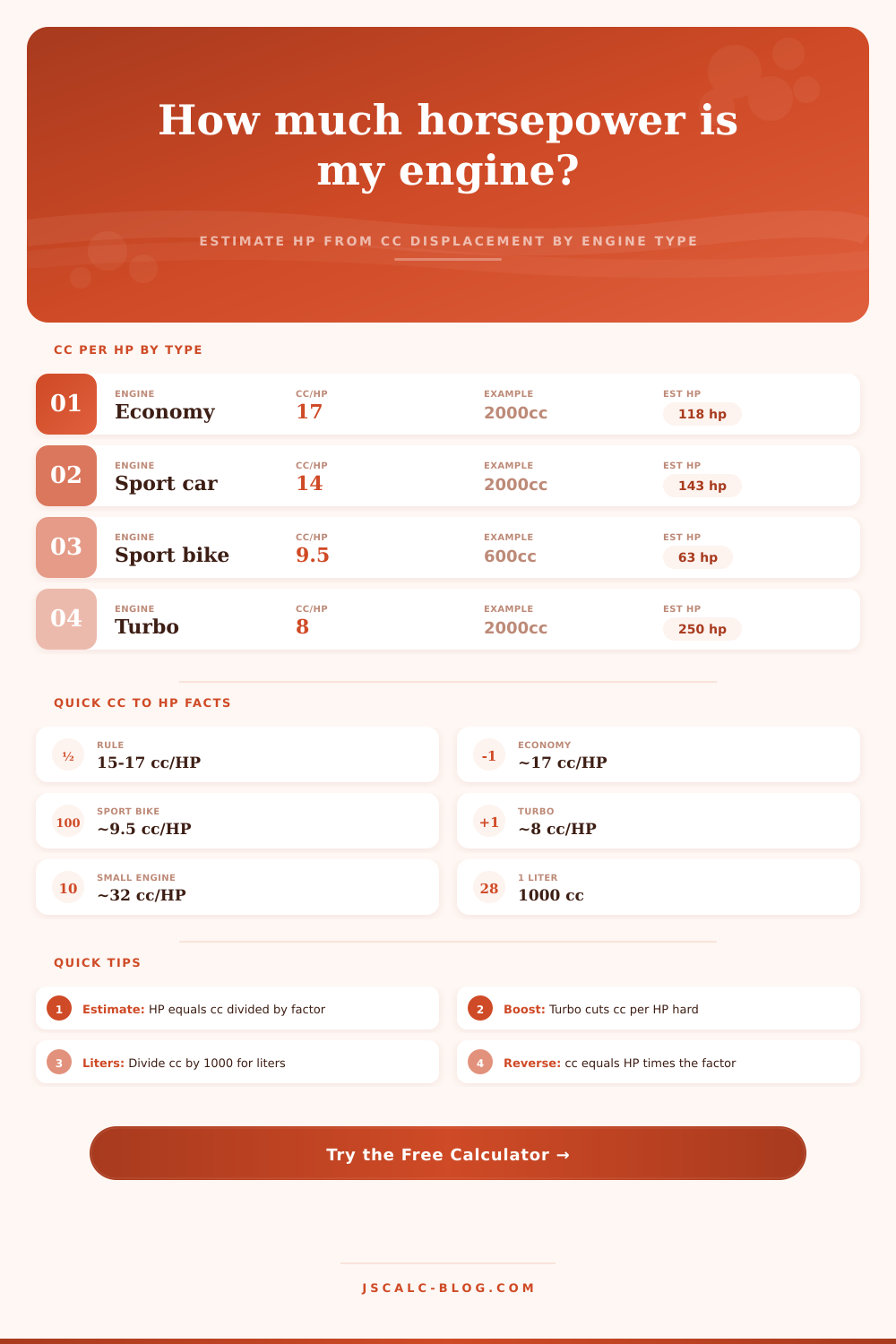
📊CC per HP by Engine Type
| Engine Type | Typical cc/HP | Specific Output | Character |
|---|---|---|---|
| Economy car (NA) | 16 – 18 | ~56 – 63 hp/L | Efficient, low stress |
| Sport / performance car | 13 – 15 | ~67 – 77 hp/L | Higher RPM, revvy |
| Motorcycle (standard) | 11 – 13 | ~77 – 91 hp/L | Light, high revving |
| Sport bike (high RPM) | 9 – 10 | ~100 – 111 hp/L | Screaming top end |
| Turbo / supercharged | 7 – 9 | ~111 – 143 hp/L | Forced induction |
| Diesel (torque focus) | 18 – 22 | ~45 – 56 hp/L | Low RPM, high torque |
| Small engine (mower/kart) | 30 – 35 | ~29 – 33 hp/L | Governed, low RPM |
🎯CC to HP Quick Reference
| Displacement | Economy 17 | Sport 14 | Sport Bike 9.5 | Turbo 8 | Small 32 |
|---|---|---|---|---|---|
| 50 cc | 3 hp | 4 hp | 5 hp | 6 hp | 2 hp |
| 125 cc | 7 hp | 9 hp | 13 hp | 16 hp | 4 hp |
| 250 cc | 15 hp | 18 hp | 26 hp | 31 hp | 8 hp |
| 600 cc | 35 hp | 43 hp | 63 hp | 75 hp | 19 hp |
| 1000 cc | 59 hp | 71 hp | 105 hp | 125 hp | 31 hp |
| 1500 cc | 88 hp | 107 hp | 158 hp | 188 hp | 47 hp |
| 2000 cc | 118 hp | 143 hp | 211 hp | 250 hp | 63 hp |
| 3000 cc | 176 hp | 214 hp | 316 hp | 375 hp | 94 hp |
| 5000 cc | 294 hp | 357 hp | 526 hp | 625 hp | 156 hp |
🔄CC to Liters Conversion
| Displacement (cc) | Liters | Cubic Inches | Common Example |
|---|---|---|---|
| 50 cc | 0.05 L | 3.1 ci | Moped, string trimmer |
| 125 cc | 0.125 L | 7.6 ci | Commuter scooter |
| 250 cc | 0.25 L | 15.3 ci | Entry motorcycle |
| 600 cc | 0.6 L | 36.6 ci | Supersport bike |
| 1000 cc | 1.0 L | 61.0 ci | Liter bike, small car |
| 1600 cc | 1.6 L | 97.6 ci | Compact economy car |
| 2000 cc | 2.0 L | 122.0 ci | Midsize sedan |
| 3500 cc | 3.5 L | 213.6 ci | V6 SUV |
| 5000 cc | 5.0 L | 305.1 ci | V8 truck / muscle |
🗂Engine Class Comparison Grid
| Class | Displacement | Cylinders | cc/HP | Est HP | Est kW |
|---|---|---|---|---|---|
| Moped / 50cc | 50 cc | 1 | 15 | 3 hp | 2 kW |
| Scooter / 125cc | 125 cc | 1 | 13 | 10 hp | 7 kW |
| Lawn mower | 190 cc | 1 | 32 | 6 hp | 4 kW |
| Go-kart (212cc) | 212 cc | 1 | 30 | 7 hp | 5 kW |
| Supersport bike | 600 cc | 4 | 9.5 | 63 hp | 47 kW |
| Liter bike | 1000 cc | 4 | 6.5 | 154 hp | 115 kW |
| Economy sedan | 1600 cc | 4 | 17 | 94 hp | 70 kW |
| Turbo hot hatch | 2000 cc | 4 | 8 | 250 hp | 186 kW |
| V6 SUV | 3500 cc | 6 | 15 | 233 hp | 174 kW |
| V8 muscle car | 5000 cc | 8 | 11 | 455 hp | 339 kW |
⚙Full Formula Breakdown
📋Reference Values
| Item | Typical Value | How It Is Used | Effect on Estimate |
|---|---|---|---|
| General rule | 15 – 17 cc/HP | Divide cc by factor | Baseline for NA car engines |
| Forced induction | 7 – 9 cc/HP | Lower factor per cc | Big jump in estimated HP |
| Diesel factor | 18 – 22 cc/HP | Higher factor per cc | Lower HP, more torque |
| Liter conversion | 1000 cc = 1 L | Divide cc by 1000 | Feeds specific output |
| HP to kW | 1 HP = 0.7457 kW | Multiply HP by 0.7457 | Metric power figure |
💡Practical Estimation Tips
That’s what you see on the sticker and think you’re good to go. For decades, we’ve thought in terms of cars. Displacement is our unit of measurement, so a two-liter feels like ‘x’ amount of power. But the world is a lot messier than the badge leads you to believe.
The truth is: Displacement represents nothing more than how much air an engine can inhale per stroke. How hard the engine blows that air out is something else entirely. And that difference between volume and velocity is the space where horsepower lives. This means a large naturally aspirated V8 could get beat by a small turbocharged block every time as long as the tune favors the latter.
Why Engine Size Does Not Mean Power
Once you choose your engine type, the calculator above does the math for you so you don’t waste time guessing whether your project is going to turn over or spin its tires. What we’re talking about here is efficiency factor, or what’s often measured in terms of cubic centimeters per horsepower. Reliable and economical cars are all about running safely and efficient; they use seventeen cubic centimeters for every horsepower.
Sports cars and performance machines can achieve much smaller tolerances with this number because their engines allows for more aggressive cam profiles and higher revolutions. Essentially, you’re getting more energy out of the exact same physical space. That’s how you have sports cars making almost forty percent more power from a two liter engine than a two liter economy sedan. It has nothing to do with the metal, only the geometry and the software.
But forced induction is different. Forced induction bypasses atmosphere. With a supercharger or turbocharger, the cylinders completes their intake stroke first. Then, forced induction pushes even more air into cylinder. Two breaths for the price of one. That’s why the cc per HP factor is knocked down to roughly eight with forced induction on the calculator. That’s an enormus gain in efficiency.
So if you’re building something and trying to figure out how much power your motor can make once a turbo is slapped on, look at that lower factor and it’ll give you a reasonable ceiling. You won’t reach those numbers without cooling and proper fueling but it shows the potential of the equipment, theoreticaly. The devil is in the details, but nothing is as different than motorcycles, where weight is enemy #1.
There’s no way a bike can lug around a large block that produces huge torque at low RPMs. Instead, they must be lightweight yet have a very high specific output. Thus, a 600cc sportsbike will make sixty HP while an equivalent-sized car engine will barely crack thirty. While the bike consumes fuel rapidly and revs higher, it trades off efficiency for instant response. Knowing this helps avoid comparing apples to oranges when discussing power between vehicle.
On the far opposite end of the range is the diesel engine, whose focus is on torque versus maximum horsepower. By running at higher compression and lower RPMs, a diesel require greater displacement for each unit of power, yet its focus lies on torque rather than peak horsepower. Also note the liters conversion in the result. Although cubic centimeters are accurate, liters are better units for comparing engines from various markets. Liter is simply 1,000 cc. Divide out your cc’s by 1000 and you have number of liters in the engine. This provides some context to engine size.
For today’s performance comparisons, specific output (horsepower per liter) is perhaps a more meaningful metric than straight displacement. Specific output indicates how hard an engine has to work to reach its rating. Higher specific output put more stress on the engine. This may make it less reliable over time unless it is built exceptionally well.
What? This is a reminder that tuning matters. Stock engines run conservatively in order to meet emission requirements and last longer than they would of otherwise. A mild tune will improve boost level and fuel timing and unlock the hidden potential of an engine. This allows you to tune for those stages and shows what it takes to increase your power by twenty-five percent with a Stage 1 modification without altering physical block. Tuning matters more than most people realize.
But don’t take any of this stuff as gospel truth. This is all average/estimate, aka rule-of-thumb stuff. Real-world performance will vary widely based off dozens of factors such as surrounding temperature, exhaust back pressure, intake flow, etc. Use the calculator to get an idea of what you’re getting into and whether or not your objectives make sense BEFORE you go dropping coin on parts.
For instance, if the numbers tell you that it’s going to require a huge engine size to achieve the HP you want naturally, perhaps it’s time to look at forced induction. Knowing how volume translates to power will save you a lot of frustration and time down the road. It will transform your hazy dreams into real engineering problems that can be addressed.