Permutation & Combination Calculator
Compute nPr and nCr with full factorial steps, decide when order matters, and compare arrangements and selections with or without repetition for lotteries, hands, lineups, passwords, and committees.
🎯Real Counting Presets
📝Counting Inputs
The size of the full set you draw from. Kept at or below 170 so factorials stay finite.
How many you pick. For selections without repetition r must be at or below n.
Choose which value the highlighted answer describes. Both are always shown.
Reusable items change permutations to n^r and combinations to C(n+r–1, r).
A hint only. It suggests nPr for ordered problems and nCr for grouped ones.
🔢Formula Snapshot
📐nPr vs nCr Formula Reference
| Count | Meaning | Formula | Order | Repetition |
|---|---|---|---|---|
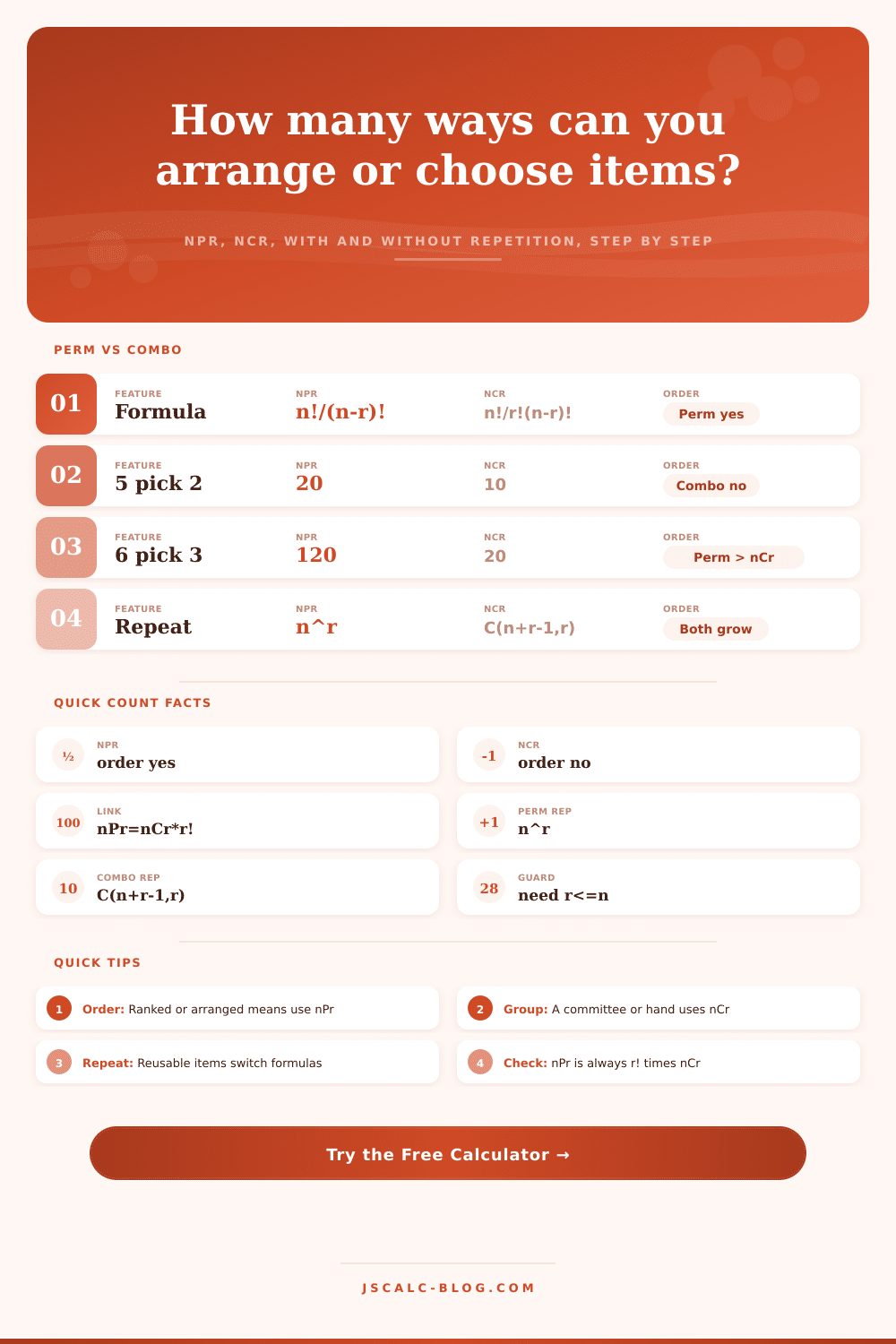
| Permutation nPr | Arrangements of r from n | n! / (n – r)! | Matters | Not allowed |
| Combination nCr | Selections of r from n | n! / (r! (n – r)!) | Ignored | Not allowed |
| Permutation with repeat | Sequences, items reusable | n ^ r | Matters | Allowed |
| Combination with repeat | Multisets, items reusable | C(n + r – 1, r) | Ignored | Allowed |
| Relationship | Link between the two | nPr = nCr × r! | r! orderings | Either mode |
| Full permutation | Arrange all n items | n! (when r = n) | Matters | Not allowed |
🧭Permutation vs Combination Decision Guide
| Question | Use This | Everyday Example | Why |
|---|---|---|---|
| Are results ranked 1st, 2nd, 3rd? | Permutation | Race podium places | Swapping places changes the outcome |
| Is it just a group with no order? | Combination | Pizza toppings chosen | Same toppings equal the same pizza |
| Do digit positions matter? | Permutation | PIN or lock code | 1234 differs from 4321 |
| Is it a hand or committee? | Combination | Poker hand dealt | Card order in hand is irrelevant |
| Are you arranging in a line? | Permutation | Seating or lineup | Position along the line counts |
| Are you drawing a subset? | Combination | Lottery number draw | Balls counted regardless of order |
📊Small Values Reference (nPr and nCr)
| n , r | n! | (n–r)! | r! | nPr | nCr |
|---|---|---|---|---|---|
| 4 , 2 | 24 | 2 | 2 | 12 | 6 |
| 5 , 2 | 120 | 6 | 2 | 20 | 10 |
| 5 , 3 | 120 | 2 | 6 | 60 | 10 |
| 6 , 3 | 720 | 6 | 6 | 120 | 20 |
| 7 , 3 | 5,040 | 24 | 6 | 210 | 35 |
| 8 , 4 | 40,320 | 24 | 24 | 1,680 | 70 |
| 10 , 4 | 3,628,800 | 720 | 24 | 5,040 | 210 |
| 10 , 5 | 3,628,800 | 120 | 120 | 30,240 | 252 |
🔁With vs Without Repetition Comparison
| n , r | Perm no repeat | Comb no repeat | Perm repeat n^r | Comb repeat | Ratio nPr/nCr |
|---|---|---|---|---|---|
| 3 , 2 | 6 | 3 | 9 | 6 | 2 |
| 4 , 2 | 12 | 6 | 16 | 10 | 2 |
| 5 , 2 | 20 | 10 | 25 | 15 | 2 |
| 5 , 3 | 60 | 10 | 125 | 35 | 6 |
| 6 , 3 | 120 | 20 | 216 | 56 | 6 |
| 6 , 4 | 360 | 15 | 1,296 | 126 | 24 |
| 8 , 3 | 336 | 56 | 512 | 120 | 6 |
| 10 , 3 | 720 | 120 | 1,000 | 220 | 6 |
⚙Full Formula Breakdown
📋Worked Scenario Reference
| Scenario | n , r | Order? | Formula Used | Result |
|---|---|---|---|---|
| Lottery 6 of 49 | 49 , 6 | No | nCr = 49! / (6! 43!) | 13,983,816 |
| Race top 3 of 8 | 8 , 3 | Yes | nPr = 8! / 5! | 336 |
| 5 card hand of 52 | 52 , 5 | No | nCr = 52! / (5! 47!) | 2,598,960 |
| 4-digit PIN | 10 , 4 | Yes | Perm repeat 10^4 | 10,000 |
| Committee 4 of 20 | 20 , 4 | No | nCr = 20! / (4! 16!) | 4,845 |
| Handshakes 12 people | 12 , 2 | No | nCr = 12! / (2! 10!) | 66 |
💡Practical Counting Tips
The more options there are for messing something up, even a seemingly simple one, the more panicky it gets. You’re standing in line at the deli, looking at twenty toppings, and wondering whether your pizza will be special or simply one more repetition of an old pairing. Or you select a set of six lottery numbers, and the pressure of millions of possibilities presses down on you. How could anything that seems so random have an answer? But it doesn’t. It’s arithmetic disguised as randomness.
Two ways of counting things, permutations and combinations; are just labels for two different ways of counting. One way counts where order is important; the other way where it’s not. Until you try to use this distinction, it sounds like mere hair-splitting. But then, suddeny, the difference between a committee and a lineup becomes the gap between success and complete confusion.
Why Order and Repetition Matter
So, let’s go back to our original question about sequence. Permutations occur when you switch something and there’s an impact on the result. On a podium at a race, bronze or gold matter greatly. When we move them around we has a different outcome. Why? This is because position itself shows value. The calculator does the math for us (above). It divides the factorial of the total by the factorial of remainder. In doing so, it removes all combinations that aren’t relevant and just leaves ordered sequences that do matter. That’s efficient. And efficiency is why it works.
Combinations throw all that out the window. You have an ace of spades paired with a king of hearts. You also have another combination, the king of hearts paired with an ace of spades. But those two poker hands are equally strong regardless of how you got them in your hand. They’re the same. We’ll divide by the factorial of whatever we select (aka how many choices there is). Permutations will account for this. They know how many duplicates there are, but dividing by this number removes them. It shrinks down a huge number of arrangements into something reasonable: a number of possible combinations. If not for that part, you’d swear there must be millions of committee you could choose from. In reality, there are just a few dozen.
Things can get reused in the real world, making things messier. Four digits can repeat themselves. That’s why we shift from factorials to just plain exponentiation, because you could have your first digit be 7 and your last digit be 7 too. Now it grows exponentially, and that’s terrifyingly fast. Adding another digit to a password doesn’t just make the possibilities ten times as many. It increases entire system by increasing the base. Toggle the repetition option on the calculator to switch it over. This lets you see how much complexity explodes when you relax constraints.
Most people trip up because instead of relying on the structure, they attempt to imagine all possibilities. That’s impossible (you can’t imagine 36 million). But you can follow the rules that create those possibilities. Change one element: does that change the outcome? Yes? Multiply. No? Divide. It is a tiny little check in your head, but it will save you hours of incorrect guesses.
On the page itself, they have the reference tables laid out for smaller groups. Even just a few items (like five or six) demonstrates just how fast things grow. These are the kinds of numbers that help you understand probability and the risk. When you know that there are almost fourteen million possibilities for pulling six numbers out of a pool of forty nine, winning a lottery feels appropriately impossible. It puts your luck into context. When you know that there are only a few thousand possible ways to create a small committee, it becomes obvious how fragile consensus can be. You just don’t have that many options.
And here’s why I love this math: It transforms chaos into structure. Because we have an unlimited number of choices in life, but nearly all of our choices adheres to those two simple rules of order and repetition. When you realize that pattern, the stress evaporates. Where there used to be a wall of options, you begin to see a grid of possibilities. And that transition from clarity to overwhelm? It has far more greater value then any one answer.