Carbon Footprint Calculator
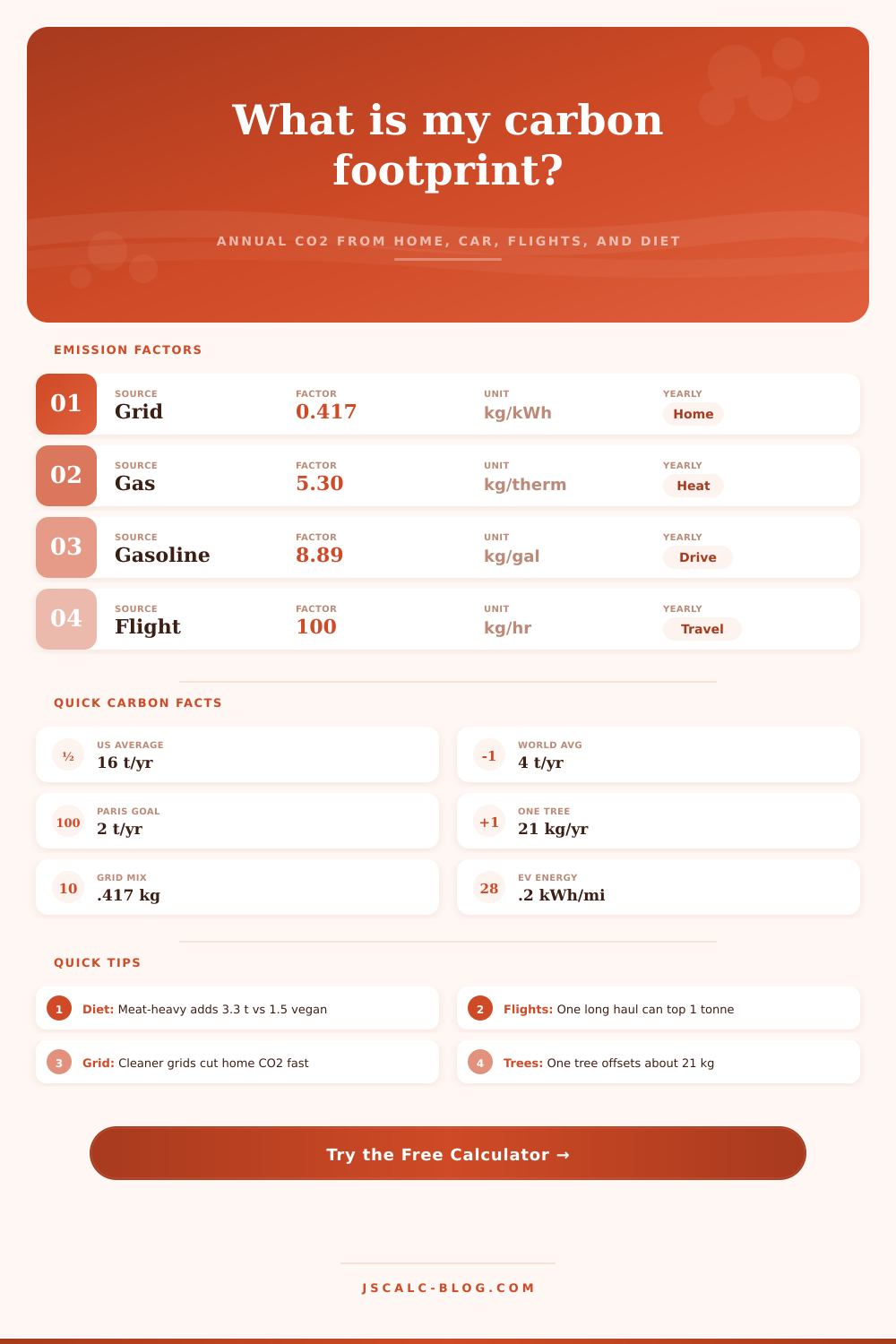
Estimate your annual CO₂ footprint from home electricity and gas, driving or an EV, short and long haul flights, and diet, then compare it against US and global per-person averages using EPA and DEFRA style emission factors.
🌍Real Lifestyle Presets
📝Your Lifestyle Inputs
US average is roughly 890 kWh per month.
Heating, hot water and cooking. Set 0 if all-electric.
Gasoline cars only. EV uses 0.20 kWh per mile.
Domestic and regional trips at about 90 kg/hr.
Intercontinental trips at about 110 kg/hr.
Home and car totals split across people for per-person view.
Applied to a 1200 kg/yr household waste baseline.
🔢Benchmark Snapshot
📊Emission Factor Reference
| Source | Factor Used | Unit | Notes |
|---|---|---|---|
| Electricity (US grid) | 0.417 | kg CO₂ per kWh | National average; varies a lot by region |
| Natural gas | 5.30 | kg CO₂ per therm | Direct combustion for heat and cooking |
| Gasoline | 8.89 | kg CO₂ per gallon | Burned per gallon of motor gasoline |
| EV electricity | 0.20 | kWh per mile | Multiplied by your grid intensity |
| Short-haul flight | 90 | kg CO₂ per hour | Domestic and regional, per passenger |
| Long-haul flight | 110 | kg CO₂ per hour | Intercontinental, per passenger |
🥗Diet Carbon Reference
| Diet Pattern | Annual CO₂ | Daily Share | Main Driver |
|---|---|---|---|
| Meat-heavy | 3300 kg | 9.0 kg/day | Beef and lamb, dairy |
| Average mixed | 2500 kg | 6.8 kg/day | Mixed meat and dairy |
| Vegetarian | 1700 kg | 4.7 kg/day | Dairy, eggs, cheese |
| Vegan | 1500 kg | 4.1 kg/day | Plant staples, imports |
🌎How You Compare
| Benchmark | Per Person | Meaning | Gap Guidance |
|---|---|---|---|
| US average | 16.0 t/yr | Typical American | Aim below this line |
| EU average | 7.0 t/yr | Typical European | Grid and transit help |
| World average | 4.0 t/yr | Global per person | Fair global share |
| Paris pathway | 2.0 t/yr | 2050 climate goal | Deep cuts needed |
| Zero direct | 0.0 t/yr | Fully offset | Offsets plus cuts |
🗂Lifestyle Comparison Grid
| Profile | Home Energy | Driving | Flights | Diet | Approx Total |
|---|---|---|---|---|---|
| Avg US household | Grid + gas | 12k mi gas | Some short | Average | ~11 t/yr |
| Eco-conscious | Green tariff | Low miles | Rare | Vegetarian | ~4 t/yr |
| Frequent flyer | Grid + gas | 10k mi gas | Heavy long | Average | ~16 t/yr |
| Car commuter | Grid + gas | 20k mi gas | Little | Meat-heavy | ~14 t/yr |
| EV owner | Cleaner grid | 12k mi EV | Some short | Average | ~7 t/yr |
| Apartment dweller | Grid only | No car | Some short | Vegetarian | ~4 t/yr |
⚙Full Formula Breakdown
📋Reduction Reference
| Action | Typical Cut | Why It Works | Effort |
|---|---|---|---|
| Switch to green tariff | 1 to 3 t/yr | Grid factor falls toward zero | Low, one signup |
| Drive an EV | 2 to 4 t/yr | No gasoline, uses clean grid | High, new car |
| Cut one long flight | 1 to 2 t/yr | Long haul is very intense | Medium, plan trips |
| Shift to vegetarian | ~0.8 t/yr | Less beef, lamb and dairy | Medium, habit |
| Improve home heating | 0.5 to 1 t/yr | Fewer therms of gas burned | Medium, upgrades |
| Recycle and compost | ~0.3 t/yr | Less landfill methane | Low, daily habit |
💡Practical Carbon Tips
In reality, you don’t need to think about your carbon footprint as an amorphous state of mind, it’s really a collection of very concrete actions: your diet, the miles you drive in gas cars, and amount of electricity you burn at home. The secret to not being powerless is knowing which one of those things will make your number go down.
Your biggest source of emissions will generaly be electricity/heat. You enter your kilowatt-hours and therms per month into calculator. The important factor here is what you call “grid mix.” If your region use mostly hydro or wind, that household have far lower emissions than someone on a coal-heavy system. That’s why two similarly-sized houses might end up with very different footprints. Improving insulation or switching to a green tariff tackles this major chunk right at the root, which is usually better then chasing after those little symbolic things. Scale has power.
How to Lower Your Carbon Footprint
The next topic is driving. How much you save here isn’t as dependent on the type of vehicle as you might think. Because an electric car uses electricity from the very same electrical grid that powers your house, it’s only as clean as the grid in your neighborhood. To account for that, the calculator factors in how intense your local grid is when accounting for your miles driven. For gas-powered vehicles, the math rely on fuel economy and gallons burned. Frequent fliers may find their yearly driving savings from swapping to an electric vehicle wiped out with just one long-distance flight. That’s the catch no one calculates until it all adds up.
Discussions around diets can be contentious, but thankfully there is numbers to keep us mostly down-to-earth. Animal products in general emit about twice as much than plant-based foods, especially lamb and beef. But even if you follow a mixed diet (not a strict vegetarian), that diet still produces far greater amounts than vegan ones. That said, it’s based off yearly averages, so you’ll at least get a feel for how much food adds up to your total. Awareness is what matters here, not perfection.
And then there’s waste behavior, which also makes a small but significant dent: How much do you recycle? Compost? The tool starts with a base level of waste and tacks on or subtracts accordingly. Sending organic materials to landfills generates methane, an extremely powerful greenhouse gas, which means they should be diverted. That, added to home energy conservation, is a double whammy, more difficult to accomplish from one direction alone. Again, you’re after the handful of modifications that will reduce the biggest amount of carbon per hour invested.
It provides you with a tonnage number, but in what context? There’s no point comparing your answer to some random number on the internet; you should compare it to something meaningful: the world average, or target set by the Paris Agreement. Unless you’re a typical American, you’ll find out that you’re emitting way above the world average, and there are ways to fix this. This isn’t about reaching zero immediately. It is about getting a clear idea of where you stand so you can focus your efforts on one specific area and know what it is. You wouldn’t of guess.
To reduce your impact, begin by taking off the blinders. Every decision has an unseen cost to the planet, whether it’s eating out, flying somewhere, heating your house. It never appears on the check. And when we see these numbers in front of us, we can make choices informed by fact instead of fear. Reducing your impact isn’t as much about depriving yourself; it’s about making decisions about priorities. What do you want to hold onto? What are you willing to let go so you can have a cleaner future? You choose.