Brick Quantity Calculator
Turn wall area into a total brick count for one or many identical walls. Pick a brick size and bond, add the mortar joint, choose single or double wythe, then apply a waste allowance for breakage.
📏Unit System
Switching units converts your wall length, wall height, and mortar joint automatically.
🧱Wall Quantity Presets
📝Wall & Brick Inputs
Default 3/8 in imperial or 10 mm metric.
Covers breakage, cuts, and mismatched bricks.
🔢Count Formula Snapshot
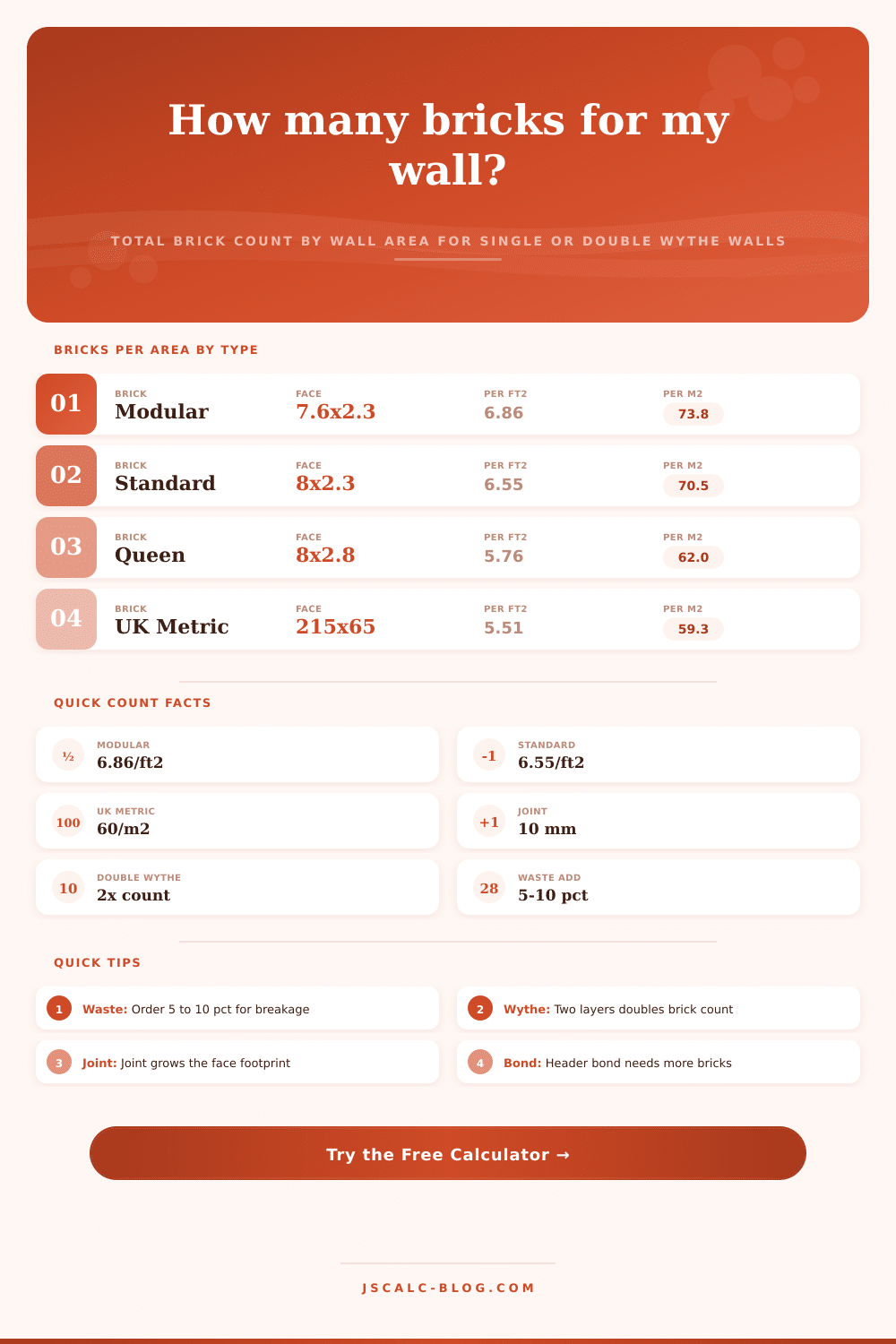
🧱Bricks Per Area By Brick Type
| Brick Type | Face L × H | Face + 3/8 in Joint | Bricks / ft² | Bricks / m² |
|---|---|---|---|---|
| Modular | 7.625 × 2.25 in | 8.0 × 2.625 in | 6.86 | 73.8 |
| Standard | 8 × 2.25 in | 8.375 × 2.625 in | 6.55 | 70.5 |
| Queen | 8 × 2.75 in | 8.375 × 3.125 in | 5.50 | 59.2 |
| UK Metric | 215 × 65 mm | 225 × 75 mm | 5.51 | 59.3 |
| Engineering | 215 × 65 mm | 225 × 75 mm | 5.51 | 59.3 |
Values are single wythe, stretcher bond, with a 3/8 in (10 mm) mortar joint. Metric bricks use per m²; US modular is the familiar 6.86 per ft² standard.
📐Wall Area To Modular Bricks
| Wall Area | Single Wythe | +8% Waste | Double Wythe | Double +8% |
|---|---|---|---|---|
| 50 ft² | 343 | 371 | 686 | 741 |
| 100 ft² | 686 | 741 | 1,372 | 1,482 |
| 160 ft² | 1,098 | 1,186 | 2,195 | 2,371 |
| 250 ft² | 1,715 | 1,853 | 3,429 | 3,704 |
| 400 ft² | 2,743 | 2,963 | 5,486 | 5,925 |
| 600 ft² | 4,115 | 4,444 | 8,229 | 8,888 |
Based on 6.86 modular bricks per ft². Double wythe simply doubles the count for two brick layers.
🗂Brick Type Comparison Grid
| Brick Type | Face Size | Bricks / ft² | Bricks / m² | Per 100 ft² | Per 10 m² |
|---|---|---|---|---|---|
| Modular | 7.625 × 2.25 in | 6.86 | 73.8 | 686 | 738 |
| Standard | 8 × 2.25 in | 6.55 | 70.5 | 655 | 705 |
| Queen | 8 × 2.75 in | 5.50 | 59.2 | 550 | 592 |
| UK Metric | 215 × 65 mm | 5.51 | 59.3 | 551 | 593 |
| Engineering | 215 × 65 mm | 5.51 | 59.3 | 551 | 593 |
🧰Single Vs Double Wythe
| Wall Thickness | Layers | Multiplier | Typical Use |
|---|---|---|---|
| Single wythe (half brick) | 1 | ×1 | Veneers, planters, non-load |
| Double wythe (one brick) | 2 | ×2 | Boundary and garden walls |
| Triple wythe (heavy) | 3 | ×3 | Piers, retaining, tall walls |
Wythe count is the biggest lever on brick quantity: a double-wythe wall needs twice the bricks of a single-wythe wall of the same face area.
⚙Full Count Breakdown
💡Practical Brick Quantity Tips
Here’s what happens: You imagine a solid brick wall in your head, then find yourself standing in front of an empty swath of land. Seems doable, right? Then you start thinking about supply logistics: If you order to few, you’ll be interrupted part-way through building and have a half-completed eyesore left out in the rain, mocking you. Order too many, and you’ve got some serious, money-wasting, back-straining excess bricks on your hands.
The answer to whether it succeeds or fails is often as simple as knowing square footage before buying a single brick. To get the wallpaper amount, just multiply your height by your width. Masonry is far too granular. Because it’s not all solid brick, mortar joints between bricks takes up more surface space than you might think. Every 3/8 inch joint (a typical size) will add up fast across a big surface.
How to Count Bricks Correctly
The calculator above adjusts for that; it calculates the true footprint of each individual brick, factoring in the width of the joint on both sides (so it’s added to both the height and length). This slight tweak ensures it doesn’t make the most common mistake: undercounting. It is simply a change in the shape of the bricks. Standard bricks are longer; modular ones are shorter and also squattier (requiring more bricks per given square foot). Queen bricks is taller, so they require fewer rows to reach the top mortar line. A header bond exposes a narrower strip than a stretcher bond, while the opposite is true of width… So that changes the math dramaticly.
Complex patterns mix these up (e.g., English or Flemish bonds), resulting in more bricks per unit area but great visual interest. With complex patterns, you’re paying for beauty in added bricks. And then there’s wall thickness. Obviously, some walls are meant to only be one layer thick (a “single” brick-thick), like a screen wall or a planter around the garden. But more often, especially when considering something like a retaining structure or a true boundary wall, a wall must be double wythe: two complete bricks, plus ties between them. That makes your brick purchase literal twice as large overnight. Before you ever get to price, you’ll have a huge swing factor at the supplier’s counter, based simply on how much looks versus strength you require.
No one puts up a flawless wall. You’ve got to cut bricks to fit corners and work them around pipes. Some gets crushed under foot and others may have chipped in transit. For any serious endeavor, there’s no getting around including a waste percentage as part of your plan. Five to 10 percent is a normal allowance for breakage and those rare occasions where you end up with an unmatched brick or two to discard. Going without it is the surest road to running short on a Saturday afternoon when every supplier within reach is closed. The tool will include this buffer into the total and clearly show you what your actual rather than theoretical requirement is for excess inventory.
Quantity isn’t all there is to purchasing brick, you must take into account not only how many you’ll purchase but how consistent the batch and colour variation of those bricks may be. There can be subtle variations in color between each run of the kiln, which becomes apparent when laying the bricks alongside one another. This makes it worthwhile to order a little extra from the same batch, although you’re likely to have a few left over as a result.
Also, take into account their placement: do you want light or thin coloured bricks for your decorative facade? Or would you prefer strong engineering bricks for the foundations, which can withstand load and moisture? If mixing types, plan carefuly to prevent any weak spots in the structure. A word about mortar: Just like with brick, the type of mortar used is important. It needs to be consistent with the brick’s porosity, otherwise moisture can become trapped within the brick body and freeze, damaging it over time. For new buildings, a stiff cement mortar creates a strong bond; for older ones, softer lime mortars are flexible and gentle on aged masonry. Get the chemical formula correct, and your walls will last decades without spalling or cracking.
You can spend less money buying cheap materials today. Sure. But when that bond gives out, you’ll pay extra big-time in repair costs, sooner then you think. Finally, precision is your friend when it comes to masonry. It’s always better to measure twice and calculate once. Accounting for things like waste factor, bonds, and joints helps us move from guesswork to a real plan. And that makes us confident, which lets us concentrate on actualy building the wall instead of stressing out about if there is enough left over for tomorrow. Plan well ahead of when you put the first brick down, because a well built wall begins with a well thought-out plan that ensures every unit has its place in the final structure.