Brick Per Square Foot Calculator
Find the brick coverage density from the exposed face length, face height, and mortar joint. The headline result is bricks per square foot, with bricks per square meter, face area, and a wall total for any area you enter.
🧱Brick Type Presets
📐Brick Face & Joint Inputs
Density uses the two face dimensions you enter below.
Added once to length and once to height (one bed + one head joint per brick).
Optional net wall area after subtracting openings.
🔢Density Formula Snapshot
📊Brick Size To Density Lookup
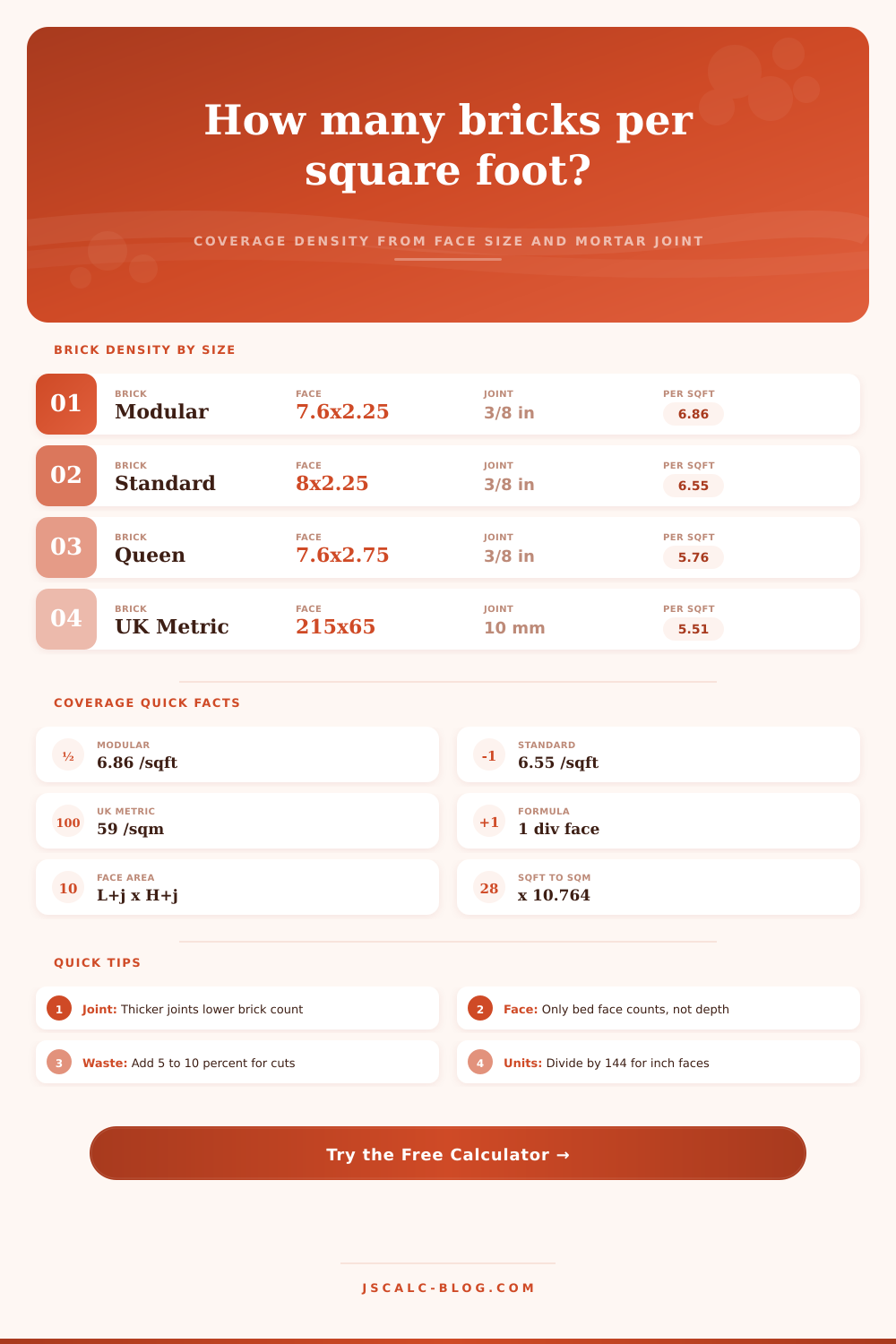
| Brick Type | Face L × H | Joint | Face Area (sqft) | Per SqFt | Per SqM |
|---|---|---|---|---|---|
| US Modular | 7.625 × 2.25 in | 3/8 in | 0.1458 | 6.86 | 73.8 |
| Standard | 8 × 2.25 in | 3/8 in | 0.1527 | 6.55 | 70.5 |
| Queen | 7.625 × 2.75 in | 3/8 in | 0.1736 | 5.76 | 62.0 |
| King | 9.625 × 2.625 in | 3/8 in | 0.2083 | 4.80 | 51.7 |
| Jumbo / Engineer | 7.625 × 2.75 in | 1/2 in | 0.1834 | 5.45 | 58.7 |
| Utility | 11.625 × 3.625 in | 3/8 in | 0.3333 | 3.00 | 32.3 |
| Roman (thin) | 11.625 × 1.625 in | 3/8 in | 0.1667 | 6.00 | 64.6 |
| Norman | 11.625 × 2.25 in | 3/8 in | 0.2188 | 4.57 | 49.2 |
| UK Metric | 215 × 65 mm | 10 mm | 0.1816 | 5.51 | 59.3 |
| Indian Modular | 230 × 76 mm | 10 mm | 0.2222 | 4.50 | 48.4 |
🔗Joint Thickness Effect On Density
| Joint | Modular Per SqFt | Standard Per SqFt | Modular Per SqM | Change vs 3/8 in |
|---|---|---|---|---|
| 0 in (no joint) | 8.39 | 8.00 | 90.3 | +22.4% |
| 1/4 in (6 mm) | 7.31 | 6.98 | 78.7 | +6.7% |
| 3/8 in (10 mm) | 6.86 | 6.55 | 73.8 | baseline |
| 1/2 in (13 mm) | 6.44 | 6.16 | 69.4 | –6.0% |
| 5/8 in (16 mm) | 6.07 | 5.81 | 65.3 | –11.5% |
| 3/4 in (19 mm) | 5.73 | 5.49 | 61.7 | –16.4% |
🧮Per SqFt To Wall Total (Modular 6.86)
| Wall Area | Bare Count | +5% Waste | +10% Waste | Per SqM Basis |
|---|---|---|---|---|
| 25 sq ft | 172 | 180 | 189 | 2.3 sqm |
| 50 sq ft | 343 | 360 | 377 | 4.6 sqm |
| 100 sq ft | 686 | 720 | 754 | 9.3 sqm |
| 200 sq ft | 1,372 | 1,441 | 1,509 | 18.6 sqm |
| 400 sq ft | 2,743 | 2,880 | 3,017 | 37.2 sqm |
| 1,000 sq ft | 6,857 | 7,200 | 7,543 | 92.9 sqm |
🗂Brick Coverage Comparison Grid
| Brick Type | Face Size | Joint | Per SqFt | Per SqM | Per 100 SqFt |
|---|---|---|---|---|---|
| US Modular | 7.625 × 2.25 in | 3/8 in | 6.86 | 73.8 | 686 |
| Standard | 8 × 2.25 in | 3/8 in | 6.55 | 70.5 | 655 |
| Queen | 7.625 × 2.75 in | 3/8 in | 5.76 | 62.0 | 576 |
| King | 9.625 × 2.625 in | 3/8 in | 4.80 | 51.7 | 480 |
| Jumbo | 7.625 × 2.75 in | 1/2 in | 5.45 | 58.7 | 545 |
| Utility | 11.625 × 3.625 in | 3/8 in | 3.00 | 32.3 | 300 |
| Roman | 11.625 × 1.625 in | 3/8 in | 6.00 | 64.6 | 600 |
| Norman | 11.625 × 2.25 in | 3/8 in | 4.57 | 49.2 | 457 |
| UK Metric | 215 × 65 mm | 10 mm | 5.51 | 59.3 | 551 |
⚙Full Density Formula Breakdown
📋Reference Face Dimensions
| Brick | Nominal Face | Actual Face | Typical Joint | Region |
|---|---|---|---|---|
| Modular | 8 × 2 2/3 in | 7.625 × 2.25 in | 3/8 in | USA |
| Standard | 8 × 2 2/3 in | 8 × 2.25 in | 3/8 in | USA |
| Queen | 8 × 3 in | 7.625 × 2.75 in | 3/8 in | USA |
| King | 9 5/8 × 2 5/8 in | 9.625 × 2.625 in | 3/8 in | USA |
| UK Metric | 225 × 75 mm | 215 × 65 mm | 10 mm | UK / EU |
| Indian Modular | 200 × 100 mm | 230 × 76 mm | 10 mm | India |
💡Coverage Density Tips
Accurate Brick Counts are Essential to Avoid Expensive Project Mistakes
Guesswork always result in too many or not enough bricks. Whether you are short by two hundred units or have three hundred extras, the sting hit when materials sit idle. Knowing how dense a surface will cover save you money. It’s not about faces but about knowing coverage density.
Why Accurate Brick Counts Matter
The calculator above do the work for you after you input your own dimensions. No more wasting time converting and figuring out coefficients.
Brick size isn’t the only factor; in fact it’s more about mortar joint size. Everyone forget to remember that brick itself doesn’t use all of the space; there’s also the mortar between them. The larger the mortar joint, the less dense the bricks is per square foot. Switching from three-eighths inch to half-inch joint will greatly impact number of bricks required per given wall area.
Face orientation counts as well. Because one side is completely different than the other it allows the tool to select from either a soldier or stretcher bond. Soldier means narrow end is exposed, and stretcher means long side is exposed. It also impacts amount of coverage each unit provide. No worries; the calculator accounts for that. Your count will reflect the way you intend to lay them out.
When you know how it affects your needs, you can order without making mistakes. Finally, there’s waste: Builders tend not to count waste until they realize they’re screwed (see: bricks, wasted). A five to ten percent buffer is a good idea just in case. This allowance means you won’t run out of anything and you’ll know what your final number will be. You don’t need to plan with a perfect grid anymore as you can just account for actual construction mayhem.
Brick sizes are historical standards based off practical factors like transport logistics and the span of a human hand. For example, in the United States, modular bricks was adopted as a good fit for stacking in wooden boxes. This is why some of those densities will seem familiar when you know their history. If you compare them all on the page, there’s a reference table showing standard types. Sometimes you can see that a king size brick will save almost half the number of pieces compared to modular ones. This means fewer lines and joints for cleaner appearance, but it is more expensive per piece.
Context brings it all together. Knowing why a thicker joint means less density helps turn an estimate from guesswork to a plan of action. Deciding on a wider joint makes sense when wanting more leeway for correct alignment, it’ll take longer, but the mason have space for that. Numbers don’t mean anything unless you know what they mean.
Counting correctly saves time and money Counting correctly safeguards your schedule and budget. It also avoids any surprises of running out of materials mid-project or having to store more than you need. You should of planned better. So, take measurements and use a common sense waste factor. Not only will it save you money but will make your wall look even better.
Counting correctly on day one guarantees that there is no shortage of materials and no extra clutter around when you’re done with the project, finishing exactly how you imagined.
Moddern bricks can be tricky. You might recieve more than expected if you dont check the density naturaly. It’s a luxurius feeling to have everythings perfect.