Brick Coverage Calculator
Convert a brick count into the square footage it covers, or turn a wall area into the bricks you need. Uses face size, mortar joint, waste, and the coverage factor in bricks per square foot.
🧱Real Coverage Presets
📝Coverage Inputs
Used only when brick face size is set to custom.
Face height is the exposed course height, not depth.
Used when area method is length × height.
Applied to bricks needed in area mode. Covers cuts and breakage.
Around 7 bags of mix per 1000 standard bricks at a 3/8 inch joint.
🔢Coverage Factor Snapshot
📊Brick Size To Coverage
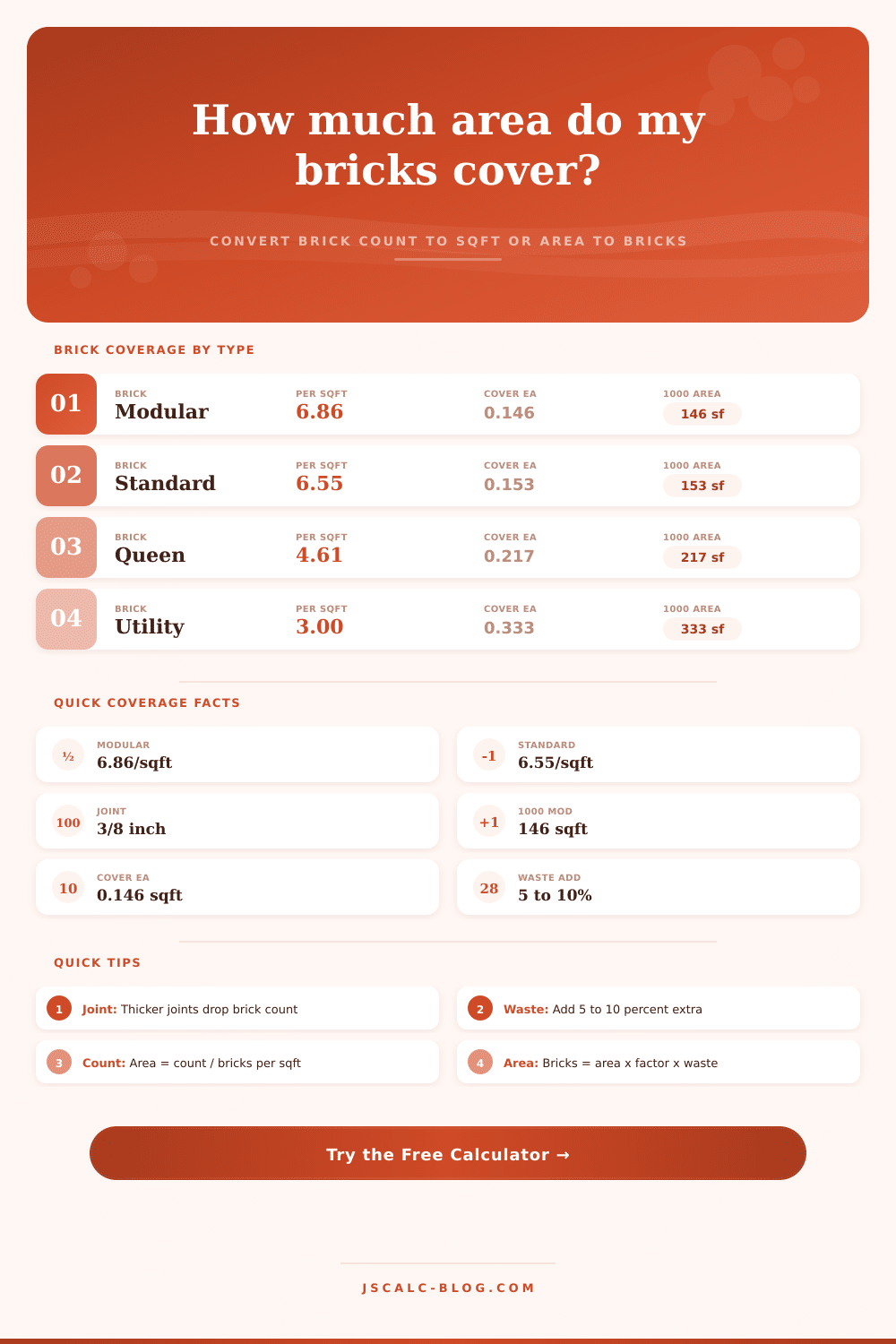
| Brick Type | Face (in) | Bricks / Sqft | Coverage Each | Area Of 1000 |
|---|---|---|---|---|
| Modular | 7.625 × 2.25 | 6.86 | 0.146 sqft | 146 sqft |
| Standard | 8 × 2.25 | 6.55 | 0.153 sqft | 153 sqft |
| Queen | 9.625 × 2.75 | 4.61 | 0.217 sqft | 217 sqft |
| King | 9.625 × 2.625 | 4.80 | 0.208 sqft | 208 sqft |
| Roman | 11.625 × 1.625 | 6.00 | 0.167 sqft | 167 sqft |
| Norman | 11.625 × 2.25 | 4.57 | 0.219 sqft | 219 sqft |
| Utility | 11.625 × 3.625 | 3.00 | 0.333 sqft | 333 sqft |
| Economy | 7.625 × 3.625 | 4.50 | 0.222 sqft | 222 sqft |
🧮Count To Area (Modular, 3/8 Joint)
| Brick Count | Area Covered | Wall Length At 8 ft | Typical Use |
|---|---|---|---|
| 100 bricks | 14.6 sqft | 1.8 ft run | Small repair patch |
| 250 bricks | 36.5 sqft | 4.6 ft run | Planter or step |
| 500 bricks | 72.9 sqft | 9.1 ft run | Half pallet accent |
| 750 bricks | 109.4 sqft | 13.7 ft run | Garden wall section |
| 1000 bricks | 145.8 sqft | 18.2 ft run | Single pallet load |
| 1500 bricks | 218.8 sqft | 27.3 ft run | Large feature wall |
| 2000 bricks | 291.7 sqft | 36.5 ft run | Full facade side |
📐Area To Bricks (Modular, 10% Waste)
| Wall Area | Bricks Needed | With Mortar Bags | Scale |
|---|---|---|---|
| 25 sqft | 189 bricks | 2 bags | Backsplash |
| 50 sqft | 378 bricks | 3 bags | Chimney face |
| 100 sqft | 755 bricks | 6 bags | Small wall |
| 150 sqft | 1132 bricks | 8 bags | Accent facade |
| 200 sqft | 1509 bricks | 11 bags | Large wall |
| 300 sqft | 2263 bricks | 16 bags | Garage side |
| 500 sqft | 3772 bricks | 27 bags | House facade |
🗂Coverage Comparison Grid
| Brick Type | Bricks / Sqft | Coverage Each | Area Of 500 | Area Of 1000 | Mortar / 1000 |
|---|---|---|---|---|---|
| Modular | 6.86 | 0.146 sqft | 73 sqft | 146 sqft | 7 bags |
| Standard | 6.55 | 0.153 sqft | 76 sqft | 153 sqft | 7 bags |
| Queen | 4.61 | 0.217 sqft | 109 sqft | 217 sqft | 6 bags |
| King | 4.80 | 0.208 sqft | 104 sqft | 208 sqft | 6 bags |
| Roman | 6.00 | 0.167 sqft | 83 sqft | 167 sqft | 7 bags |
| Norman | 4.57 | 0.219 sqft | 109 sqft | 219 sqft | 6 bags |
| Utility | 3.00 | 0.333 sqft | 167 sqft | 333 sqft | 5 bags |
| Economy | 4.50 | 0.222 sqft | 111 sqft | 222 sqft | 6 bags |
⚙Full Coverage Formula
📋Reference: Mortar Per 100 Bricks
| Brick Count | Mortar Bags | Joint Size | Note |
|---|---|---|---|
| 100 bricks | 0.7 bags | 3/8 inch | Round up per batch |
| 500 bricks | 3.5 bags | 3/8 inch | Half pallet mix |
| 1000 bricks | 7 bags | 3/8 inch | Full pallet mix |
| 1000 bricks | 5 bags | 1/4 inch | Thin joint saves mix |
| 1000 bricks | 9 bags | 1/2 inch | Thick joint uses more |
💡Practical Coverage Tips
A blank wall stares back at you. It’s going to be solid brick. Your mortar bags is waiting to go, your bricks are all nicely stacked on pallet; but now what? How many of these red rectangle do I want in the space? Before you lay it down, you’d like to know exactly how many.
At first glance this looks easy, this is multiplication right? Well… yes…but no. Brick work isnt always that simple. There aren’t just “blocks” being laid here. You aren’t just stacking block, you are filling a void with both clay and mortar. This duality is where the majority of folks makes their first guess on the wrong track.
How to Calculate Bricks and Mortar for Your Wall
After specifying your own parameters, calculator takes care of all the work for you. You no longer have to guess about the conversion rate and coefficient. A brick is never alone on wall face; there are always other bricks surrounding it, each with a thin layer of wet cement between them. These thin layers adds up very fast when you’re talking about hundreds of units.
If you choose a mortar joint thickness in the tool, you’re effectively adjusting the size of each individual unit. Although a three-eighth-inch joint may seem insignificant on an individual brick, if you multiply that tiny space times thousands of courses on a massive facade, you’ll see how it can affects your overall count quite a lot. Since the mortar is taking up more space between the bricks (thick joints), they can cover more surface area; thus reducing the number of bricks needed overall by just a bit. Which, while not much, does matter if you’re trying to make sure you don’t run out of something midway through your project.
Another variable that seems unimportant until it isn’t is waste. There are five bricks left over from 20-square-foot area in one corner. Ouch. You can input a waste percentage into the calculator. For me, this is generally between five and ten percent based off how complex my layout is. That’s for any broken ones from being transported, any cutting mistakes I make on corners of windows, etc. It’s also for the naturaly chipping that occurs as you lug these bad boys around. With some straight walls where there aren’t too many openings, you can err on the lower side. The more complex the pattern/arch, etc., the more of that safety net you should of plan for.
This is by far the most common reason projects gets cost overruns, no one likes to pay for a half-pallet, only to run short by three bricks at the very end. Brick size also changes things completely. Smaller bricks like modular ones are different than the regular-sized brick mentioned above. Since each is smaller, you’ll use more bricks to achieve same coverage area. The tool will adjust the coverage factor to match the kind you choose. It uses existing industry standards for its face dimension. For example, bigger bricks like the utility or queen types has fewer units per square foot. Even though they’re heavier individually, it may accelerate time required to lay them.
It’s a balance between the heaviness of materials versus how quickly they go down. For some masons, small bricks is better suited for detail work because they offer greater flexibility with bonding patterns. Other masons want to get a wall done fast, so they opt for big format. There are also some more real-world numbers you get out of it. For example, it shows the mortar volume.
How much mortar do I need? You won’t have to make 10 runs to Home Depot halfway through your weekend build. This will give you an idea of how many bags of mortar you’ll need, assuming standard bag sizes and standard joint thickness. Now you know about what to expect when making a trip to the hardware store, at least for a starting point. All mixes are different, so read the directions on the bag you’re using. Double-check to ensure you’re working with the right stuff. In general, though, this formula apply to most common applications.
In short, plan for the bricks. Plan carefully but plan flexibly. The math provide you with a goal, yes, but building is built on real-world factors. Order your materials with confidence, based off those figures, and make allowances for human hands.
When you’ve got your numbers worked out and the mortar’s all stirred up, the wall no longer becomes the problem. It begins to become something else… Something tangible. Lay the first course straight, sight along it, and let the rhythm carry you forward from there.