Break-Even Mortgage Point Calculator
Decide whether paying discount points is worth it. Enter your loan amount, term, the points you would buy, the base rate without points, the reduced rate with points, and how long you plan to keep the loan. The tool finds the point cost, the payment with and without points, monthly savings, break-even months, total savings over your holding period, and a clear buy-or-skip verdict.
🎯Real Point-Buying Scenarios
📝Loan and Point Details
The mortgage balance you are financing.
Full length of the loan, commonly 15 or 30.
1 point = 1% of the loan, paid upfront.
Rate you would take if you paid no points.
Lower rate the lender quotes after points.
Time before you sell or refinance.
🔢Formula Snapshot
📋Points to Rate Reduction, Typical
| Points Bought | Upfront Cost | Rate Cut (typical) | Base to New Rate |
|---|---|---|---|
| 0 points | $0 | 0.00% | 7.00% to 7.00% |
| 0.5 point | 0.5% of loan | about 0.125% | 7.00% to 6.875% |
| 1 point | 1% of loan | about 0.25% | 7.00% to 6.75% |
| 1.5 points | 1.5% of loan | about 0.375% | 7.00% to 6.625% |
| 2 points | 2% of loan | about 0.50% | 7.00% to 6.50% |
| 3 points | 3% of loan | about 0.75% | 7.00% to 6.25% |
💵Cost Per Point by Loan Size
| Loan Amount | 1 Point (1%) | 2 Points (2%) | 3 Points (3%) |
|---|---|---|---|
| $150,000 | $1,500 | $3,000 | $4,500 |
| $250,000 | $2,500 | $5,000 | $7,500 |
| $300,000 | $3,000 | $6,000 | $9,000 |
| $400,000 | $4,000 | $8,000 | $12,000 |
| $500,000 | $5,000 | $10,000 | $15,000 |
| $750,000 | $7,500 | $15,000 | $22,500 |
📊Break-Even by Scenario
| Scenario | Rate Move | Point Cost | Monthly Save | Break-Even |
|---|---|---|---|---|
| 300k, 30yr, 1 pt | 7.00 to 6.75 | $3,000 | $50.11 | 60 months |
| 250k, 30yr, 2 pt | 7.50 to 7.00 | $5,000 | $84.78 | 59 months |
| 400k, 30yr, 0.5 pt | 7.00 to 6.875 | $2,000 | $34.28 | 58 months |
| 500k, 15yr, 2 pt | 6.50 to 6.00 | $10,000 | $136.25 | 73 months |
| 200k, 30yr, 3 pt | 7.25 to 6.50 | $6,000 | $100.28 | 60 months |
| 750k, 30yr, 1 pt | 6.75 to 6.50 | $7,500 | $122.94 | 61 months |
🗃Points Comparison Grid ($300k, 30yr, base 7.00%)
| Points | New Rate | Point Cost | Monthly Payment | Monthly Save | Break-Even | 10-Year Net |
|---|---|---|---|---|---|---|
| 0 pt | 7.000% | $0 | $1,995.91 | $0.00 | never | $0 |
| 0.5 pt | 6.875% | $1,500 | $1,970.79 | $25.12 | 60 mo | $1,514 |
| 1 pt | 6.750% | $3,000 | $1,945.79 | $50.11 | 60 mo | $3,014 |
| 1.5 pt | 6.625% | $4,500 | $1,920.92 | $74.99 | 60 mo | $4,499 |
| 2 pt | 6.500% | $6,000 | $1,896.20 | $99.71 | 60 mo | $5,965 |
| 2.5 pt | 6.375% | $7,500 | $1,871.61 | $124.30 | 60 mo | $7,416 |
| 3 pt | 6.250% | $9,000 | $1,847.15 | $148.76 | 60 mo | $8,851 |
| 4 pt | 6.000% | $12,000 | $1,798.65 | $197.26 | 61 mo | $11,671 |
⚙Formula Breakdown
💡Smart Point-Buying Tips
The closing table typically isn’t a negotiating table. There’s always pressure to sign. It is often a race to the signature line involving pile of paperwork and decisions about title insurance or whether to buy discount points.
You may hear something like, “If you pay cash at closing, we’ll drop your interest rate by a quarter of a percent or more.” It sounds like free lunch. But then you remember that it is real money out of your pocket before you get the keys.
When To Buy Discount Points
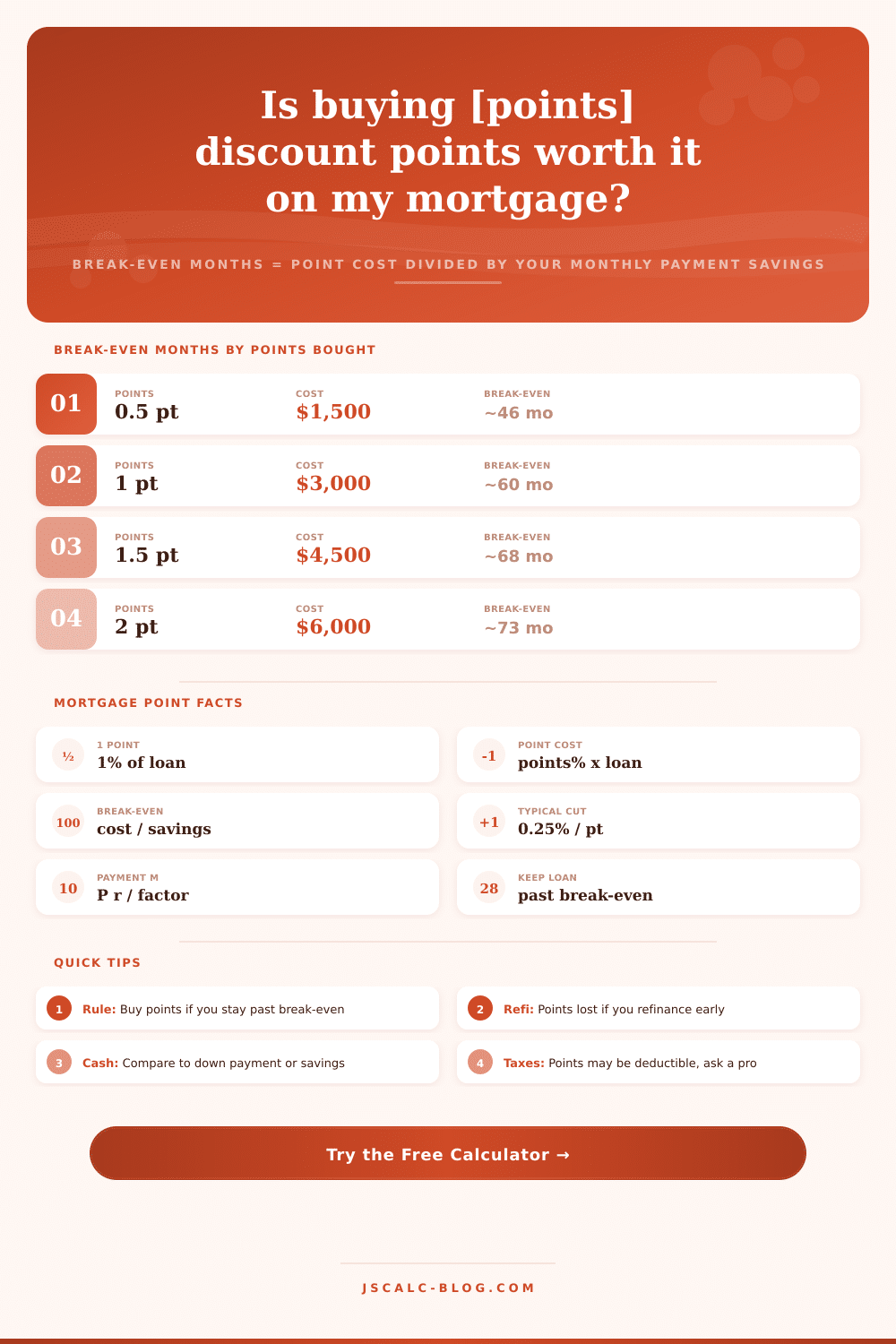
The calculator above does the math for you, but knowing how it works will help you believe the answer. Points are nothing more than a one-time payment to prepay interest now (a lump sum) rather than later (over many month). That’s why the payoff depends only on your time horizon. One percent of your loan value is called a “discount point.” A point on a three-hundred-thousand-dollar mortgage would cost you three grand. You’ll save perhaps a quarter of a percent on interest rate for each point, depending on market.
People obsess over how much you’ll save every month and forget about upfront sting. They’re the ones who gets it wrong. It doesn’t matter what you save on your payment unless you remain in the home long enough to recover that up-front expense. If you sell early, you wasted money on a rate cut you never had time to benefit from.
There are three steps to the break-even calculation. It first figures out your total point cost. Next, it uses the usual formula for paying off a loan (in this case, two loans: one at your baseline rate, and another at the discounted rate), which give you two different results; one month’s payment if you had kept the mortgage, and another based on your new, lower rate. Then it takes the difference between those two numbers to give you how much money per month you’re saving. Finally, it divides the amount you paid in points by that number. This is the number of months until your savings have grown enough to offset initial investment. Simple math, and yet it drive everything.
When does the tide shift? From red to black? Let’s say, for example, that you has borrowed three-hundred-thousand-dollars over thirty years at the rate of seven percent. That means your monthly mortgage payment will be approximately two grand. You decide to purchase one point for three thousand bucks. This reduces interest rate down to six and three quarter percent. And it reduces your payment by around fifty bucks per month. Three thousand divided by fifty equals…sixty months. You break even in five years. Everything beyond that point is gravy. Sell/refi prior to this date? Points wasted. You lost money on the transaction. The calculator displays all of this data with ease, so you’ll know your tipping-point instanly.
This brings us to the biggest variable in this equation: Your holding period. The longer you hold a mortgage, the more points makes sense. They only start paying over time. A borrower with a twenty year horizon gets an entirely different answer from one with a three-year horizon. Many homeowners sell or refinance long before their loan reach thirty years, as evidenced by national average numbers. No matter how compelling the savings on paper look, points is a bad match for short-term borrowers. Get brutally honest about your timeline. If there’s any realistic possibility that you’ll refinance at a later date (and rates drop), then the upfront cost can vanish before you’ve broken even.
But there’s more to consider different than cold, hard cash. What else would you do with that money? That point is that money isn’t free money. Free money doesn’t sit idling. It’s money you’d put toward something else, such as increasing your down payment so you don’t have to deal with private mortgage insurance at all. You could also pay off high interest debt, like the kind on your credit cards. This debt usually cost more than any discount you’ll recieve from your mortgage, and will save you even more. Another good idea: keeping an emergency fund.
Break-even months are the core of this analysis, but the reality of liquidity needs and tax deductibility should also enter into your thinking. For some borrowers, the discount points is tax-deductible in the year of purchase, which softens the equation a bit further. Check with a tax pro to see what applies where you live.
You’re trying to improve your financial position here, not simply reduce your monthly payment. Plug the numbers in. Read the verdict. And if the timeline really does work out in your favor, then go ahead and buy points. Otherwise, leave the cash in hand. There’s no sense tying it up in a property you intend to vacate.