Bolt Torque to Force Calculator
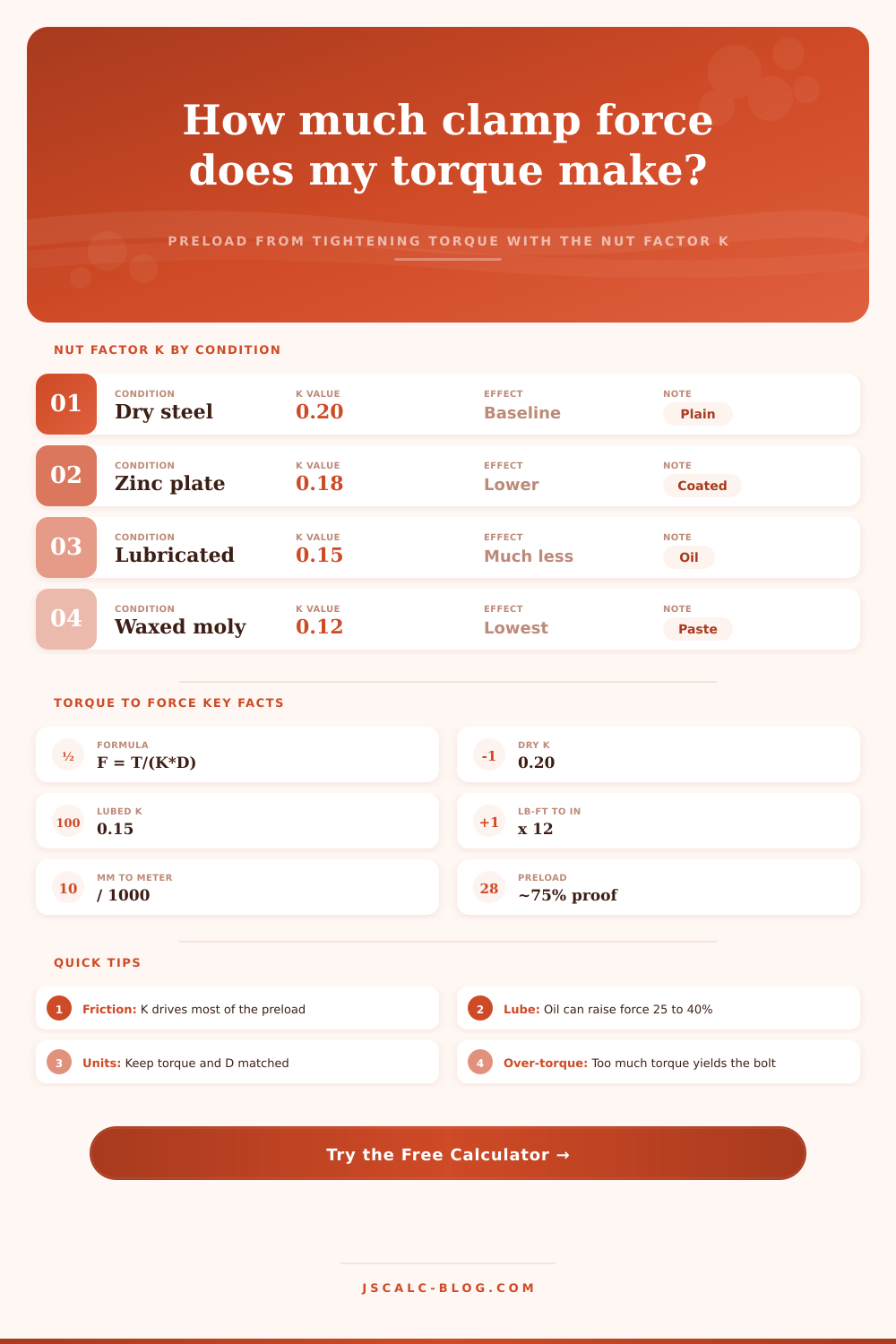
Convert tightening torque into bolt clamp force (preload) with the short-form equation F = T ÷ (K × D), where K is the nut factor for friction. Solve preload from torque, or the torque needed for a target load, in imperial or metric units.
🔩Real Bolt Presets
📝Torque and Bolt Inputs
Used when solving for clamp force.
Dimensionless. Lower K means more force per unit torque.
Used when solving for torque. lb or N per unit system.
🔢Equation Symbols
📊Nut Factor K by Condition
| Surface / Lubrication | Typical K | Relative Force | Notes |
|---|---|---|---|
| Dry, plain finish steel | 0.20 | Baseline | Common default assumption |
| Zinc plated | 0.18 | +11% force | Standard plated hardware |
| Black oxide | 0.16 | +25% force | Mild friction coating |
| Lubricated / oiled | 0.15 | +33% force | Machine oil on threads |
| Waxed / molybdenum | 0.12 | +67% force | Assembly paste, moly |
| PTFE / anti-seize | 0.10 | +100% force | Very slick, easy to over-load |
📏Bolt Diameter Reference
| Imperial Size | D (in) | Metric Size | D (mm) | Stress Area (approx) |
|---|---|---|---|---|
| 1/4 in | 0.250 | M6 | 6.0 | 0.032 in² / 20.1 mm² |
| 5/16 in | 0.3125 | M8 | 8.0 | 0.052 in² / 36.6 mm² |
| 3/8 in | 0.375 | M10 | 10.0 | 0.078 in² / 58.0 mm² |
| 1/2 in | 0.500 | M12 | 12.0 | 0.142 in² / 84.3 mm² |
| 5/8 in | 0.625 | M16 | 16.0 | 0.226 in² / 157 mm² |
| 3/4 in | 0.750 | M20 | 20.0 | 0.334 in² / 245 mm² |
🔧Typical Torque Specs
| Application | Bolt Size | Torque | Assumed K | Approx Preload |
|---|---|---|---|---|
| Passenger car lug nut | 1/2 in | 100 lb-ft | 0.20 | ~12,000 lb |
| Cylinder head bolt | M12 | 65 N·m | 0.15 | ~36,100 N |
| Structural connection | 3/4 in | 250 lb-ft | 0.18 | ~22,200 lb |
| Small machine screw | M6 | 10 N·m | 0.20 | ~8,330 N |
| Flange bolt oiled | M16 | 200 N·m | 0.15 | ~83,300 N |
| Bracket fastener | 3/8 in | 30 lb-ft | 0.18 | ~5,330 lb |
🗂Torque vs K Clamp Force Grid
Resulting clamp force for a 1/2 in bolt (D = 0.5 in) at each torque and nut factor, in pounds using F = T ÷ (K × D). Torque shown in lb-ft is converted to lb-in first.
| Torque | K 0.10 | K 0.12 | K 0.15 | K 0.18 | K 0.20 |
|---|---|---|---|---|---|
| 40 lb-ft | 9,600 lb | 8,000 lb | 6,400 lb | 5,333 lb | 4,800 lb |
| 60 lb-ft | 14,400 lb | 12,000 lb | 9,600 lb | 8,000 lb | 7,200 lb |
| 80 lb-ft | 19,200 lb | 16,000 lb | 12,800 lb | 10,667 lb | 9,600 lb |
| 100 lb-ft | 24,000 lb | 20,000 lb | 16,000 lb | 13,333 lb | 12,000 lb |
| 120 lb-ft | 28,800 lb | 24,000 lb | 19,200 lb | 16,000 lb | 14,400 lb |
| 150 lb-ft | 36,000 lb | 30,000 lb | 24,000 lb | 20,000 lb | 18,000 lb |
| 200 lb-ft | 48,000 lb | 40,000 lb | 32,000 lb | 26,667 lb | 24,000 lb |
⚙Full Formula Breakdown
📋Force / Preload Examples
| Scenario | Torque | Diameter | K | Clamp Force |
|---|---|---|---|---|
| 1/2 in dry | 100 lb-ft | 0.5 in | 0.20 | 12,000 lb |
| 1/2 in lubricated | 100 lb-ft | 0.5 in | 0.15 | 16,000 lb |
| 3/8 in zinc | 30 lb-ft | 0.375 in | 0.18 | 5,333 lb |
| M12 lubricated | 50 N·m | 12 mm | 0.15 | 27,778 N |
| M10 class 8.8 | 45 N·m | 10 mm | 0.20 | 22,500 N |
| 3/4 in structural | 250 lb-ft | 0.75 in | 0.18 | 22,222 lb |
💡Practical Torque Tips
If we’re honest, you’ve cranked down on a wrench ’til it clicks; you’ve left knowing you met the spec sheet number and felt good about securing that joint. But here’s the deal, torque is not tension. Never was, never will be. While torque is force you input via an impact gun or arm, clamp force is what pulls those steel plates together and holds them as something attempts to pull them apart. Those two are related, yet they’ll rarely ever match up without you controlling for the factor in-between.
We don’t want you to remember any one specific number, which is why the calculator above do all of the conversion math for you. Knowing why the numbers change is more important than remembering any given number. Friction is like a tax on your effort while the bolt stretch. K is the nut factor and K represents the frictional component that lives between your wrist and the stretch of the bolt. In other words, k is a tax on how much you has to tighten something. Ninety percent of the torque you put into a fastener fights with friction under the bolt head and down through the threads. Ten percent is what actualy does the work and elongates your fastener to produce preload.
Torque Is Not Tension
So if those threads are rusty and dry, most of your energy goes up in smoke…as both resistance and heat. Your wrench feels super-stiff when you hit your target torque reading, but the bolt didn’t really tighten at all. This is why rusted bolts often seem hard to turn but do very little clamping force. So what happens if you grab that same bolt and paint it with molybdenum paste, or heck, just a little clean machine oil? Friction drops like a stone. It’s as if you have a new, light wrench in your hand. The lack of resistance makes you wonder if maybe you didn’t torque it quite hard enough. Truth be told, however, much more of your effort is now going direct into stretching the shank.
And that’s when folks tear off bolts. They lube their fastener. But they follow a torque specification established for dry steel. This results in an overload that either stretches the bolt beyond its yield point (before you hear that click from the wrench) or breaks the threads clean off. The reference table on this page show how much surface conditions affect these numbers. So if you go from plain zinc to a waxed coating, at the same torque input you’re seeing a dramatic change in your clamp force.
Guessing wrong here is going to cost money; when you’re clamping together an engine block or bolting together some heavy structural steel, you’ll want to match what’s on the chart to reality. For example, the shop manual calls for eighty foot-pounds based off a dry condition. In fact, you just greased the threads for protection. You should of expect a lot more tension then the chart predicts. Make the adjustment for that difference and avoid total failure later on.
The other factor is bolt diameter, and that functions as a lever arm in this equation. If the material properties and thread pitch is the same, larger bolts need more torque to reach the same percent of their proof load than smaller bolts do. To make things easier, it’s all switchable between metric and imperial units with no head scratching. That can save some headaches if you’re using both import parts and domestic machinery. As long as your input values match, the tool’s conversion logic should not gets confused.
In all high-stakes assemblies, achieving about seventy-five percent of the bolt’s proof strength is the goal. This leaves you with plenty of clamp load to withstand thermal cycling and vibration without separating the joint. It also provides a safety margin if the joint is hit by an unexpected jolt. Achieving this sweet spot takes discipline. Make sure those threads are clean. If it calls for lube, apply consistently. Use a torque multiplier or calibrated wrench where high values is involved. And always keep in mind that the click on the handle means nothing without considering the hidden variable, friction.
Ultimately, good fastening comes from a combination of solid design and careful attention to detail, not necessarily raw force. When small inputs are carefully managed, they control much greater forces than any person could produce alone. Realizing that this is all just a necessary part of getting preload helps you start thinking like an engineer and stop relying only on the gauge. Thinking like that will save your builds more than anything else… including tool.