Board Feet Lumber Calculator
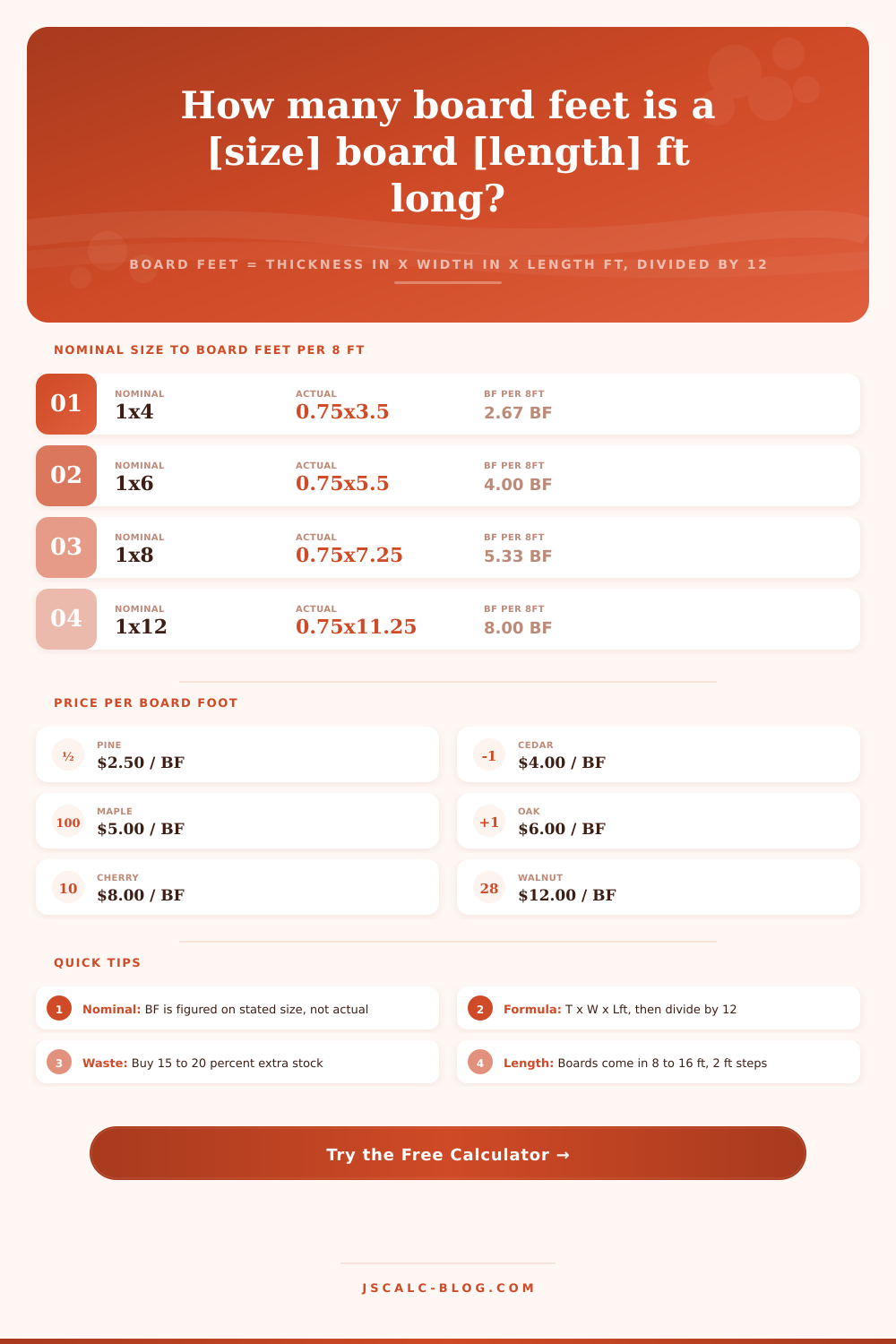
Find the board-foot volume of any lumber with Board Feet = thickness (in) times width (in) times length (ft), divided by 12. Enter the size, pick nominal or actual dimensions, choose a wood species for a real price per board foot, and get board feet per piece, total board feet, total lineal feet, and total cost in one shot.
🎯Real Lumber Order Presets
📏Lumber Dimensions
Board feet are conventionally figured on nominal size. Actual lets you enter dressed dimensions directly.
Picking a size fills thickness and width for you. Choose Custom to type your own.
Nominal thickness of the board in inches (T in the formula).
Nominal width of the board face in inches (W in the formula).
Length of a single board (L). Set the unit at right.
Feet uses T x W x Lft / 12; inches uses T x W x Lin / 144.
How many identical boards of this size you need.
Sets a typical market price per board foot for this species.
Leave as filled to use the species price, or type your supplier quote.
Controls rounding on the board-foot result cards.
🔢Formula Snapshot
📏Nominal vs Actual Dimensions
| Nominal Size | Actual Thickness | Actual Width | Reads As |
|---|---|---|---|
| 1 x 2 | 0.75 in | 1.5 in | One by two |
| 1 x 4 | 0.75 in | 3.5 in | One by four |
| 1 x 6 | 0.75 in | 5.5 in | One by six |
| 1 x 8 | 0.75 in | 7.25 in | One by eight |
| 1 x 12 | 0.75 in | 11.25 in | One by twelve |
| 2 x 4 | 1.5 in | 3.5 in | Two by four |
| 2 x 6 | 1.5 in | 5.5 in | Two by six |
| 2 x 8 | 1.5 in | 7.25 in | Two by eight |
| 2 x 10 | 1.5 in | 9.25 in | Two by ten |
| 2 x 12 | 1.5 in | 11.25 in | Two by twelve |
📋Board Feet per Lineal Foot
| Nominal Size | BF per Lineal Foot | BF per 8 ft | BF per 16 ft |
|---|---|---|---|
| 1 x 4 | 0.333 BF | 2.67 BF | 5.33 BF |
| 1 x 6 | 0.500 BF | 4.00 BF | 8.00 BF |
| 1 x 8 | 0.667 BF | 5.33 BF | 10.67 BF |
| 1 x 12 | 1.000 BF | 8.00 BF | 16.00 BF |
| 2 x 4 | 0.667 BF | 5.33 BF | 10.67 BF |
| 2 x 6 | 1.000 BF | 8.00 BF | 16.00 BF |
| 2 x 8 | 1.333 BF | 10.67 BF | 21.33 BF |
| 2 x 10 | 1.667 BF | 13.33 BF | 26.67 BF |
| 2 x 12 | 2.000 BF | 16.00 BF | 32.00 BF |
| 4 x 4 | 1.333 BF | 10.67 BF | 21.33 BF |
💰Price per Board Foot & Standard Lengths
| Species | Price per BF | Common Grade | Typical Use |
|---|---|---|---|
| Pine | $2.50 | No. 2 common | Framing, shelving |
| Cedar | $4.00 | Select tight knot | Decking, siding |
| Maple | $5.00 | FAS hardwood | Cabinets, tops |
| Oak | $6.00 | Red oak FAS | Flooring, furniture |
| Cherry | $8.00 | FAS hardwood | Fine furniture |
| Walnut | $12.00 | FAS hardwood | Heirloom pieces |
| Standard Length | In Inches | BF of a 2x4 | Note |
|---|---|---|---|
| 8 ft | 96 in | 5.33 BF | Most common stud |
| 10 ft | 120 in | 6.67 BF | Walls and plates |
| 12 ft | 144 in | 8.00 BF | Joists and rafters |
| 14 ft | 168 in | 9.33 BF | Longer spans |
| 16 ft | 192 in | 10.67 BF | Longest common |
🗃Lumber Size Comparison Grid
| Nominal Size | Actual Size | BF per 8 ft | BF per Lineal Ft | Common Use | Relative Cost |
|---|---|---|---|---|---|
| 1 x 4 | 0.75 x 3.5 | 2.67 BF | 0.333 BF | Trim and flooring | Low |
| 1 x 6 | 0.75 x 5.5 | 4.00 BF | 0.500 BF | Fencing and shelves | Low |
| 1 x 12 | 0.75 x 11.25 | 8.00 BF | 1.000 BF | Wide shelving | Medium |
| 2 x 4 | 1.5 x 3.5 | 5.33 BF | 0.667 BF | Wall studs | Low |
| 2 x 6 | 1.5 x 5.5 | 8.00 BF | 1.000 BF | Rafters and decks | Medium |
| 2 x 8 | 1.5 x 7.25 | 10.67 BF | 1.333 BF | Floor joists | Medium |
| 2 x 10 | 1.5 x 9.25 | 13.33 BF | 1.667 BF | Beams and stairs | High |
| 2 x 12 | 1.5 x 11.25 | 16.00 BF | 2.000 BF | Long span joists | High |
| 4 x 4 | 3.5 x 3.5 | 10.67 BF | 1.333 BF | Posts and legs | Medium |
⚙Formula Breakdown
💡Lumber Buying Tips
There’s nothing more odd than standing at the lumber yard counter, armed with a stud-and-trim shopping list, while the guy piles on pieces of wood that seem to be less then what they say on sign overhead, have I been robbed? Actualy, it’s easier than you might think. Boards aren’t simply bought by their width or length. They is purchased based off volume. That volume is expressed in something called…drumroll please…board feet.
And this is why: Board feet are a unit of measure that measures what you’re really purchasing, a piece of wood that’s so many inches wide by so many inches deep by so many inches long. Knowing how to compute it for yourself spares you any embarassing conversations… And keeps the cost of your project closer to price tag on the pile sitting outside your driveway.
How to Count Board Feet for Wood
One board foot are equal to 144 cubic inches of wood. It’s best to imagine this as a one-inch-thick-by-twelve-inches-wide-by-twelve-inches-long piece of wood. This way, length, width and thickness is all tied together with just one number. And a convenient shape at that.
The formula is straightforward: Multiply the length in feet times the width in inches times the thickness in inches, then divide result by 12. If you have measured your length in inches rather than feet, you divides by 144. Once you enter your measurements into calculator above, it will do math for you, so you don’t need to bother converting things manually. Understanding where these numbers come from allows you to catch mistakes before they becomes an expense.
That’s just most of the trick. You have to know what they’re really measuring. Nominal size, the size written on tag and quoted on price list… Is purely theoretical and is used for softwood lumber. A two-by-four are named as such, but is actualy roughly 1.5 by 3.5 inches after milling and drying.
By convention, the industry computes board feet based on nominal size; you pay for the theoretical lumber, not the dressed-up version sitting in your hand. It keep us from quibbling endlessly over tiny variations from planing. For instance, you feed a two-by-four into the thing, and it calculates with full two inches of thickness.
If you buy hardwood, rough sawn, where actual dimension sets price, then maybe you should of change the calculator to base everything on actual rather than nominal sizes. That make a big difference in amount of lumber you think you’ve got.
To scale-up, it’s got to be more than one board; most jobs has multiple boards. Board feet is simply the number of pieces multiplied by size of each (volume). For example: 10 eight-foot two-by-fours equals about 53 board feet. It can also do lineal feet, or simple sum of the running lengths of all wood, regardless of thickness. If your lumber guy prices by the foot, lineal feet are for you; if it’s a hardwood counter, board feet reigns supreme.
Being familiar with both will allow you to understand quotes expressed in various units, and avoid being lost in translation. It pay for itself through cost estimation. Wood varies considerably in price depending on type of wood and location. For example, pine runs several dollars a board foot; walnut may run upwards of a dozen.
To handle this variation, the calculator pre-loads reasonable average prices for popular woods such as maple, oak and cedar. So you’ll instantly know how much your chosen wood will change bottom line. Beyond that, the calculator take you through the math one step at a time so you can clearly understand the contribution of each piece’s size (length + thickness + width) to total cost. That comes in handy when you’re debating whether to upgrade from pine to cedar on your next deck project.
There’s always waste when buying lumber. You’ll lose some stock to saw kerf, end trimming, and some hidden defects. To account for this loss, many people adds 15 to 20 percent to their calculated board feet. If you’re dealing with rough-sawn hardwoods (which tend to have more irregularities), add an additional buffer.
Total board feet makes it easy to compare suppliers regardless of different lengths and piece counts. Walk into the yard confident, not hopeful. Knowing the volume numbers up front helps whether you’re building a shelf or framing a wall. The next time you look at a stack of lumber, you’ll know precisely how much wood is actualy in that pile.