Blown-In Insulation R-Value Calculator
Estimate how many bags of loose-fill cellulose, fiberglass, or rock wool you need and the settled depth in inches to reach a target attic R-value over your square footage, minus any existing insulation.
🎯Real Attic Presets
📝Attic & Coverage Inputs
Used when area method is direct floor area.
Active when target is set to custom.
Subtracted from target. Use 0 for bare joists.
Extra bags for long-term settle (cellulose 10 to 20%).
Overblow at edges, rafters, and uneven joists.
🔢Estimating Snapshot
🧱Loose-Fill Material Reference
| Material | R-Per-Inch | Bag R-sqft | Coverage At R-49 | Settling | Notes |
|---|---|---|---|---|---|
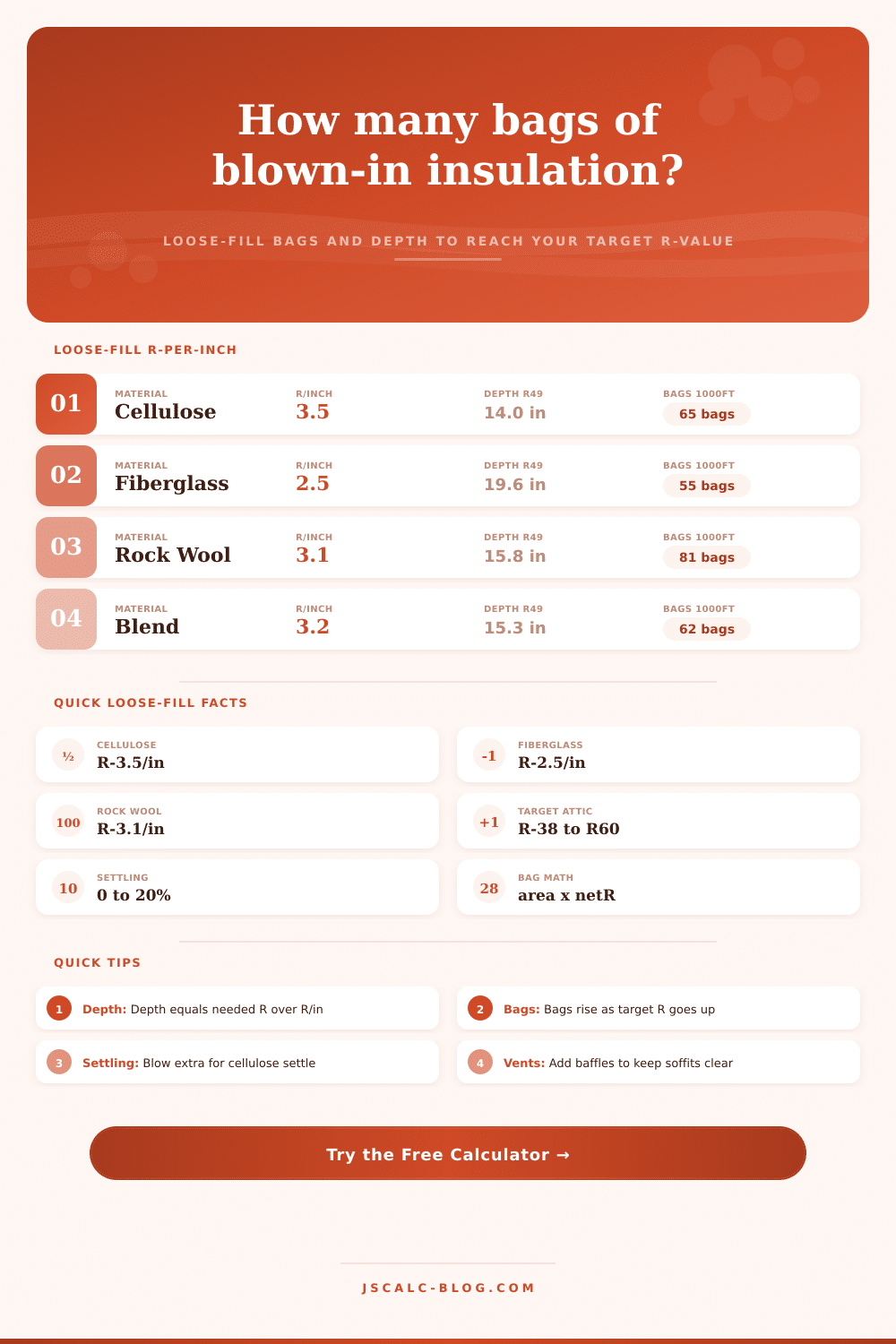
| Blown cellulose | R-3.5 | 760 R-sqft | 15.5 sqft/bag | 10 to 20% | Dense, recycled paper, best air block |
| Blown fiberglass | R-2.5 | 893 R-sqft | 18.2 sqft/bag | 2 to 4% | Light, high loft, low settle |
| Loose-fill rock wool | R-3.1 | 608 R-sqft | 12.4 sqft/bag | Under 2% | Fire resistant, heavy, stable |
| Fiberglass/cellulose blend | R-3.2 | 798 R-sqft | 16.3 sqft/bag | 6 to 10% | Balanced loft and coverage |
🌍Target R-Value By Climate Zone
| Climate Zone | Example Region | Attic Target R | Cellulose Depth | Fiberglass Depth |
|---|---|---|---|---|
| Zone 1 to 2 | South FL, Gulf Coast | R-30 to R-49 | 8.6 to 14.0 in | 12.0 to 19.6 in |
| Zone 3 | Southern US | R-30 to R-49 | 8.6 to 14.0 in | 12.0 to 19.6 in |
| Zone 4 | Mid-Atlantic | R-38 to R-60 | 10.9 to 17.1 in | 15.2 to 24.0 in |
| Zone 5 | Lower Midwest | R-49 to R-60 | 14.0 to 17.1 in | 19.6 to 24.0 in |
| Zone 6 | Upper Midwest | R-49 to R-60 | 14.0 to 17.1 in | 19.6 to 24.0 in |
| Zone 7 to 8 | Northern, Alaska | R-49 to R-60 | 14.0 to 17.1 in | 19.6 to 24.0 in |
📏Settled Depth For Common R-Values
| Target R | Cellulose Depth | Fiberglass Depth | Rock Wool Depth | Blend Depth |
|---|---|---|---|---|
| R-19 | 5.4 in | 7.6 in | 6.1 in | 5.9 in |
| R-30 | 8.6 in | 12.0 in | 9.7 in | 9.4 in |
| R-38 | 10.9 in | 15.2 in | 12.3 in | 11.9 in |
| R-49 | 14.0 in | 19.6 in | 15.8 in | 15.3 in |
| R-60 | 17.1 in | 24.0 in | 19.4 in | 18.8 in |
📦Bags Per 1000 Sqft By Target R
| Target R | Cellulose | Fiberglass | Rock Wool | Blend |
|---|---|---|---|---|
| R-30 | ~40 bags | ~34 bags | ~50 bags | ~38 bags |
| R-38 | ~50 bags | ~43 bags | ~63 bags | ~48 bags |
| R-49 | ~65 bags | ~55 bags | ~81 bags | ~62 bags |
| R-60 | ~79 bags | ~68 bags | ~99 bags | ~76 bags |
🗂Loose-Fill Comparison Grid
| Material | R-Per-Inch | Depth For R-49 | Bags Per 1000 sqft | Settling | Cost Tier |
|---|---|---|---|---|---|
| Blown cellulose | R-3.5 | 14.0 in | ~65 bags | 10 to 20% | Low |
| Blown fiberglass | R-2.5 | 19.6 in | ~55 bags | 2 to 4% | Low to mid |
| Loose-fill rock wool | R-3.1 | 15.8 in | ~81 bags | Under 2% | High |
| Fiberglass blend | R-3.2 | 15.3 in | ~62 bags | 6 to 10% | Mid |
| High-density cellulose | R-3.7 | 13.2 in | ~72 bags | 8 to 15% | Mid |
| Premium fiberglass | R-2.7 | 18.1 in | ~53 bags | 2 to 3% | Mid |
⚙Full Formula Breakdown
📋Reference Values
| Item | Common Entry | How It Is Used | Effect On Bags |
|---|---|---|---|
| Target R-value | R-30 to R-60 | Sets total needed R | Higher target adds bags |
| Existing R-value | 0 to R-30 | Subtracted from target | More existing cuts bags |
| Material R/inch | 2.5 to 3.7 | Sets depth per R | Higher R/inch cuts depth |
| Bag R-sqft | 600 to 900 | Fixed yield per bag | Higher yield cuts bags |
| Settling allowance | 0 to 20% | Adds extra fill | Adds bags for settle |
💡Practical Loose-Fill Tips
An attic has to be seen more as a heat barrier over your head and not merely floor space. An attic either traps heat inside of it or it leak heat outside into the cold night air. And depending on what kind of resistance you have to the difference in temperature, your winter bill will either shock you or make you happy. R-value describes this resistance. It’s not simply a piece of paper on a bag; r-value show a physical barrier to heat loss.
When you input your desired insulation level and dimensions of your roof, the calculator does the math for you, no more guesswork required as to coverage rate and factor. Simply select whether you’re using fiberglass or cellulose, input length and width of your attic floor, and specify your desired insulation level (e.g., R-49). Then the calculator let you know precisely how much product you need; and how deeply you should of pack this settled pile of goodness. No more fear of purchasing too few; or too many, bags, and no more waste!
How To Use The Insulation Calculator
Density is key: But not as you might imagine. “Fluffy” fiberglass doesn’t pack down and resist air flow as well as cellulos, a blend of borate-treated recycled paper, does. Cellulose give you more R-value for each inch of depth. Yes, fiberglass is lighter and loftier, which makes it easier to blow into tight corners, but it’s also bulkier (requiring more vertical space to achieve equivalent thermal resistance). So if you’ve got low-hanging ductwork/rafters that won’t allow burying insulation, cellulose allow you to achieve high R-values without compromising air flow.
That’s why knowing settled depth is important, before you even begin considering cost. But even with tight-fill insulation, there’s something else to consider: gravity, which will cause any sort of loose fill insulation to settle over time. If not blown densely at installation, cellulose will settles 15 percent or more during its first few years. You can make up for this settling in the calculator’s input field for “allowance for settling.” Otherwise, your R-49 goal may sneakily become an R-38 in just a couple of winters. On paper, it doesn’t sound like much, but in heat-transfer terms, its the difference between wearing a coat or a sweater.
If it’s an older house and you’re topping up, existing insulation matters as well. Decades ago, that was all code, which means many houses were constructid only with R-19 batts between floor joists. But even then, these old batts becomes compressed over time or leave gaps and thus lower their effective insulation value. The loose fill applied on top creates a continuous layer of insulation that bridge these weak spots.
Keep in mind: In cold climates, you don’t want to block off your soffit vents. Air must be able to circulate from the eaves up to the ridge, otherwise you’ll get ice dams and moisture buildup. To avoid this, you can purchase rafter baffles, which is cheap plastic channels installed ahead of time to keep insulation away from the vent openings when you blow in insulation. It saves you five minutes now but costs you hundreds (in mold remediation) later.
That doesn’t mean the target number should be X. This is because there are climate zones. A Florida person might find R-30 is overkill; until their electric bill comes in August. Someone living up North in Minnesota who aims for an R-38 is simply shelling out money to warm outside air. The page has a reference table that explains what’s suggested and where for each climate zone. You can adjust your effort to match your area instead of sticking with national averages that might not apply to your specific zip code.
Insulation is one of those weird home purchases where going cheap now doesn’t matter as much as getting it done right the first time. Because once it’s hidden between rafters and deep in your memory (and more importantly, forgotten), you can’t just go back in and buy another bag, there are no second chances.
Before that truck shows up with the bags, make sure you’ve ordered enough by checking depth and number of bags and then that money you spent actualy stays in your house instead of escaping through the roof. That’s what folks don’t think about when looking for cheap per bag versus performance per square foot, use the calculator to nail down the details, order a bit more for edge waste, and enjoy watching those heating bills plummet during the next cold snap.
That math equation will result in a warm feeling inside.