Axle Ratio Calculator
Find your rear-end gear ratio from ring and pinion tooth counts, engine RPM at any cruising speed, tire diameter from a size code, and the effective ratio after a tire swap using accurate drivetrain math.
🎯Real Drivetrain Presets
📝Drivetrain Inputs
Larger crown gear on the axle differential.
Small drive gear on the driveshaft input.
Used when ratio source is decimal.
Metric size: width / aspect R wheel.
Used when method is inches.
1.00 for direct drive, below 1 for overdrive.
Used for the speed-at-RPM mode.
🔢Formula Snapshot
🚗Common Axle Ratios By Use Case
| Axle Ratio | Character | Best Use Case | Trade-off |
|---|---|---|---|
| 3.08:1 | Very tall | Highway economy, small tires | Weak launch and low towing power |
| 3.23:1 | Tall | Fuel-focused daily cruiser | Sluggish off the line |
| 3.42:1 | Balanced tall | Common stock light-truck gearing | Modest tow capacity |
| 3.55:1 | Balanced | Mixed daily and light hauling | Slight economy loss vs 3.42 |
| 3.73:1 | Sporty | Stronger acceleration, 33in tires | Higher cruise RPM |
| 4.10:1 | Aggressive | Off-road and larger tires | Noticeable economy drop |
| 4.30:1 | Heavy pull | Trail crawling, 35in tires | High RPM at highway speed |
| 4.56:1 | Very aggressive | Serious towing and off-road | Loud, thirsty highway cruise |
📏Tire Size To Diameter Reference
| Tire Size | Approx Diameter | Class | Common Fit |
|---|---|---|---|
| 235/75R15 | 28.9 in | Stock SUV | Older 4x4 and wagons |
| 265/70R17 | 31.6 in | Stock truck | Half-ton factory size |
| 285/70R17 | 32.7 in | Light lift | Popular all-terrain upsize |
| 275/65R20 | 34.1 in | Modern truck | 20 inch wheel packages |
| 315/70R17 | 34.4 in | Off-road | 35in class metric size |
| 35x12.50R17 | 35.0 in | Flotation | Trail and mud builds |
| 37x12.50R17 | 37.0 in | Big flotation | Heavy crawler builds |
📈Cruise RPM By Ratio (33in Tire, 1.00 Top Gear)
| Axle Ratio | RPM at 60 mph | RPM at 65 mph | RPM at 70 mph | Feel |
|---|---|---|---|---|
| 3.08:1 | 1673 | 1813 | 1952 | Very relaxed |
| 3.42:1 | 1858 | 2013 | 2168 | Easy cruiser |
| 3.55:1 | 1929 | 2090 | 2251 | Balanced |
| 3.73:1 | 2027 | 2196 | 2365 | Sporty buzz |
| 4.10:1 | 2228 | 2414 | 2600 | Busy highway |
| 4.56:1 | 2478 | 2685 | 2891 | Loud, revvy |
🔄Effective Ratio After Tire Upsize
| Old Tire | New Tire | Size Change | Stock 3.73 | Stock 4.10 | Regear To Match |
|---|---|---|---|---|---|
| 31.6 in | 32.7 in | +3.5% | 3.60:1 | 3.96:1 | Up one step |
| 31.6 in | 33.0 in | +4.4% | 3.57:1 | 3.93:1 | 3.90 or 4.30 |
| 33.0 in | 35.0 in | +6.1% | 3.52:1 | 3.87:1 | 4.10 or 4.56 |
| 33.0 in | 37.0 in | +12.1% | 3.33:1 | 3.66:1 | 4.56 or 4.88 |
| 35.0 in | 37.0 in | +5.7% | 3.53:1 | 3.88:1 | 4.30 or 4.56 |
| 32.7 in | 34.4 in | +5.2% | 3.55:1 | 3.90:1 | 4.10 class |
⚙Full Formula Breakdown
📋Reference Values
| Item | Common Entry | How It Is Used | Effect On Result |
|---|---|---|---|
| Ring teeth | 37 to 43 | Numerator of the ratio | More teeth raises the ratio |
| Pinion teeth | 8 to 13 | Denominator of the ratio | Fewer teeth raises the ratio |
| Tire diameter | 28 to 37 in | Divides in the RPM formula | Bigger tire lowers RPM |
| Trans top gear | 0.64 to 1.00 | Multiplies overall drive ratio | Overdrive drops cruise RPM |
| Speed | 55 to 75 mph | Multiplies in the RPM formula | Higher speed raises RPM |
💡Practical Gearing Tips
You get on the highway, set cruise, and pull out. Everything sounds great as you motor down the road; then you realize engine isn’t humming at the same pitch as it was when you bought the car. On shorter runs, it didn’t seem so noticeable, but now that you’ve driven for four hundred miles, those few more revolutions per minute sound like an unecessary waste of fuel, and probably some unnecessary wear and tear, to.
Most often, your issue stem from old axle gears that don’t match your new tires. Understanding the math behind these parts can save you money while keeping your truck running well. But how do you know what to put into calculator? This page does it all for you.
How Gear Ratio Math Works
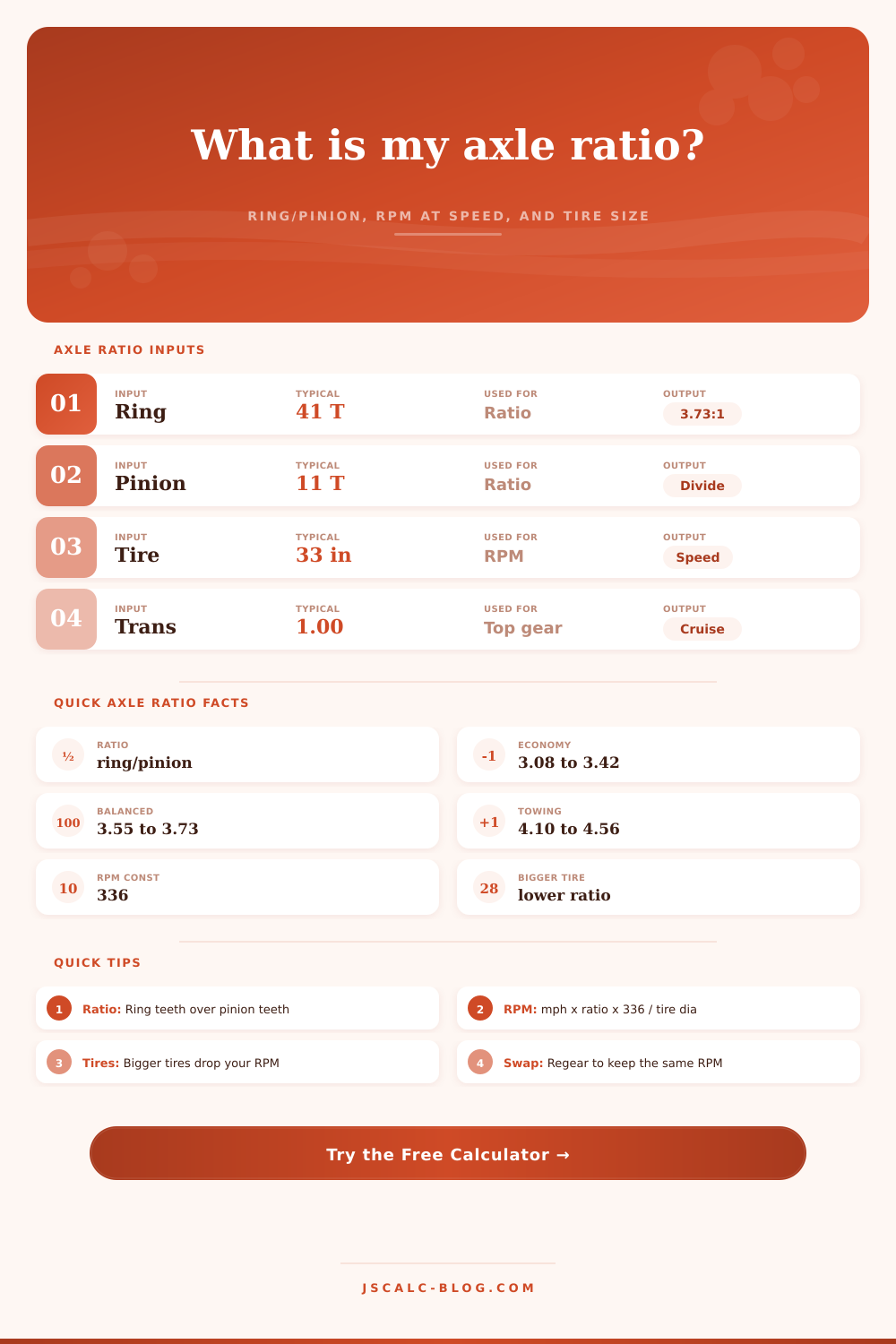
The first thing most folks look at is teeth count on their ring and pinion. Those are the numbers that gives you your starting axle ratio. If you have an 11 tooth pinion and a 41 tooth ring gear, your base axle ratio would be 3.73. That sounds easy enough until you swap out your tires. Going up in height decreases your effective gearing; although gears remain unchanged, the engine will has to spin quicker to travel the same amount of distance. This is not good for fuel economy or cabin noise level. Why? Because RPM is what matter here.
For every combination of tire size, engine speed, and gear ratio, there’s a fixed value: 336. This is the number we use to calculate RPM (revolutions per minute) from tire size, speed and gear ratio. It takes into account minutes in an hour, tire circumference, and miles per hour. You don’t need to memorize this, but keep in mind that without changing your gears, larger tires will result in higher RPMs at the same speed. Smaller tires will decreases your RPMs, making the truck feel sluggish when acceleration are required.
Here’s an example of where different gear ratios fits different driving scenarios from table: A 3.08 gear ratio is fairly economical if you mostly drive long stretches of open highway at speed, even with stock tire sizes; however, it will fall short when climbing steep hills or pulling a boat. A 4.56 gear ratio offers plenty of grunt for hard pulling, like heavy towing or off-road excursions; however, at highway speeds, it will be noisy and less efficient. A 4.56 won’t get along well on the highway in general. Ratios from 3.55-3.73 gears is optimal for most everyday use. They’ll deliver sufficient acceleration to merge into traffic while still maintaining decent mileage during long drives.
When you upsize your tires (to match your original driving dynamics), you should of also think about regearing. For example, going from a 33-inch tire to a 35-inch tire means a significant drop in effective ratio. You’d want a numerically higher gear ratio to maintain the same RPM at 70 miles per hour. Use the calculator to determine this target number and purchase the appropriate ring and pinion set before dropping thousands on lifts and tires. Get it right the first time with less costly parts swaps later.
Another factor is the top gear of the transmission. Many new trucks feature an overdrive gear, so the final drive ratio will be less than 1. So when you’re cruising along at speed, engine can lower its RPM’s even more. Be sure to include your transmission’s top gear in calculation. Without it, you’ll get a higher estimate and unecessarily worry that your engine isn’t happy or that you’re using too much fuel.
This is where the trick comes in; you have to know what each modification does to your vehicle. Each tooth on a gear affects how power gets to the pavement. It also changes height of your tires by inches. Do you want efficiency or do you want to accelerate? How do you get both? That’s where looking at everything as a whole variable is important different than changing one piece independently. A little math goes into this but being able to know your truck is geared properly for its purpose is worth the effort.