Angular Velocity Calculator
Find angular velocity omega in rad/s from RPM, frequency, period, or a tangential speed and radius, and even from an angle turned over a time. The tool then reports rotational speed in RPM, frequency in Hz, degrees per second, plus the rim tangential speed v = omega times r and the centripetal acceleration for any rotating wheel, disc, or shaft.
🔄Choose an Input Mode
🎯Real Rotating Object Presets
📝Rotation Inputs
Revolutions per minute, used in the From RPM mode.
Revolutions per second, one Hz is one full turn each second.
Seconds for one complete revolution, omega = 2 pi / T.
Linear speed of the rim, used with radius as omega = v / r.
Distance from the axis to the rim, sets v and centripetal a.
Angle turned during the elapsed time in the unit chosen below.
How the swept angle above is measured.
Time taken to sweep that angle, omega = angle / time.
Controls rounding on every result card and row.
🔢Formula Snapshot
📋RPM to Angular Velocity Conversions
| RPM | rad/s | deg/s | Hz |
|---|---|---|---|
| 33.3 | 3.49 | 200 | 0.555 |
| 45 | 4.71 | 270 | 0.750 |
| 60 | 6.28 | 360 | 1.00 |
| 100 | 10.5 | 600 | 1.67 |
| 300 | 31.4 | 1800 | 5.00 |
| 500 | 52.4 | 3000 | 8.33 |
| 1200 | 126 | 7200 | 20.0 |
| 3600 | 377 | 21600 | 60.0 |
| 7200 | 754 | 43200 | 120 |
⚙Common Rotating Objects
| Object | Speed | omega (rad/s) | Period T | Frequency |
|---|---|---|---|---|
| Vinyl LP record | 33.3 RPM | 3.49 | 1.80 s | 0.555 Hz |
| Clock second hand | 1 rev / min | 0.105 | 60 s | 0.0167 Hz |
| Ceiling fan | 300 RPM | 31.4 | 0.200 s | 5.00 Hz |
| Car engine idle | 800 RPM | 83.8 | 0.075 s | 13.3 Hz |
| Washing machine spin | 1200 RPM | 126 | 0.050 s | 20.0 Hz |
| Car engine redline | 3600 RPM | 377 | 0.0167 s | 60.0 Hz |
| Hard disk drive | 7200 RPM | 754 | 0.0083 s | 120 Hz |
| Earth daily spin | 1 rev / day | 0.0000727 | 86400 s | 0.0000116 Hz |
📏Angular Unit Conversion Factors
| Convert | Multiply By | Result Unit | Note |
|---|---|---|---|
| RPM to rad/s | 0.10472 | rad/s | Equals 2 pi / 60 |
| rad/s to RPM | 9.5493 | RPM | Equals 60 / 2 pi |
| rad/s to deg/s | 57.296 | deg/s | Equals 180 / pi |
| deg/s to rad/s | 0.017453 | rad/s | Equals pi / 180 |
| rad/s to Hz | 0.15915 | Hz | Equals 1 / 2 pi |
| Hz to rad/s | 6.2832 | rad/s | Equals 2 pi |
🗃RPM to Speed and Rim Comparison Grid
| RPM | rad/s | deg/s | Hz | v at r = 0.5 m |
|---|---|---|---|---|
| 33.3 | 3.49 | 200 | 0.555 | 1.74 m/s |
| 60 | 6.28 | 360 | 1.00 | 3.14 m/s |
| 100 | 10.5 | 600 | 1.67 | 5.24 m/s |
| 300 | 31.4 | 1800 | 5.00 | 15.7 m/s |
| 1000 | 105 | 6000 | 16.7 | 52.4 m/s |
| 3600 | 377 | 21600 | 60.0 | 188 m/s |
| 7200 | 754 | 43200 | 120 | 377 m/s |
🔬Formula Breakdown
💡Angular Velocity Tips
The hub doesn’t move much, but the rim spins around and flies past your hand. No magic there. It is just angular velocity. How fast something goes around is different than how fast it covers distance.
Whether you’re looking at a hard drive that sounds like a jet engine or a fan blade you need to size, this calculator on page does the math for you so you can focus on what those numbers actualy mean for your project.
How to Use the Angular Velocity Calculator
Angular position is what the thing is pointing at; angular velocity is how fast it’s changing its position. If something spin one revolution per second, that’s about 6.28 rad/s (a full revolution is $2\pi$ radians). The radian is natural unit because it ties rotation directly to distance around the arc. This is what physics uses as the actual measure of spin rather than revolutions or degrees. That is why you see rad/s in the tool instead of degrees or revolutions. Omega is always reported in rad/s first, with other friendlier units displayed next to them, covering workshop as well as the classroom.
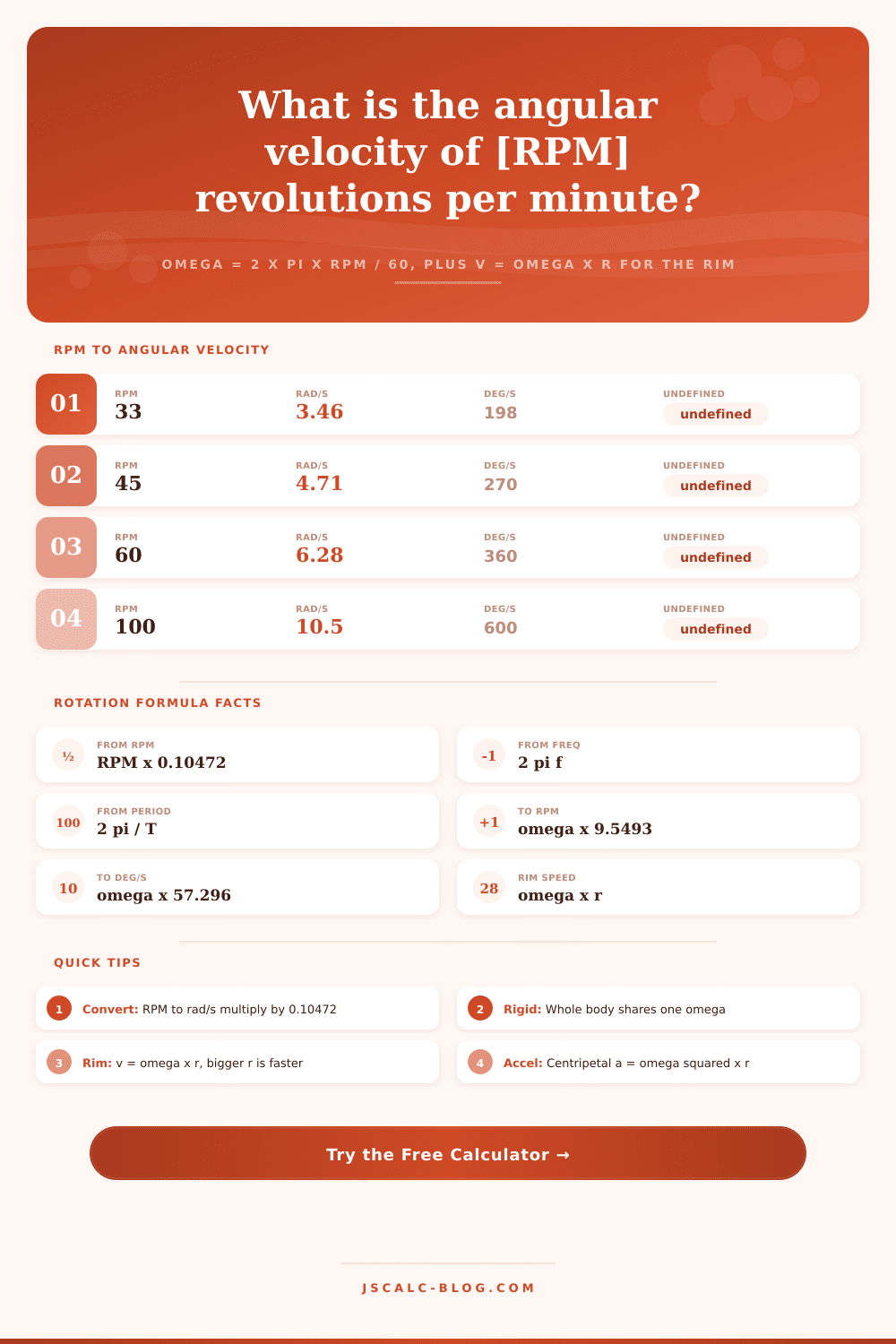
When most machines tell you their speed, it’s in terms of “RPM,” meaning “revolutions per minute.” Convert to angular velocity by substituting the formula for omega (omega equals $2\pi$ times RPM divided by 60). This reduce to one nifty constant: simply multiply RPM by approximately 0.10472. So if your car engine is spinning at 3600 RPM, that means it’s rotating at around 377 rad/s.
Reverse the process by multiplying rad/s by 9.5493. It will be converted into RPM instantly using the From RPM mode. It will also display the substituted values so you can trace along and see each step without reaching for your calculator.
It’s periodic rotation, which means you can describe it by its frequency (in hertz) or by its period (in seconds). Period is number of seconds per cycle, and frequency is the number of cycles per second. If you know the frequency, then omega is $2\pi$ times f. If you know the period, then omega is $2\pi$ over T. The angular velocity of a 120-Hz spinning hard drive is approximately 754 rad/s. The tool connects rate-based and time-based thinking. You choose the right input mode for your data, and it handles both ways neatly.
The speed of an object depend on its angular velocity and its distance away from the axis of rotation in units called radians per second (rad/s). These two variables is related through this equation: v = omega times r where v is tangential speed. Knowing one variable allows you to calculate the other; for example, you could know how fast edge of a wheel is moving instead of just how fast the wheel spins. With a radius of 0.35 meters and moving at 8.94 m/s, a bicycle wheel rolls along at roughly 25.5 rad/s.
This means that if you made a bigger or smaller wheel, you’d need to spin it faster or slower to get the same rim speed. That’s because of this equation and why any rotating machine, from a centrifuge to a pulley system, are designed to have specific angular velocity for best use.
The simplest way to calculate it is angular velocity = angle turned / time taken. For example, if you have a turntable that turns 360 degrees in one second, convert the angle to radians and divide by the time (about 6.28 rad/s). In this mode, you can enter the swept angle as degrees, radians, or complete revolutions. It will divide by elapsed seconds, and the calculator will display the result. This is perfect for making measurements in the lab where, instead of using a tachometer, you measure how long it takes the object to rotate and use your watch to time it.
There are four result cards summarizing all calculations: Angular Velocity (rad/s), then Rotational Speed (RPM) for motor users You can see all the different rate units such as frequency, degrees per second, and period, on one card. The Centripetal Acceleration Tangential Rim Speed Breakdown Panel lets you check your work and shows every number used line by line.
Centripetal acceleration grows with the square of angular velocity. Radius, on the other hand, is linear: the greater the radius, the greater the tangential speed. This means that at higher speeds, there’s a huge force pulling inward, which is why the rotors need to be strong and balanced. If you’re designing a structure or just choosing materials for something rotating rapidly, then you want to know what those forces will be, and this tool figures them out for you without costing your hide.
It’s a great tool whether you’re an engineer looking to size up a shaft or a student studying circular motion. It’ll give you solid numbers fast so that abstract ideas of rotation becomes real values you can count on. Spin the wheel. The numbers follow.