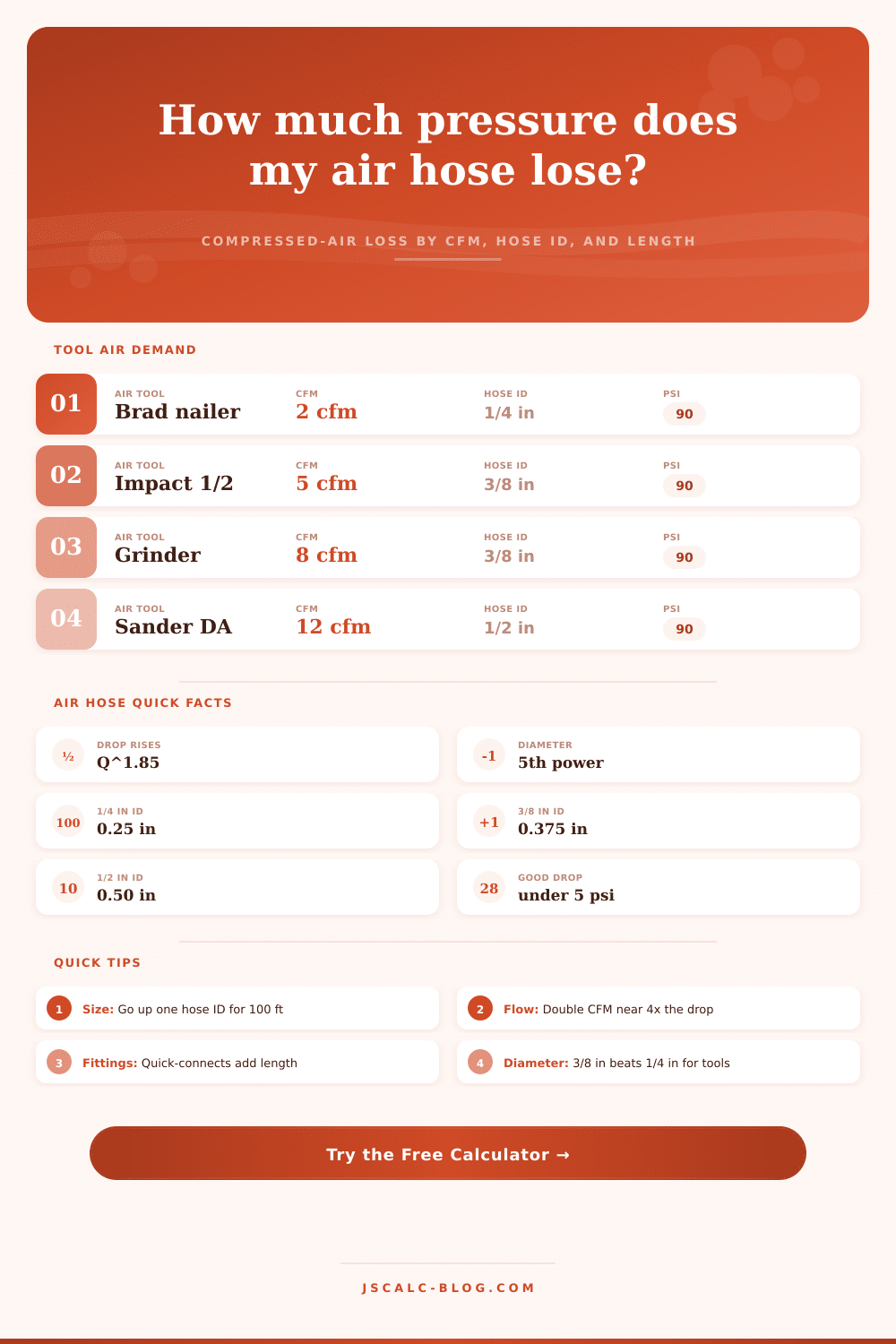
Air Hose Pressure Drop Calculator
Estimate compressed-air pressure loss through a portable air hose from CFM, inside diameter, and length, then see delivered end pressure, percent drop, and a recommended hose size using the standard empirical air formula.
🎯Real Air Hose Presets
🔧Air Hose Inputs
Free-air flow the tool draws while running. Pick a tool above to auto-fill.
Used only when hose ID is set to custom.
Regulator or coupler pressure, commonly 90 to 120 psi.
Recommendation picks the smallest hose ID under this drop.
🔢Formula Snapshot
🛠Air Tool CFM Requirements
| Air Tool | Typical SCFM | Common Hose ID | Duty |
|---|---|---|---|
| Brad / finish nailer | 0.5 to 2 SCFM | 1/4 in | Short bursts |
| Framing nailer | 2 to 3 SCFM | 1/4 to 3/8 in | Intermittent |
| Air ratchet 3/8 in | 3 to 5 SCFM | 3/8 in | Intermittent |
| Impact wrench 1/2 in | 4 to 6 SCFM | 3/8 in | Intermittent |
| Angle grinder | 6 to 9 SCFM | 3/8 in | Continuous |
| Die grinder | 5 to 8 SCFM | 3/8 in | Continuous |
| Cut-off tool | 4 to 6 SCFM | 3/8 in | Continuous |
| DA sander | 10 to 14 SCFM | 1/2 in | Continuous |
| HVLP spray gun | 9 to 14 SCFM | 1/2 in | Continuous |
📊Hose ID vs Drop Comparison (50 ft, 90 psi)
| Hose ID | 5 SCFM | 10 SCFM | 15 SCFM | 20 SCFM | Best For |
|---|---|---|---|---|---|
| 1/4 in | 8.8 psi | 31.8 psi | 66.6 psi | 114.7 psi | Nailers only |
| 3/8 in | 1.2 psi | 4.2 psi | 8.8 psi | 15.1 psi | Most air tools |
| 1/2 in | 0.3 psi | 1.0 psi | 2.1 psi | 3.6 psi | Sanders, spray |
| 5/8 in | 0.1 psi | 0.3 psi | 0.7 psi | 1.2 psi | High-flow runs |
| 3/4 in | 0.04 psi | 0.1 psi | 0.3 psi | 0.5 psi | Long feeder line |
📏Recommended Hose ID by Length and CFM
| Flow SCFM | 25 ft Run | 50 ft Run | 100 ft Run |
|---|---|---|---|
| Up to 3 SCFM | 1/4 in | 1/4 in | 3/8 in |
| 3 to 6 SCFM | 1/4 in | 3/8 in | 3/8 in |
| 6 to 10 SCFM | 3/8 in | 3/8 in | 1/2 in |
| 10 to 15 SCFM | 3/8 in | 1/2 in | 1/2 in |
| 15 to 25 SCFM | 1/2 in | 1/2 in | 3/4 in |
🌡Inlet Pressure Effect (3/8 in, 8 SCFM, 50 ft)
| Inlet PSI | Compression Ratio | Pressure Drop | Delivered End |
|---|---|---|---|
| 80 psi | 6.44 | 3.06 psi | 76.9 psi |
| 90 psi | 7.12 | 2.77 psi | 87.2 psi |
| 100 psi | 7.80 | 2.53 psi | 97.5 psi |
| 120 psi | 9.16 | 2.15 psi | 117.8 psi |
⚙Full Formula Breakdown
📋Reference Values
| Hose ID | Decimal Inch | Metric ID | Typical Use |
|---|---|---|---|
| 1/4 in | 0.250 in | 6.3 mm | Nailers, low CFM tools |
| 3/8 in | 0.375 in | 9.5 mm | General shop air tools |
| 1/2 in | 0.500 in | 12.7 mm | Sanders and spray guns |
| 5/8 in | 0.625 in | 15.9 mm | High-flow supply drops |
| 3/4 in | 0.750 in | 19.1 mm | Long feeder runs |
💡Practical Air Hose Tips
So you’ve got a new impact wrench that says it will provide enough torque to bolt on a truck axle and you attach it to your shop air compressor via one of those cheap hoses laying in the corner. It coughs, wheezes, nothing happens and the tool stall out. Is the regulator set incorrectly? Is the compressor too weak? Probably not; the culprit probably lies in the plastic tubing you can’t even see.
Hoses don’t behave like water hoses do when it comes to getting air through them. The internal diameter of the hose, its length, and the flow rate all affects pressure loss. Because of this, the physics of compressed air have no tolerance for half measures. Once you enter your configuration into the calculator above, it will do all of the math for you. Knowing what those numbers represent allow you to make more informed purchasing choices.
Why Your Air Hose Size Matters
Most folks care most about CFM rating of their air tool. They see a sticker on their tool with ten CFM and assume they have to buy a compressor rated for ten cubic feet per minute. That is only half the equation. The second half is amount of pressure lost between where your air leaves your compressor and when it finally hits the head of the tool. If there’s too great of a loss along the way, your tool starve for air. This is known as pressure drop and represents the difference between what you’re controlling out of your compressor versus what you get at your tool’s coupler.
This is why moving from a quarter-inch hose to a three-eighth-inch one will cut your pressure loss by almost eight times while keeping same flow rate, because it dramatically reduces the surface area that comes into contact with those moving air molecules (friction scales non-linearly with inside diameter of the tube). A wider hose allow more air to flow through. A narrow hose can make a framing nailer appear sluggish, even when compressor gauge shows ninety PSI. This happens because the air cannot move quickly enough through the tight space to deliver its full force at the end of line.
This effect compounds with hose length in a straight-forward fashion, but it still surprises folks and each 50′ increases resistance substantially. Long runs and kinks around rough concrete can effectively increase length by creating turbulent flow. This also include small limitations introduced by the coupler itself. Fittings also affect total drag, and the tool lets you account for them since those will add up too. Your physical hose may be 10′, but if there are 3 different sized adapters on it and it has to go through a narrow reel, then it’s acting more like much longer piece of hose. That’s what most folks fail to consider when they size their system.
For example, a finish nailer or a blowgun require only brief bursts of air and will have time to refill the pressure between each shot. An angle grinder or a DA sander demands steady high-volume flow without any interruption. Even a small decrease of five PSI can make cutting slower or sanding less effective. If the hose’s diameter isn’t large enough to provide enough volume for sustained use, it will feel as though the tool is laboring. It’s not actualy laboring; it’s choking because the diameter is too small. You must pair the hose with the sustained demand, not the maximum intermittent draw.
Yes, denser air moves easier so that will help offset some of the loss with higher inlet pressure. But too much pressure wastes energy and does damage to tools, so you can’t just turn up the regulator willy nilly. Always begin with sufficient diameter… And then add length or increase PSI as needed, which is always the smart approach. If you’re running long lengths of hose throughout your job site, upgrading one size in hose diameter typically provide greater benefit than stepping up to a bigger compressor. It ensures the air gets where it’s needed and keeps your current set-up humming along efficienty.
A highway analogy helps here: one-lane roads cause traffic jams even without hundreds of cars backing up behind them, whereas widening the road clears the jam without adding another car. Your compressor is the traffic on this road. The road itself is the size of your hose, which determines whether or not those cars can travel to their destination without being blocked. Once you see the pressure numbers in the results, you’ll immediately know what size you need to feed your tools properly. This prevents choking them out and stopping them from working as they should. Properly sized means that when you pull the trigger, it’s working for you instead of fighting its way through its own supply line.