500m Row Calculator: Split to Watts
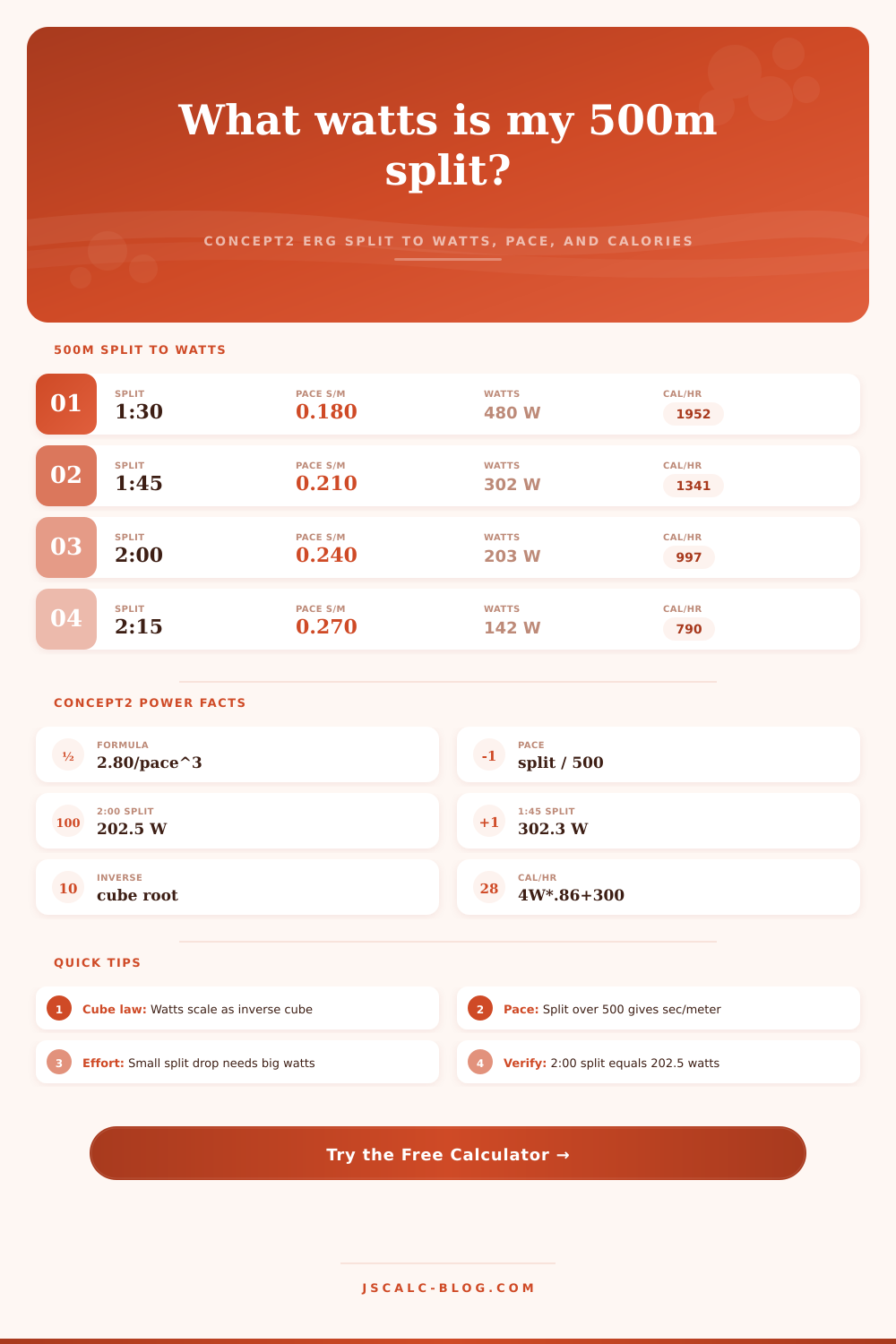
Turn any 500m erg split into watts, pace per meter, and calories per hour using the official Concept2 power formula. Work either direction, split to watts or a target watts back to a 500m split.
🚣Split and Watts Presets
📝Rowing Inputs
Used in split to watts mode.
2:00.0 means 2 min and 0.0 sec per 500m.
Used in watts to split mode.
Strokes per minute for watts-per-stroke.
Shows watts per kilogram of body weight.
Projects finish time at this 500m split.
🔢Formula Snapshot
📊500m Split to Watts Chart
| 500m Split | Split Seconds | Pace (s/m) | Watts | Cal/hr |
|---|---|---|---|---|
| 1:20 | 80.0 | 0.1600 | 683.6 W | 2653 |
| 1:25 | 85.0 | 0.1700 | 569.9 W | 2261 |
| 1:30 | 90.0 | 0.1800 | 480.1 W | 1952 |
| 1:40 | 100.0 | 0.2000 | 350.0 W | 1504 |
| 1:45 | 105.0 | 0.2100 | 302.3 W | 1341 |
| 1:50 | 110.0 | 0.2200 | 262.9 W | 1205 |
| 2:00 | 120.0 | 0.2400 | 202.5 W | 997 |
| 2:15 | 135.0 | 0.2700 | 142.3 W | 790 |
| 2:30 | 150.0 | 0.3000 | 103.7 W | 657 |
⚡Watts to 500m Split Chart
| Watts | Pace (s/m) | 500m Split | Cal/hr | Typical Use |
|---|---|---|---|---|
| 100 W | 0.3037 | 2:31.8 | 644 | Easy warm-up |
| 150 W | 0.2653 | 2:12.6 | 816 | Base cardio |
| 200 W | 0.2410 | 2:00.5 | 988 | Steady state |
| 250 W | 0.2237 | 1:51.9 | 1160 | Threshold work |
| 300 W | 0.2105 | 1:45.3 | 1332 | Hard intervals |
| 400 W | 0.1912 | 1:35.6 | 1677 | Race pace |
| 500 W | 0.1776 | 1:28.8 | 2021 | Sprint effort |
| 600 W | 0.1670 | 1:23.5 | 2365 | All-out power |
🎯Training Pace Zones
| Zone | Effort | 500m Split Range | Watts Range | Focus |
|---|---|---|---|---|
| UT2 | Light aerobic | 2:20 to 2:45 | 85 to 128 W | Long steady base |
| UT1 | Moderate aerobic | 2:05 to 2:20 | 128 to 179 W | Endurance volume |
| AT | Anaerobic threshold | 1:55 to 2:05 | 179 to 226 W | Tempo and threshold |
| TR | Transport intervals | 1:45 to 1:55 | 226 to 302 W | VO2 max intervals |
| AN | Anaerobic power | 1:25 to 1:45 | 302 to 570 W | Short sprints |
🗂Split and Watts Comparison Grid
| Scenario | 500m Split | Pace (s/m) | Watts | Cal/hr | Effort Level |
|---|---|---|---|---|---|
| Recovery row | 2:45.0 | 0.3300 | 77.9 W | 568 | Very easy |
| Beginner steady | 2:30.0 | 0.3000 | 103.7 W | 657 | Easy |
| Steady state | 2:15.0 | 0.2700 | 142.3 W | 790 | Moderate |
| Common benchmark | 2:00.0 | 0.2400 | 202.5 W | 997 | Comfortably hard |
| Threshold push | 1:52.5 | 0.2250 | 245.8 W | 1146 | Hard |
| Fast intervals | 1:45.0 | 0.2100 | 302.3 W | 1341 | Very hard |
| Sprint pace | 1:30.0 | 0.1800 | 480.1 W | 1952 | Near maximal |
| Elite sprint | 1:25.0 | 0.1700 | 569.9 W | 2261 | Maximal |
🔥Calories per Hour by Watts
| Watts | Cal/hr Formula | Calories per Hour | Calories per Minute |
|---|---|---|---|
| 100 W | 4 × 100 × 0.8604 + 300 | 644 | 10.7 |
| 150 W | 4 × 150 × 0.8604 + 300 | 816 | 13.6 |
| 200 W | 4 × 200 × 0.8604 + 300 | 988 | 16.5 |
| 250 W | 4 × 250 × 0.8604 + 300 | 1161 | 19.3 |
| 300 W | 4 × 300 × 0.8604 + 300 | 1332 | 22.2 |
| 400 W | 4 × 400 × 0.8604 + 300 | 1677 | 27.9 |
⚙Full Formula Breakdown
📋Reference Values
| Item | Value | How It Is Used | Notes |
|---|---|---|---|
| Power constant | 2.80 | Numerator of 2.80 / pace^3 | Concept2 official value |
| Split length | 500 m | Divides split time for pace | Standard erg reference |
| Cal factor | 0.8604 | Multiplies 4 × watts | Concept2 calorie model |
| Cal offset | 300 | Added after the multiply | Baseline metabolic term |
| Cube exponent | 3 | Raises pace to the power | Drives steep watts curve |
💡Practical Rowing Tips
When you get on Concept2 rower, there’s no mistaking it: here’s your moment. The screen lights up and those number appear. They are going to measure how well you do.
For most casual rower, it becomes all about the 500m split time; it feels like speed. A two-minute split is slow, while a 1:55 looks fast. That’s where the math gets you. The screen show time per five hundred meters, but the flywheel measure power. Wattage is the reason for time as a side effect. Chase the clock at your own peril if you don’t understand the price in energy. Burnout comes quickly and so does leaving some speed on the table if you didn’t went hard enough early on.
How to Read Your Rower Screen
Your output is related to your split in a cube-like way. Almost no one gets tripped up by a square or linear relationship but cubic? Cubic will get ya. Once you input target pace, the calculator does the rest. It spares you from doing math with exponents by hand. It just takes that split time and break it down into seconds per meter. Then, it uses the official Concept2 constant to do all the work. And what’s the constant? Two point eight zero. It’s baked in by design so all ergometer speak the same language. From there you have a wattage number that reflects what you’re putting out.
But wait! There’s more. You can turn it around as well. Maybe you want to put out three hundred watts during an interval. No problem. Just use the tool to flip the equation. Figure out exactly how long it should of take you to hold that power for five hundred meters. Make the vague goal of energy become a real pacing target.
That’s where cubic scaling comes into play. Small differences in speed demand large variations in work output. If you’re thinking linearly, maybe that sounds doable. Maybe you can shave fifteen seconds off a two minute split. Pace, however, gets cubed in this equation. To knock off those fifteen seconds from a two-minute base, you have to make a huge leap up in watts. You’re not simply going a little quicker, you’re forcing a lot more air through the drag factor. This is why sprinting feels so much harder than it looks on paper. On paper it doesn’t look like much but the numbers quickly soar as you near maximal effort.
Going from two minutes down to one forty-five is approximately an additional hundred watts of output. That’s no small change. It transforms your form, your breathing and your heart rate instantly.
Also included next to the wattage will be number of calories per hour. This number is an estimate generated by the machine’s own algorithm. Essentially it takes your power, times that by an efficiency factor plus a base line amount of metabolic cost. This gives you an idea of your total volume for a long, steady-state workout. But don’t think of them like nutrition labels. There is no way any ergometer can measure individual metabolic variation or body composition. It is there so you know how much energy you expended through the workout. It is especially helpful when you do two different workouts, different than one long moderate session and one short intense session.
Rowers often compare themselves to other rowers. That’s fine, as long as you use watts per kilo to even the playing field. And you should also use it over time to monitor improvement. It is true that a heavier rower has more mass to move. There is also more inertia to overcome. Rowing output adjusted for weight paints a cleaner picture of relative power.
The rowing zones are spelled out nicely in the embedded page of reference tables. They explain where your easy aerobic range ends and anaerobic threshold begins. Holding red line intensity too long is the most common cause of training errors, and trying to hang out in the gray areas of neither stimulus nor recovery is another one.
Define your boundaries with the tool prior to pulling on the oars. Then let the numbers do their talking, telling you what’s realy going on under the surface tension of the flywheel. If you know how to read it, the screen doesn’t lie.