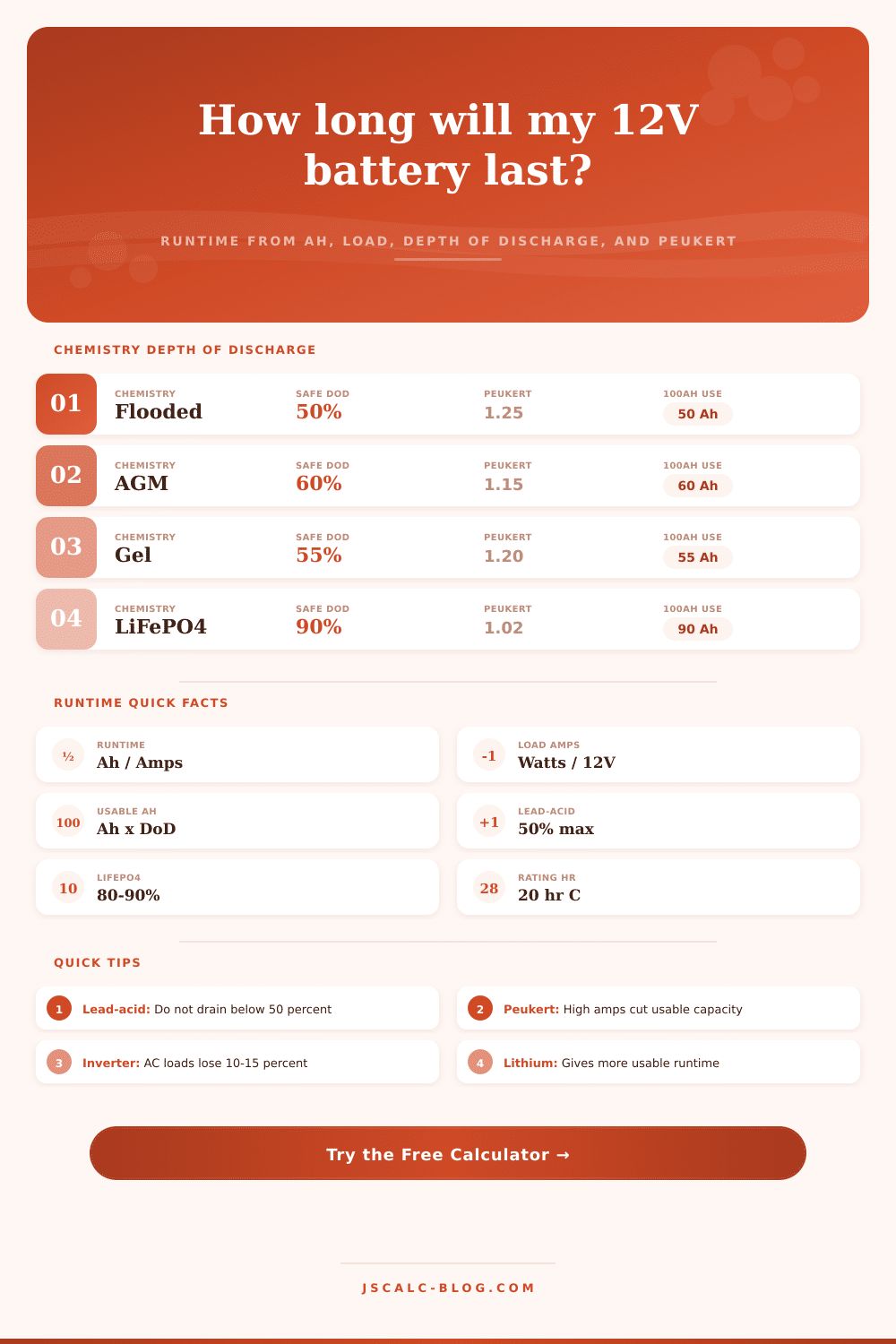
12 Volt Battery Life Calculator
Estimate how long a 12V battery will run a load. Enter capacity in amp-hours, pick a chemistry with its safe depth of discharge, set the load in watts or amps, and see runtime before and after the Peukert correction.
🔋Real Battery Presets
📝Battery & Load Inputs
Rated at the 20 hour discharge rate on most spec sheets.
Usable share of capacity. Lead-acid lasts longer near 50%.
Used when load method is watts.
Used when load method is amps.
Applies only to AC loads. 85-92% is typical.
Nominal 12V for a standard 12 volt battery bank.
1.02 lithium, 1.1-1.3 lead-acid, higher for old cells.
🔢Formula Snapshot
🔌Chemistry Depth of Discharge Limits
| Chemistry | Safe DoD | Typical Peukert k | Usable from 100Ah | Cycle Note |
|---|---|---|---|---|
| Flooded lead-acid | 50% | 1.20 to 1.30 | 50 Ah | Deeper drains shorten life |
| AGM | 50% to 60% | 1.10 to 1.20 | 60 Ah | Handles higher current well |
| Gel | 50% to 60% | 1.15 to 1.25 | 55 Ah | Sensitive to fast charging |
| Deep-cycle lead-acid | 50% to 70% | 1.15 to 1.25 | 60 Ah | Built for repeated cycling |
| LiFePO4 lithium | 80% to 100% | 1.01 to 1.05 | 90 Ah | Flat voltage, near-linear |
📊Runtime by Load on a 100Ah Battery
| Load | Amps at 12V | Runtime 50% DoD | Runtime 80% DoD | With Peukert 1.25 |
|---|---|---|---|---|
| 12 W | 1.0 A | 50.0 h | 80.0 h | 62.9 h |
| 24 W | 2.0 A | 25.0 h | 40.0 h | 26.4 h |
| 60 W | 5.0 A | 10.0 h | 16.0 h | 8.4 h |
| 120 W | 10.0 A | 5.0 h | 8.0 h | 3.5 h |
| 240 W | 20.0 A | 2.5 h | 4.0 h | 1.5 h |
| 360 W | 30.0 A | 1.7 h | 2.7 h | 0.9 h |
⚡Peukert Effect at Different Exponents
| Peukert k | Battery Fit | 50Ah Usable / 5A | 50Ah Usable / 10A | 50Ah Usable / 20A |
|---|---|---|---|---|
| 1.02 | LiFePO4 lithium | 9.9 h | 4.9 h | 2.4 h |
| 1.10 | Good AGM | 9.3 h | 4.4 h | 2.0 h |
| 1.20 | Healthy flooded | 8.7 h | 3.8 h | 1.6 h |
| 1.25 | Average lead-acid | 8.4 h | 3.5 h | 1.5 h |
| 1.35 | Aging or cold cell | 7.8 h | 3.1 h | 1.2 h |
📈Load and Depth of Discharge Comparison Grid
| Load (W) | Amps (12V) | Usable Ah 50% | Runtime 50% | Runtime 80% | Runtime 100% | Peukert 50% k1.25 |
|---|---|---|---|---|---|---|
| 10 W | 0.8 A | 50 Ah | 60.0 h | 96.0 h | 120.0 h | 83.1 h |
| 25 W | 2.1 A | 50 Ah | 24.0 h | 38.4 h | 48.0 h | 24.9 h |
| 50 W | 4.2 A | 50 Ah | 12.0 h | 19.2 h | 24.0 h | 10.5 h |
| 75 W | 6.3 A | 50 Ah | 8.0 h | 12.8 h | 16.0 h | 6.3 h |
| 100 W | 8.3 A | 50 Ah | 6.0 h | 9.6 h | 12.0 h | 4.5 h |
| 150 W | 12.5 A | 50 Ah | 4.0 h | 6.4 h | 8.0 h | 2.7 h |
| 200 W | 16.7 A | 50 Ah | 3.0 h | 4.8 h | 6.0 h | 1.9 h |
| 300 W | 25.0 A | 50 Ah | 2.0 h | 3.2 h | 4.0 h | 1.1 h |
🔌Common 12V Device Draws
| Device | Typical Watts | Amps at 12V | Runtime on 50Ah Usable |
|---|---|---|---|
| LED light strip | 6 W | 0.5 A | 100.0 h |
| CPAP machine (no humidifier) | 30 W | 2.5 A | 20.0 h |
| 12V compressor fridge | 45 W | 3.8 A | 13.2 h |
| Laptop via inverter | 65 W | 6.0 A | 8.3 h |
| Starlink dish | 75 W | 6.9 A | 7.2 h |
| Roof vent fan | 24 W | 2.0 A | 25.0 h |
| Trolling motor (low) | 360 W | 30.0 A | 1.7 h |
⚙Full Formula Breakdown
💡Practical Runtime Tips
Knowing how long your power will last removes anxiety from off-grid living.
You get a dead screen on your devices and sudden silence from your lights. How long will your batteries holds out? When will you find yourself stuck in the dark? The truth is, it’s not as simple as battery size. It requires current draw, battery chemistry, and efficiency losses that many tends to ignore until it’s too late.
How to Know How Long Your Battery Lasts
Enter in your load and your capacity, and the calculator above will take care of math for you. No need to guess what conversion or coefficient is right. However, understanding how those numbers work help you understand your results.
First, let’s talk a little bit about depth of discharge. Depth of discharge refers to amount of battery that is usable. It is the amount you can spend before damaging cell prematurely. Lead acid batteries are generaly not good if you drain them completely. It’s better to keep them above half way point to get best performance. If you treat them like empty buckets, they’ll go bad fast.
Lithium, however, is different. There’s no penalty for using 90% or more of its rated capacity. That’s why a one-hundred-amp hour lithium pack feels like double the size of a one-hundred-amp hour lead acid pack. Although the numbers on box are the same, the usable energy is not even close. Here you’re paying for density and longevity.
Run time is impacted by something called the Peukert effect. Don’t worry; it’s actualy nothing more complicated than internal resistance and heat. When you extract current rapidly from a lead-acid battery, its capacity decrease. This means a 20 hour battery at one amp won’t be a 10 hour battery at two amps. Why? Because pulling high current stress the chemical reactions in the cell. This results in wasted energy being converted into heat rather than supply your load. Lithium cells are far less affected by this, making their runtimes more predictable.
To account for this, the tool allows you to set the exponent according to your chemistry and to switch between alternating and direct current loads. If you’re running any sort of AC appliance based off an inverter, there is losses in the conversion process that reduce efficiency. Less efficient means less time until you run out of power. It’s a small percentage loss per device but over the course of a long day of boating or camping it adds up.
Consider what you’ll be using it for when buying gear. Is it something that will require high power in short bursts (motor or winch)? Or do you have lots of electronics/lighting that pulls steady low draw? As we discussed above with the Peukert effect, lead-acid batteries really get hammered by high burst applications. Steady low loads is more forgiving on older chemistries. Using the correct battery type for your load profile avoids being disappointed down the road.
A lot of folks see total amp hours listed on the label and assume that’s all they’ll get. But that figure is based off perfect conditions, which we don’t often find in real life. Aging cells, temperature variations, and shoddy wiring can all be factors. You’re better off having more power than not because then, when you’re trying to charge your phone while your lights are dimming it won’t matter as much.
A lot of battery planning isn’t an exact science; it’s adding a margin of safety. How much extra do I need? You need enough in case the temperature gets cold and slows down those chemical reactions. Or you might accidental go overboard on something. The calculator provides a starting point. Understanding your limitations and how much you can do serve as your safety net.
Understanding your battery capacity takes the worry out of living off the grid. It makes it a plan instead of a guess. Knowing your discharge rate and depth of discharge means that when the dark hours approach, you no longer have to guess what’s in store for you. You know what you need to bring along with you, just enough to see yourself through comfortabley. And that peace of mind is far better then an additional amp hour.