Win Rate Calculator
Find your win percentage from wins, losses, and optional draws, then see exactly how many all-win games you need to climb to any target win rate, plus your record, ratio, and win streak impact.
🎯Quick Win Rate Presets
📝Match Record Inputs
Ties, remakes, or overtime pushes. Counted using the rule above.
Used for the target and win streak modes.
Cannot exceed the next games above.
🔢Formula Snapshot
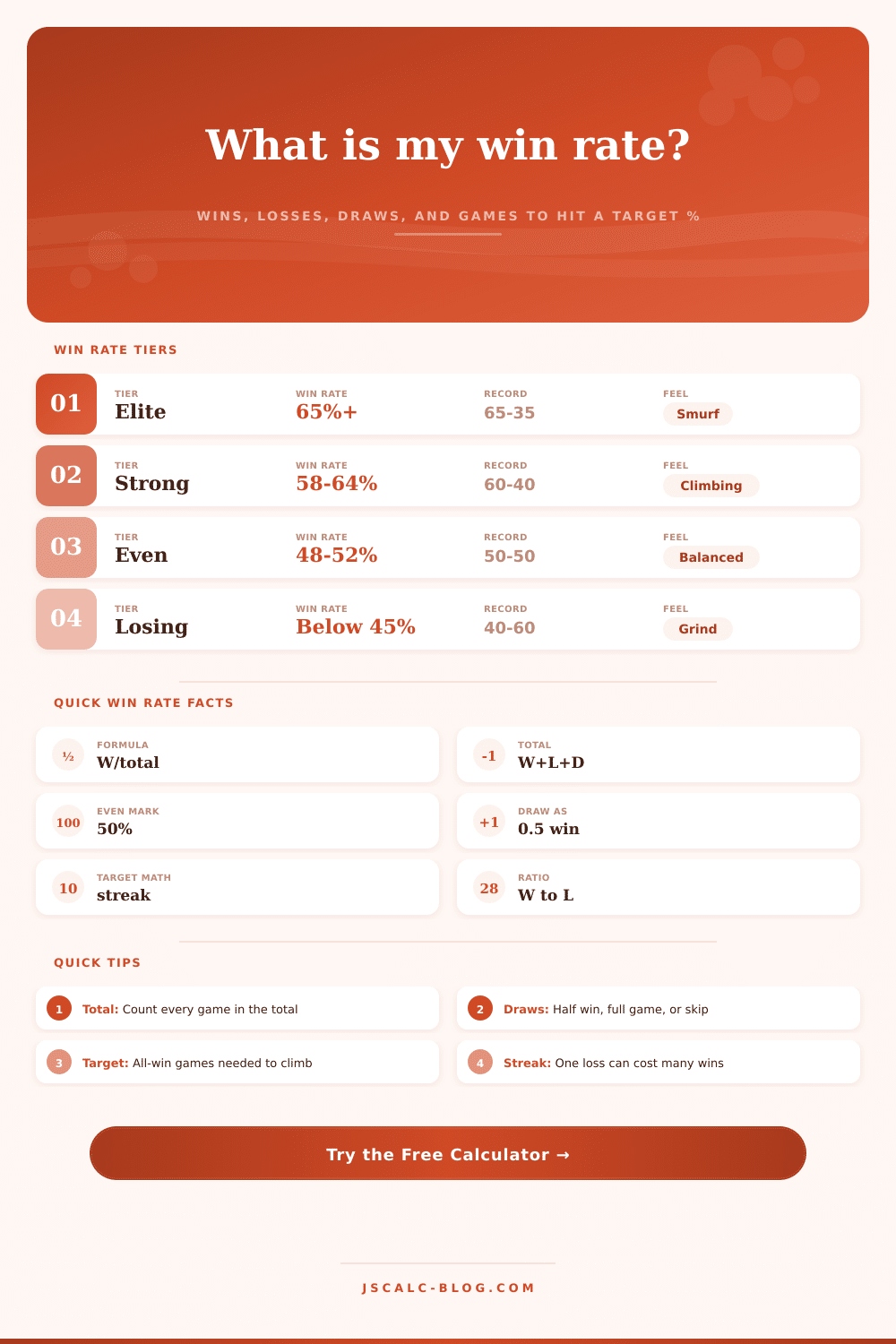
🏅Win Rate Skill Tiers
| Tier | Win Rate | Sample Record | What It Usually Means |
|---|---|---|---|
| Hard carry | 65% and up | 65-35 | Far above the lobby, steady rank gains |
| Strong | 58% to 64% | 60-40 | Reliable climbing, above average skill |
| Positive | 53% to 57% | 55-45 | Slow steady climb over a season |
| Even | 48% to 52% | 50-50 | Roughly at your true rank, no drift |
| Slipping | 45% to 47% | 46-54 | Gentle decline, small changes fix it |
| Losing | Below 45% | 40-60 | Below the lobby, review fundamentals |
📈Straight Wins Needed For Target
| Target Rate | From 45% | From 50% | From 55% | From 60% |
|---|---|---|---|---|
| Enter values above to calculate the wins needed table. | ||||
Each cell assumes a 200-game base at the starting rate, then counts straight wins with no further losses.
🗂Win / Loss To Percentage Reference
| Wins | Losses | Total | Win Rate | W:L Ratio |
|---|---|---|---|---|
| 5 | 5 | 10 | 50.0% | 1.00:1 |
| 6 | 4 | 10 | 60.0% | 1.50:1 |
| 7 | 3 | 10 | 70.0% | 2.33:1 |
| 11 | 9 | 20 | 55.0% | 1.22:1 |
| 13 | 12 | 25 | 52.0% | 1.08:1 |
| 27 | 23 | 50 | 54.0% | 1.17:1 |
| 58 | 42 | 100 | 58.0% | 1.38:1 |
| 130 | 70 | 200 | 65.0% | 1.86:1 |
⚡Win Streak Impact Grid
| Next Games | All Wins | 3 of 4 Wins | Half Wins | 1 of 4 Wins | All Losses |
|---|---|---|---|---|---|
| Enter values above to calculate the streak impact grid. | |||||
Each cell shows the new win rate after adding that block of games to your current record.
⚙Full Formula Breakdown
📋Reference Values
| Item | Common Entry | How It Is Used | Effect On Win Rate |
|---|---|---|---|
| Wins | Any whole number | Numerator of the rate | Each win raises the percentage |
| Losses | Any whole number | Adds to the total only | Each loss lowers the percentage |
| Draws | 0 to a few dozen | Half, full game, or skip | Half rule pulls toward 50% |
| Target % | 50% to 70% | Goal for the climb | Higher target needs more wins |
| Next games | 5 to 50 | Block added to record | Sets how fast the rate moves |
💡Practical Win Rate Tips
I think what can frustrate people is you play 10 games in a row and no matter how well you did, you’re still the same rank. What’s happening there is you are looking at raw number (wins) rather then the percentage that actualy moves you forward. “Your brain says ‘five wins, yea!’ But the system need sixty percent over two hundred games to move. Most people gets hung up on that space between feels good and ranks up.
It’s not as much about being a better player, it’s knowing how many games before math catches up with you improving. That’s where the calculator on this page come in. By entering your record, including wins, losses and draws, if applicable, you get a simple projection: What percent are you at right now? How many wins would it take in a row to reach X number?
How the Win Rate Calculator Helps You
It’s incredibly helpful for breaking out of plateaus; when you’re hitting 52 percent and you want to get to 55, for instance, you can plug it in and see that it’ll take fifteen straight wins. Rather than having a general idea that “I want to improve,” you’ve got a number that feels like an actualy goal to strive for. It moves something abstract from your mind into something real.
There’s one wrinkle that trips a lot of people up: how do you account for draws (or ties)? Depending on the format, a draw may be considered half a win. On others, it’s just another game where neither player came out on top so it counts towards your overall sample size. You’re able to select this option when using the calculator, and it has a significant impact on your denominator in the equation. If you consider a draw as zero, it will lower your rate even more than if you count it as half a win.
That might seem like a small change. However, it could make all the difference in whether matchmaking system sees you as slightly below average or evenly matched with someone else. If you get this baseline correct, then your goal targets are real world and not inflated.
But even beyond the numbers themselves, one must think about idea of sample size. Ten games sounds like a ton if you’re winning 70% of them, but it’s still statistically irrelevant. Luck plays a huge part when dealing with such a small data set. Two-hundred games? If you are winning at a seventy percent clip, then congratulations, you are definitely getting better. You are dominating.
The included reference table within the tool also give context for how your current place ranks against standard benchmarks. For example, knowing that a sixty-five percent win rate puts you in the elite tier makes you realize exactly why it’s such a challenge going from fifty-five to sixty percent. As you get closer and closer to perfect, each additional percentage point require exponentially more clean wins. Purely due to the fact that every loss hurts your total number more and more, until there is no room left to improve.
The nature of variance means things don’t always get better. Sometimes you’ll go on a hot streak where everything goes right, other times your teammates are unplayable and you go 0-3 despite playing flawlessly for an hour. That’s why it’s important to track your rate over time rather than just one particular session.
The streak impact part of the calculator tell you how much your overall standing will change by adding a block of wins. It illustrates how much it matters to protect a win streak. If you lose one game after going five games, that essentially undoes most of the work you’ve done; whereas if you go five games losing every time, then you has to go ten games winning every time before you’re back to an even record. That asymmetry makes it feel like you’re pushing a boulder uphill, trying to climb. When you make a mistake, know that math is not in your favor.
But beyond that: just playing well isn’t enough. To get the system to notice that you’re good, you have to beat other people more often than you lose to them across some large enough number of games. The tool helps you understand what’s going on between those two things, it helps distinguish between signal and noise. It prevents you from giving up when you go through a rough hour and keeps you honest when you luck into a great one.
It shifts your mentality away from trying to win each game individually and towards accumulating a streak that stands a chance of lasting more than a few matches. When you focus on the percentage instead of the points, you’ll begin to view it as a long-term goal. This is exactly what it takes if you want to compete seriously.