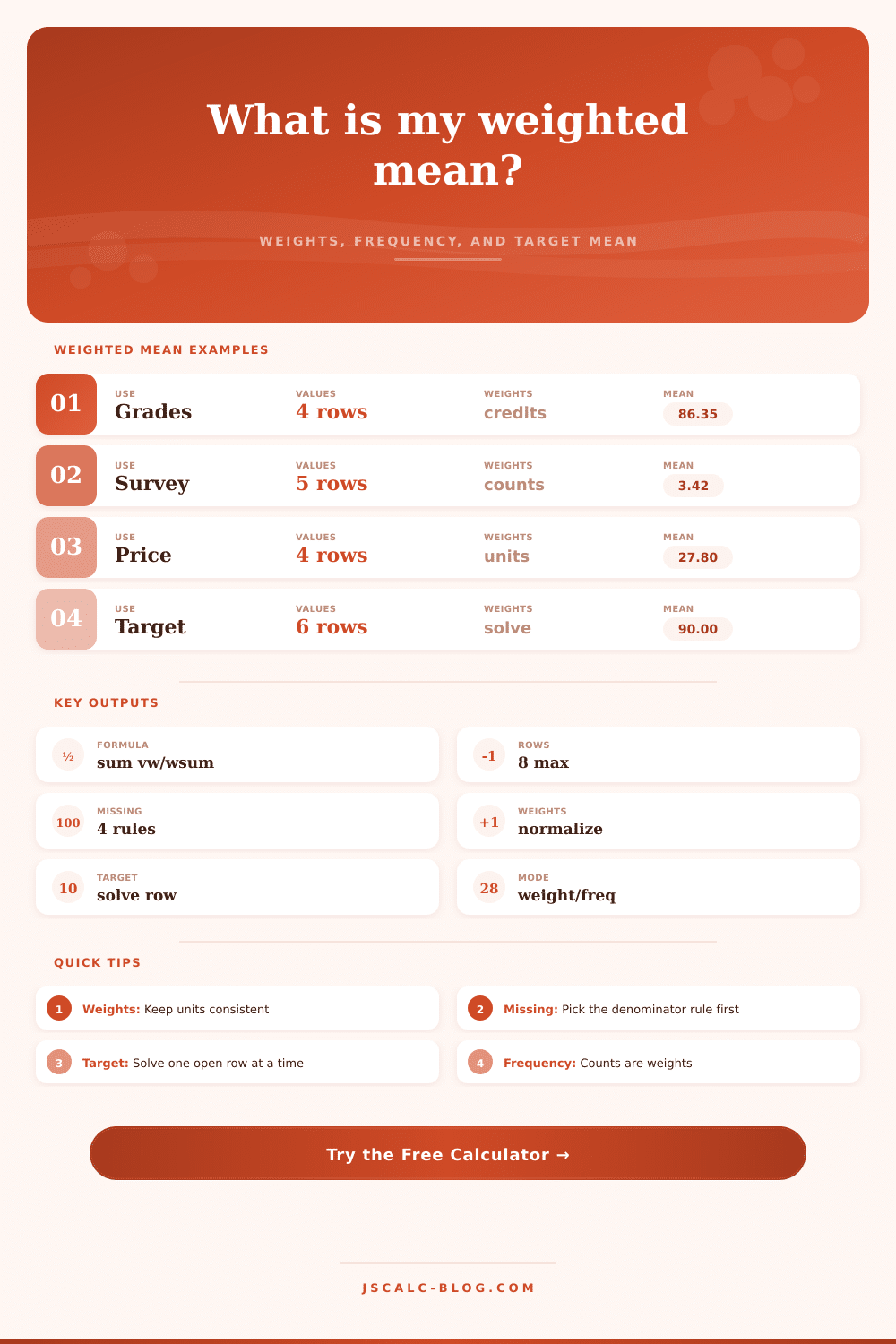
Weighted Mean Calculator
Calculate a weighted mean from values and weights, normalize the weight share, handle missing values, use grouped frequency counts, and solve the value needed to reach a target mean.
Load a real weighted-average case, then edit any label, value, weight, or missing-row rule.
Formula: weighted mean = sum(value x weight) / sum(weight).
Enter up to eight rows. Leave a value blank to test missing-value rules; set weight to zero to remove a row from the denominator.
| Row | Value used | Weight used | Normalized weight | Value x weight | Status |
|---|---|---|---|---|---|
| Enter values and weights to calculate row contributions. | |||||
| Target mean | Gap from current | Needed value in solved row | Within expected range | Denominator after solve |
|---|---|---|---|---|
| Target planning appears after calculation. | ||||
| Method | Formula | Inputs used | When to use |
|---|---|---|---|
| Weighted mean | sum(value × weight) / sum(weight) | Each used value and its effective weight | Grades, indexes, rates, or any value with importance weights. |
| Normalized weight | row weight / sum(weight) | Effective row weight and denominator | Shows each row's share after missing rules and exclusions. |
| Grouped frequency mean | sum(value × frequency) / sum(frequency) | Bin midpoint or score and count | Use when values repeat and the weight is a count. |
| Missing as target | blank value = target mean | Target input and blank rows | Useful for what-if planning, not earned results. |
| Target solved value | x = (target × (known weight + row weight) - known numerator) / row weight | Known rows, selected row weight, target mean | Finds the score or value needed in one unfinished row. |
Equal items are fine with a simple average. Not-so-equal items? Not so fine. A simple average suggest you did pretty well with an 80 on a three-hundred point exam and a 95 on a ten point assignment. But wait! That final exam is far more important. But wait! That final exam is far more important.
That’s where the weighted mean comes in: it accounts for weight. The result are pulled by heavy hitters. It’s not just arithmetic, it’s a way of measuring influence.
What Is a Weighted Mean?
After entering your weights and numbers, the calculator does the math for you. Simply place your prices (or scores) in the left-hand column, and your counts (or credit hours) in the right-hand column. The calculator will then multiply across columns to determine each line’s weighted contribution.
Students frequently fall into mental traps: They obsess about scoring well but overlook low weights. The weighted mean show what actualy matters. If the final exam receives the lion’s share of the weight, that quiz where you scored 100% won’t feel as comforting.
If your input data is a bit of a mess, the tool will help you normalize weights. For example, maybe you used raw survey counts instead of percentages and they add up to something less than 100%. Or perhaps they’re just slightly off because people didn’t finish all surveys. In these cases, normalization changes denominator such that weights add up to 1; i.e., it accounts for the gaps and makes sure each data point contribute to total.
Again, it’s about reflecting the real world… The active weight, rather than the theoretical maximum weight. That way the average doesn’t get thrown off. In lots of cases, the absence of information is itself problematic. In school an ungraded quiz goes unnoticed; on a portfolio, it can become a missing holding that’s counted as zero.
With this calculator, you can choose to skip blanks, fill them with zero, or fill them with target mean. Skip them and they don’t count at all. Fill them out with a zero and consider yourself a failure. Or, fill them in with the target mean. That’s not so much about calculating as it is about planning. If you fill in the blanks with the target mean, it give you some idea of what needs to happen to keep your average on track. That’s valuable for strategic reasons. That’s valuable for strategic reasons.
This also means it can solve for targets. If you want to maintain your scholarship and only have one test remaining, how many points do you have to get? How many points does she need? What if I tell you the calculator will tell you the exact number? It goes against that outcome. It solves for x. You enter in your target and it provides the answer. It takes an abstraction, a concern, and makes it tangible: Instead of hoping, you know exactly what you have to do.
There’s a tendency for folks to mix up weight with value. Value is what you’re trying to measure… Like a 1-5 rating, or whatever. Weight is importance of that value, like how many people rated it a 5? How many rated it a 1? The more people rate it a five, the more the overall rating ought to skew five. Giving everyone equal power is simple: a mean. But giving more weight to the bigger crowd is a weighted mean, which accounts for volume.
This weighted mean make everything fair: it gives weight to things that matter. It doesn’t drown them in trivia. That’s true for portfolio return, average cost, or grade point average. Some information has more mass than others. The calculator gets that mass right.
Instead of guesswork, you know why the average is where it is. Rather than mixed numbers, it creates a clear story about your performance. That clarity let you see where you stand, and what to do next.