Water pH Adjustment Calculator
Estimate the acid or base dose needed to raise or lower water pH. Direction is chosen automatically from your current and target pH, and total alkalinity sets the carbonate buffering that drives the real dose.
💧Real Water pH Presets
📝Water and Chemical Inputs
Also called carbonate hardness or KH. Higher alkalinity means more chemical is needed.
Percent of the label strength you are actually using. 100 uses the reference concentration.
🔢Dosing Snapshot
🧪Chemical Strength Reference
| Chemical | Form | Reference Strength | Dose Unit | Neutralizing Power | Moves pH |
|---|---|---|---|---|---|
| Muriatic acid | Liquid | 31.45% HCl | mL | ~10.0 meq/mL | Down |
| Sulfuric acid | Liquid | 35% H2SO4 | mL | ~9.0 meq/mL | Down |
| Phosphoric acid | Liquid | 85% (pH Down) | mL | ~14.6 meq/mL | Down |
| Citric acid | Dry powder | Anhydrous | g | ~15.6 meq/g | Down |
| Soda ash | Dry powder | Na2CO3 | g | ~18.9 meq/g | Up |
| Baking soda | Dry powder | NaHCO3 | g | ~11.9 meq/g | Up |
| Potassium hydroxide | Liquid | 45% KOH (pH Up) | mL | ~10.4 meq/mL | Up |
| Potassium carbonate | Dry powder | K2CO3 | g | ~14.5 meq/g | Up |
🎯Ideal pH by Application
| Application | Ideal pH Range | Typical Alkalinity | Common Direction | Notes |
|---|---|---|---|---|
| Hydroponics | 5.5 to 6.5 | Low, 0 to 80 | Lower | Nutrient uptake window |
| Aquarium (community) | 6.5 to 7.8 | 60 to 140 | Both | Adjust slowly for fish |
| Reef / marine | 8.1 to 8.4 | 140 to 215 | Raise | Alkalinity dosed too |
| Drinking water | 6.5 to 8.5 | Varies by source | Both | Corrosion control target |
| Irrigation / garden | 5.5 to 7.0 | Varies by well | Lower | Improves nutrient tie-up |
| Pond / water feature | 6.8 to 8.0 | 80 to 200 | Both | Buffer against swings |
⚖Acid vs Base Options
| Option | Category | Strength | Direction | Typical Use | Caution |
|---|---|---|---|---|---|
| Muriatic acid | Strong acid | 31.45% | Lower pH | Pools, wells, tanks | Fumes, wear gloves |
| Sulfuric acid | Strong acid | 35% | Lower pH | Irrigation, industrial | Very corrosive |
| Phosphoric acid | Weak acid | 85% | Lower pH | Hydroponics pH Down | Adds phosphate |
| Citric acid | Weak acid | Dry | Lower pH | Spas, gentle drop | Feeds biofilm |
| Soda ash | Strong base | Dry | Raise pH | Pools, ponds | Can cloud water |
| Baking soda | Mild base | Dry | Raise pH | Gentle buffer up | Raises alkalinity |
| Potassium hydroxide | Strong base | 45% | Raise pH | Hydroponics pH Up | Caustic, wear gloves |
| Potassium carbonate | Strong base | Dry | Raise pH | Reef, hydroponics | Adds potassium |
📈Alkalinity Effect on Dosing
| Alkalinity (mg/L) | Buffer Level | Relative Acid Need | pH Stability | Guidance |
|---|---|---|---|---|
| 0 to 40 | Very low | Minimal | Swings fast | Dose tiny, retest |
| 40 to 80 | Low | Light | Fairly reactive | Small steps work |
| 80 to 120 | Moderate | Medium | Balanced | Typical tap range |
| 120 to 180 | High | Heavy | Resists change | Expect larger dose |
| 180 to 260 | Very high | Very heavy | Very stable | Lower alkalinity first |
⚙Full Formula Breakdown
📋Dosing Reference Values
| Item | Common Entry | How It Is Used | Effect on Dose |
|---|---|---|---|
| Water volume | 10 to 1000+ L | Scales total equivalents | Dose scales linearly |
| pH gap | 0.3 to 2.0 units | Sets H+ and buffer fraction | Bigger gap, bigger dose |
| Alkalinity | 20 to 260 mg/L | Buffer meq = V × A / 50 | Main driver of dose |
| Chemical strength | 1% to 100% | Divides into required meq | Weaker chem, more volume |
| Neutralizing power | meq per mL or g | Converts meq to amount | Stronger chem, less needed |
💡Practical pH Adjustment Tips
You pour water into your hydroponic reservoir and watch the pH meter flicker. It’s reading seven point eight. You’re trying for six point five. What do you do? Do you reach for the bottle of muriatic acid? Do you squirt in a splash, stir, and hope for the best? That will work, if you’re lucky. If your water is high in alkalinity, however, then it’ll act like a sponge; it soaks up that acid without allowing pH level to shift.
To understand why this matters, you have to see what is inside that glass of water. It’s not so simple Water isn’t behaving like simple arithmetic when there are dissolved minerals resisting changes in pH. We call this alkalinity, which is also referred to as carbonate hardness. Alkalinity is sort of the buffer zone, if your alkalinity is too low, adding a single drop of acid can tank your pH into dangerous territory. If your alkalinity is too high, you could pour half a cup of base in and barely budge the needle.
Why Alkalinity Matters for pH Control
Once you plug in your alkalinity readings and volume into the calculator above, it do the math for you. It will save you from treating symptoms instead of causes. But no one does that second number…which is most commonly missed part of the equation. Yes, everyone measures their pH but not so many measure their total alkalinity. And it’s alkalinity that tells you just how much chemical you’ll have to add. Alkalinity sets weight on scale.
For example, if your well water has two hundred parts per million of alkalinity and you’re looking to reduce its pH, you have a heavy buffer to fight. To change the pH down in that situation require far more acid than a person who is treating rainwater which has very close to zero alkalinity. This tool takes into account that fact and scales dose to reflect that carbonate buffer need. Also, that demand is typically much greater then what you would need just to change hydrogen ion levels.
The amount is important, but so is the choice of chemical. A stronger one does more with less, but not all are created equal. Baking Soda raises pH by adding Alkalinity & Potassium, which is good for reefs. However, it accumulates in hydro systems that already has lots of Sodium. Citric Acid is safer than muriatic acid but also acts as food for bacterial growth in lines over time. Muriatic acid is very effective and inexpensive but beware: it fumes and burns. Neutralizing power is laid out in the table on that page, which also explains why a milliliter of weak base doesn’t do the same thing as a milliliter of strong acid. Match strength of chemical to the sensitivity of what you’re applying it to.
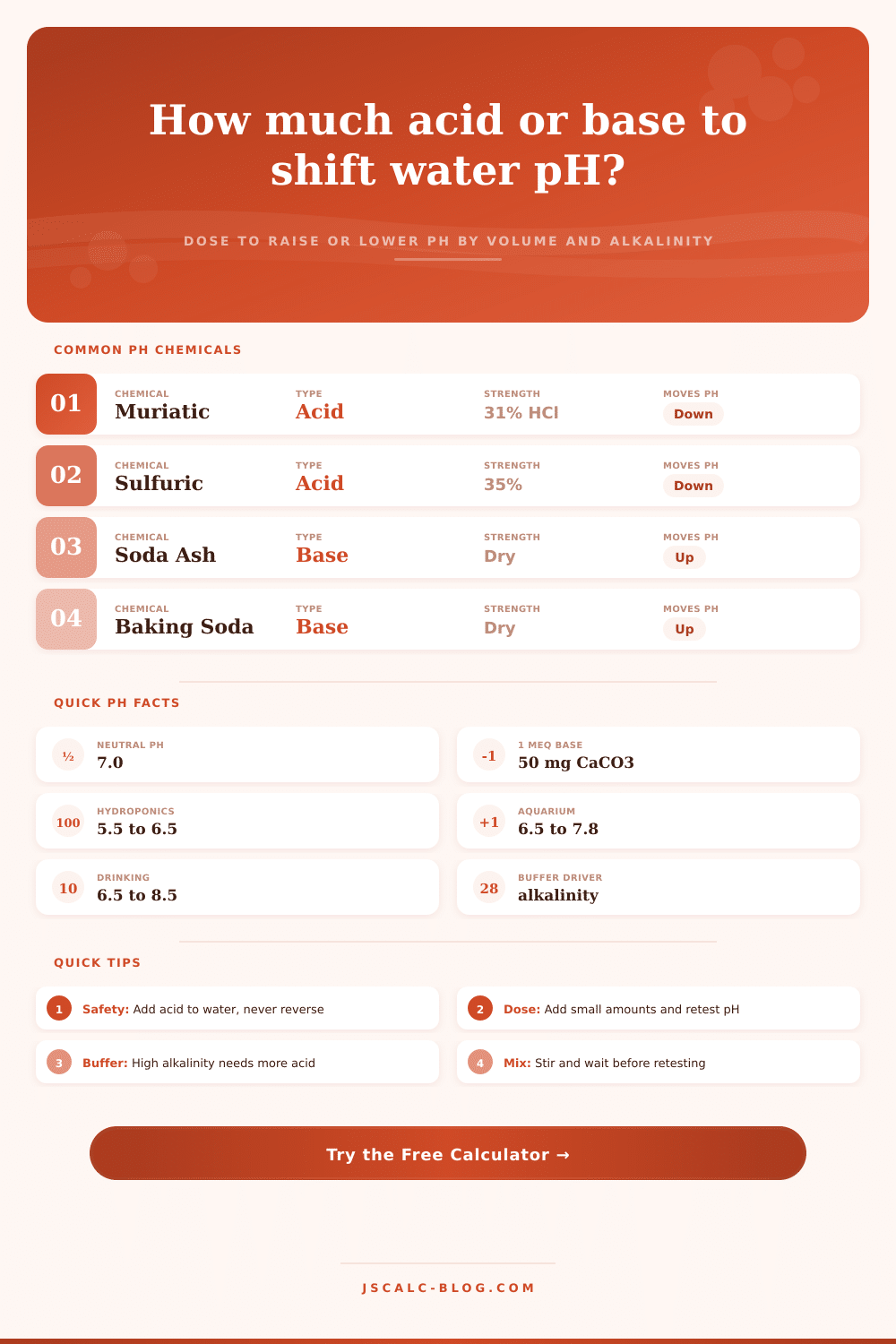
Keep in mind: safety is most important with such high concentrations of acid/base solutions. Never put water into an acid; always pour acid into water. Muriatic (or sulfuric) acid will boil immediately if you pour water into it and splash everywhere. Severe burns result. This is simply a heat-dissipation physics issue. When you pour water onto concentrated acid, the dense acid solution quickly heats up and boils, causing a violent splash. Use eye protection, gloves, and do this in a well-ventilated space. Chemistry doesn’t negotiate; these are the rules.
After you’ve got an estimate of what you think needs dosing, don’t just dump it all in. This is where people make a mistake: they take the dose calculation as if it’s the ultimate solution. Instead, put in half of what was recommended, agitate the water well, then allow time for the mixing. After that, let the chemical reaction finish up then test again. Chances are you’ll find you only needed an additional quarter dose to achieve your goal. By titrating the way I described, you avoid overshooting, which is much harder to fix rather than undershooting, which locks out plant nutrients or damages the gills of your fish.
You should of seen this coming. These are the things that will allow you to make the water manageable. It won’t be a guessing game anymore. You’ll quit chasing numbers and learn how to manage the water chemistry. I am not saying that hitting seven point zero is the goal, but rather that you should maintain that number without constantly adjusting it in a state of panic. If you respect the buffer capacity of your water, you begin to control the system instead of being at the whim of everything that happens to it.
Keep those numbers on hand. Go slow with your chemical additions. Wait for the water to settle before doing anything else. You’ll recieve better results.