Raise pH in Pool Calculator
Estimate the soda ash, borax, or aeration effort needed to lift low swimming pool pH into the ideal 7.2 to 7.8 range, with dose in ounces, pounds, grams, and the expected total alkalinity rise.
🏊Real Pool Presets
📝Pool & Water Inputs
🧪Dosing Rule Snapshot
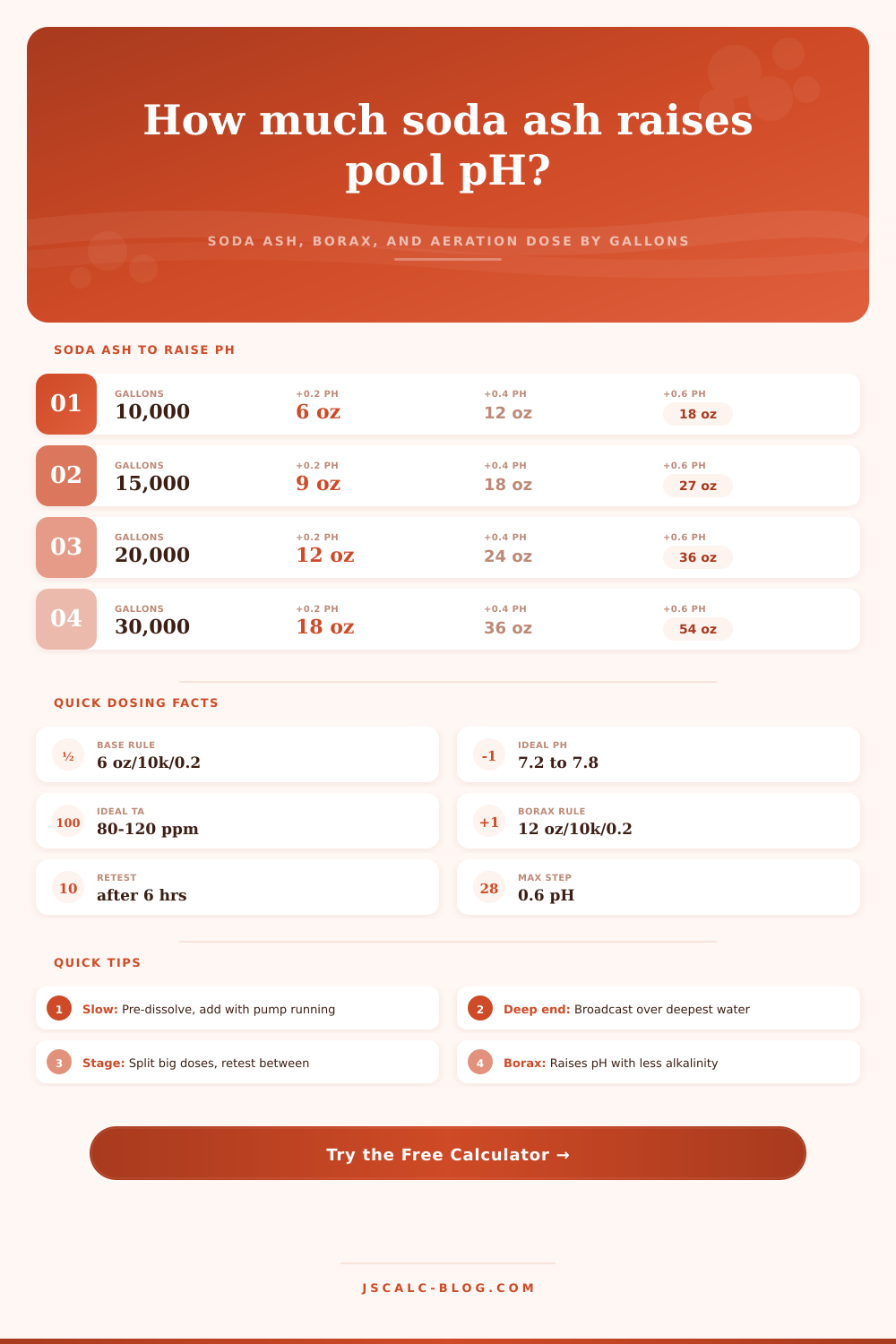
📊Soda Ash Dose by Pool Volume
| Pool Volume | +0.2 pH | +0.4 pH | +0.6 pH | +0.4 in Pounds |
|---|---|---|---|---|
| 5,000 gal | 3 oz | 6 oz | 9 oz | 0.38 lb |
| 10,000 gal | 6 oz | 12 oz | 18 oz | 0.75 lb |
| 15,000 gal | 9 oz | 18 oz | 27 oz | 1.13 lb |
| 20,000 gal | 12 oz | 24 oz | 36 oz | 1.50 lb |
| 25,000 gal | 15 oz | 30 oz | 45 oz | 1.88 lb |
| 30,000 gal | 18 oz | 36 oz | 54 oz | 2.25 lb |
| 40,000 gal | 24 oz | 48 oz | 72 oz | 3.00 lb |
Based on the soda ash rule of thumb: about 6 oz per 10,000 gallons raises pH roughly 0.2 units in water of typical alkalinity. Actual results vary with total alkalinity and starting pH.
📏Ideal pH & Alkalinity Ranges
| Reading | Low | Ideal | High | Why It Matters |
|---|---|---|---|---|
| pH | Below 7.2 | 7.4 to 7.6 | Above 7.8 | Comfort, sanitizer strength, surface wear |
| Total alkalinity | Below 80 ppm | 80 to 120 ppm | Above 120 ppm | Buffers pH and prevents swings |
| Calcium hardness | Below 200 ppm | 200 to 400 ppm | Above 400 ppm | Protects plaster, limits scale |
| Free chlorine | Below 1 ppm | 1 to 3 ppm | Above 5 ppm | Effective at correct pH |
| Cyanuric acid | Below 30 ppm | 30 to 50 ppm | Above 80 ppm | Shields chlorine outdoors |
⚖Soda Ash vs Borax vs Aeration
| Method | Chemical | Rule of Thumb | Alkalinity Effect | Best When |
|---|---|---|---|---|
| Soda ash | Sodium carbonate | 6 oz / 10k / 0.2 pH | Raises TA noticeably | Both pH and TA are low |
| Borax | Sodium tetraborate | 12 oz / 10k / 0.2 pH | Small TA change | pH low but TA already fine |
| Aeration | None (off-gas CO2) | Run fountains / jets | No TA change | Raise pH without adding TA |
| Baking soda | Sodium bicarbonate | Raises TA, not pH | Big TA rise | Only when TA is the problem |
Aeration drives off dissolved carbon dioxide, which raises pH slowly with no alkalinity change. Borax lifts pH with far less alkalinity impact than soda ash.
⚠Low pH Problem Symptoms
| Symptom | Likely Cause | Fix Direction | Retest Window |
|---|---|---|---|
| Stinging eyes, itchy skin | pH under 7.2 | Add soda ash or borax | After 6 hours |
| Etched or pitted plaster | Acidic water | Raise pH and hardness | Next day |
| Corroded ladders, fittings | Sustained low pH | Raise pH into range | After 6 hours |
| Chlorine burns off fast | Low pH plus low CYA | Balance pH first | After circulation |
| Wide daily pH swings | Low alkalinity | Soda ash raises both | Retest 24 hours |
🗂Volume vs Ounces Comparison Grid
| Volume | Liters | +0.2 pH (oz) | +0.4 pH (oz) | +0.6 pH (oz) | +0.6 pH (lb) |
|---|---|---|---|---|---|
| 5,000 gal | 18,927 L | 3.0 | 6.0 | 9.0 | 0.56 |
| 8,000 gal | 30,283 L | 4.8 | 9.6 | 14.4 | 0.90 |
| 10,000 gal | 37,854 L | 6.0 | 12.0 | 18.0 | 1.13 |
| 12,000 gal | 45,425 L | 7.2 | 14.4 | 21.6 | 1.35 |
| 15,000 gal | 56,781 L | 9.0 | 18.0 | 27.0 | 1.69 |
| 20,000 gal | 75,708 L | 12.0 | 24.0 | 36.0 | 2.25 |
| 25,000 gal | 94,635 L | 15.0 | 30.0 | 45.0 | 2.81 |
| 30,000 gal | 113,562 L | 18.0 | 36.0 | 54.0 | 3.38 |
⚙Full Formula Breakdown
💡Practical Dosing Tips
High acidity (pH) is corrosive to both your pool equipment and swimmers. After a few hours in the sun you’ll feel like you’re itching all over, your eyes will sting. That’s because high acidity builds over time from rain, heavy usage and some forms of chlorine. Before you realize what’s happening, you start noticing wear on your metal fixtures and plaster.
The first step to correcting this disparity is knowing how pH relates to total alkalinity. Total alkalinity (TA) serve as the buffer that prevents rapid shifts in pH and keeps water chemistry steady. Low TA result in pH fluctuating like a roller coaster. High TA makes pH virtually impossible to shift in either direction.
How to Fix High Acidity in Your Pool
Knowing this relationship will help you avoid dosing pH-raising chemicals blindly. Doing so might work temporarily but could cause other issues down the road. Once you input your starting values and tank size/volume, calculator does all of the math for you. This avoids human error and the need to convert units by hand.
Most people use soda ash as their primary pH up (because it’s so effective and relatively inexpensive). Soda ash is also great at increasing total alkalinity, meaning you can solve one issue but drive another value outside of optimal range. For example, if your TA is already where it should be, soda ash will raise it even more making it harder to adjust pH in the future.
The better solution would of then be borax, which increases pH without affecting TA much at all. You’ll need about twice as much borax as soda ash. Finally, bubbling air through your tank, whether via jets or fountains. Releases carbon dioxide which gradualy increases pH without altering alkalinity whatsoever.
“Most people think they’re measuring the same thing with these home test kits, but really, it’s just a snapshot of water chemistry, which can be misleading unless you know what’s going on. On paper, that 7.0 looks good, but without knowing the context, you may not realize that your alkalinity is low and that 7.0 will drop to 6.8 by afternoon and rise to 7.5 by evening.”
“The key is knowing what you’re looking at in terms of what’s really being measured. Stability trumps a single static number. And you want to adjust your target depending on your pool surface material. Plaster pools likes a slightly higher pH (about 7.6) to avoid etching. Vinyl liners are more forgiving but still benefit from staying within the standard 7.2 to 7.8 band for both swimmer comfort and more efficient sanitizers.”
How you dose also matters, too much chemical dumped at one time causes supersaturation (cloudy water) or localized hot spots, such as on pool surfaces. To avoid this problem, pre-dissolve your borax or soda ash in a bucket of pool water before spreading out over the deep-end with the pump running. This will prevent any localized spike in pH/alkalinity and allow for even distribution.
For a big adjustment, break up the dose into stages and wait several hours before retesting. You’ll be able to tell if the water chemistry has stabilized and you won’t overshoot by jumping from low than high. This is listed in the reference table on the page which makes it easy to check quickly. However, it’s an estimate with average conditions in mind.
Real-world variables can move things slightly, such as bather load, water temperature, and recent rainfall. If you’re unsure, go smaller than what you might expect then add if necessary. It’s easier to add more than it is to remove too much alkalinity or pH (partial water changes/acid washes).
The thing about pool water is you have to keep it balanced. It’s not something that once balanced it will stay so. A low pH means chlorine isn’t as effective, and there’s a risk for bacterial growth. Adjusting slowly, a little at a time, to maintain a healthy balance between your pH and alkalinity means keeping your equipment protected while ensuring the water feels good to swim in. Clear, non-irritant water doesn’t happen by chance but by honoring the buffer systems that hold it all together.