pH Slope Calculator
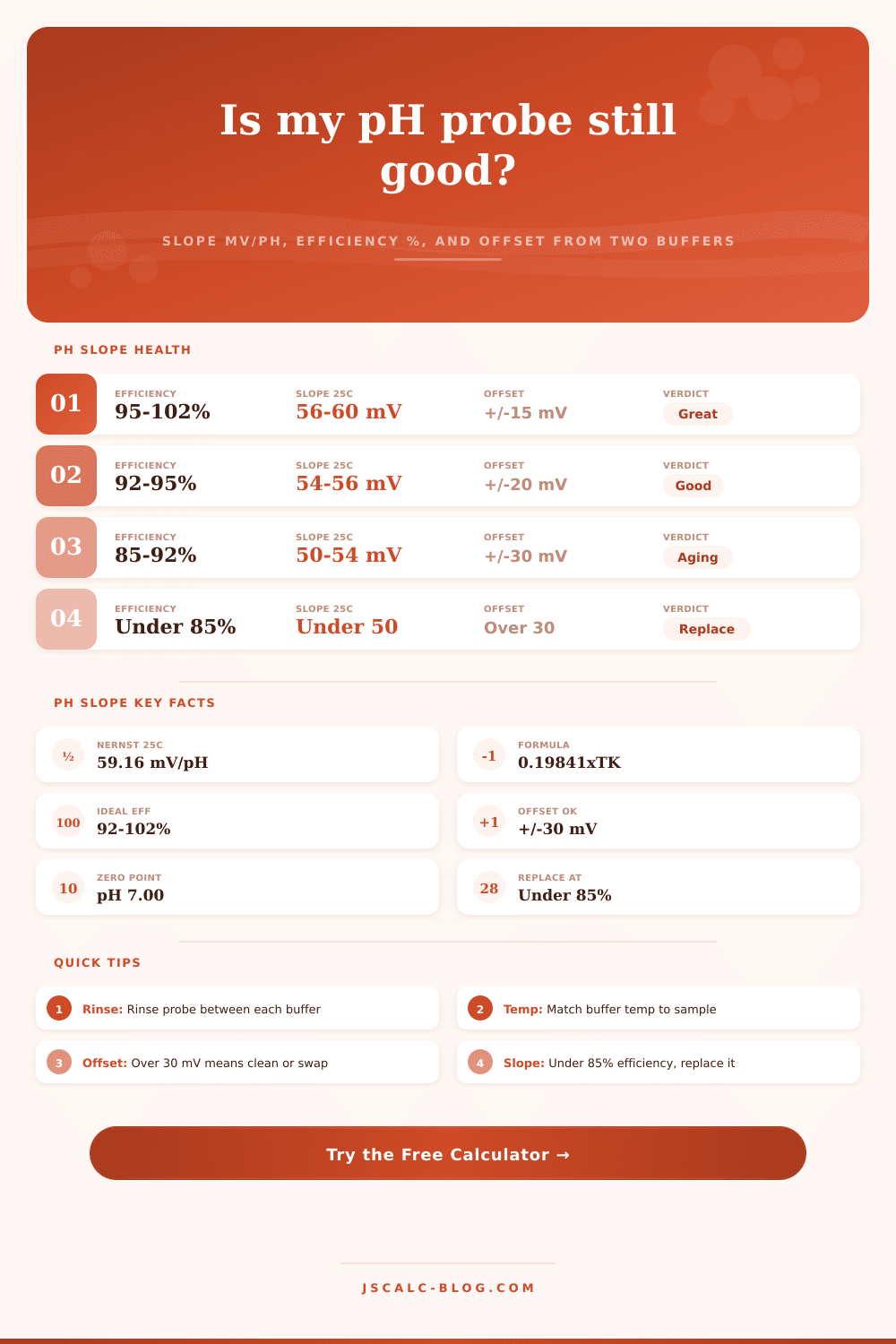
Check electrode health from a two-buffer calibration. Get the measured slope in mV per pH unit, slope efficiency versus the Nernst theoretical value, the zero-point offset at pH 7.00, and a probe verdict.
🧪Real Probe Presets
📝Calibration Inputs
Picking a set fills both buffer pH values. Choose Custom to type your own.
Drives the Nernst theoretical slope 0.19841 × (T + 273.15).
Leave blank to skip. Interpolates the sample pH from the two-point line.
🔢Nernst Formula Snapshot
🌡Theoretical Slope vs Temperature
| Temp °C | Kelvin | Nernst mV/pH | 95% Slope | 90% Slope | 85% Slope | Note |
|---|---|---|---|---|---|---|
| 0°C | 273.15 | 54.20 | 51.49 | 48.78 | 46.07 | Ice bath |
| 5°C | 278.15 | 55.19 | 52.43 | 49.67 | 46.91 | Cold store |
| 10°C | 283.15 | 56.18 | 53.37 | 50.56 | 47.75 | Chilled |
| 15°C | 288.15 | 57.17 | 54.31 | 51.45 | 48.59 | Cool room |
| 20°C | 293.15 | 58.17 | 55.26 | 52.35 | 49.44 | Ambient |
| 25°C | 298.15 | 59.16 | 56.20 | 53.24 | 50.29 | Reference |
| 30°C | 303.15 | 60.15 | 57.14 | 54.14 | 51.13 | Warm lab |
| 40°C | 313.15 | 62.13 | 59.03 | 55.92 | 52.81 | Hot process |
| 50°C | 323.15 | 64.12 | 60.91 | 57.71 | 54.50 | Heated bath |
| 60°C | 333.15 | 66.10 | 62.80 | 59.49 | 56.19 | High temp |
✅Slope Efficiency Health Ranges
| Efficiency % | Slope at 25°C | Offset Guide | Electrode State | Action |
|---|---|---|---|---|
| 98 to 102% | 58.0 to 60.3 | ±10 mV | Excellent, new or near-new | Use with confidence |
| 95 to 98% | 56.2 to 58.0 | ±15 mV | Very good, healthy junction | Normal service |
| 92 to 95% | 54.4 to 56.2 | ±20 mV | Good, mild aging | Keep, recheck weekly |
| 85 to 92% | 50.3 to 54.4 | ±30 mV | Aging, clean and recondition | Clean, soak, retest |
| Below 85% | Below 50.3 | Over ±30 mV | Worn out or fouled | Replace the electrode |
🧴Common Buffer & Offset Reference
| Buffer / Item | pH at 25°C | Ideal mV vs pH 7 | Meaning |
|---|---|---|---|
| Acid buffer | 4.01 | +177.5 mV | 3 pH units below 7 × 59.16 |
| Neutral buffer | 7.00 | 0 mV | Zero point / offset check |
| Base buffer | 10.01 | –177.5 mV | 3 pH units above 7 × 59.16 |
| DIN acid | 4.65 | +139.0 mV | European standard pair |
| DIN base | 9.23 | –131.9 mV | European standard pair |
| Offset 0 to ±15 | at pH 7 | ideal window | Junction and reference healthy |
| Offset ±15 to ±30 | at pH 7 | watch window | Clean probe, refill reference |
| Offset over ±30 | at pH 7 | fail window | Reference poisoned, replace |
⚙Full Slope & Offset Breakdown
📋Offset Interpretation Guide
| Offset at pH 7 | Rating | Likely Cause | What To Do |
|---|---|---|---|
| 0 to ±10 mV | Excellent | Fresh reference, clean junction | Nothing, calibrate as normal |
| ±10 to ±20 mV | Good | Normal aging drift | Continue, log the trend |
| ±20 to ±30 mV | Marginal | Coated bulb or low fill | Clean bulb, top up reference |
| ±30 to ±60 mV | Poor | Clogged or drying junction | Soak in storage solution |
| Over ±60 mV | Failed | Poisoned reference, cracked bulb | Replace the electrode |
💡Practical Calibration Tips
When you test water with your pH meter and reading isn’t matching what you see (the sample appears normal but reads too alkaline or too acidic), try this: don’t immediately toss glass probe. Instead, first check its health. By “health,” I mean its ability to respond linearally to a change in hydrogen ion concentration. When we talk about the probe’s ability to do so, we call it its slope. Checking this will indicate whether or not your sensor are alive.
How do I get that number? That’s some fancy math called the Nernst equation and electrochemistry. A clean electrode respond to each pH change with approximately 59.16 millivolts at 25 degrees C. So if we start out at pH 7 (neutral) and then dip our fresh probe into a solution three pH values less than neutral, it should of jump by approximately 177 millivolts. In practice, electrodes degrades over time and clogged junctions reduce this response. The page include a handy calculator to run those numbers for you. Then you can concentrate on interpreting result for your gear.
Check Your pH Probe Health
The slope is what most people don’t pay attention to. They just look at whether meter reads the same as the buffer value. But that’s not enough, an electrode might read correctly at pH 7 but incorrectly at pH 4 or 10. The slope is a measure of how well that line holds up throughout the range. Ideally, a good probe has efficiency between 95 and 102 percent, meaning it respond almost exactly like the Nernstian ideal should respond.
In the high 80s, it means you have an old electrode; still working but reading with lower and lower sensitivity over time. Below 85 percent, it mean the electrode provides inaccurate readings. There’s no calibration that will help if your glass membrane degrades.
The other side of the diagnostic equation is offset. Offset indicate where response curve lies in relation to neutral; slope indicates its steepness. At pH 7.00, a new electrode will read very near zero millivolts. As time passes and fill solution evaporates or the reference junction becomes dirty, this zero point will shift. Older probes experiences a small, normal drift of maybe ten to fifteen millivolts. Larger drift mean something has gone wrong with the reference system. These limits is indicated on the reference table on the page. You can determine if it’s time to clean or replace sensor.
Theoretically, this depends off the slope, which are affected by temperature. What might appear terrible at room temperature could be just fine in hot water. As temperature increases, the Nernst coefficient also moves. A probe with a Nernst of 50 millivolts/pH unit at cold temps could be perfectly fine. To get an accurate opinion, use a temperature compensated tool that take into account water temperature. If not, you’ll waste good probes or believe faulty ones.
The probe lasts longer if maintained. Keeping it in electrolyte solution and rinsing between buffers with distilled water will help prolong its use. To prevent buffer carryover from skewing readings, blot the bulb dry before measuring.
Is the slope low and the offset good? Clean the bulb. Both bad? Time for a new sensor. Knowing what these numbers mean removes guesswork in favor of understanding. You no longer fight your instrumentation, you just trust the data. And that gives you clarity in the process again.