pH Calculator of Two Solutions
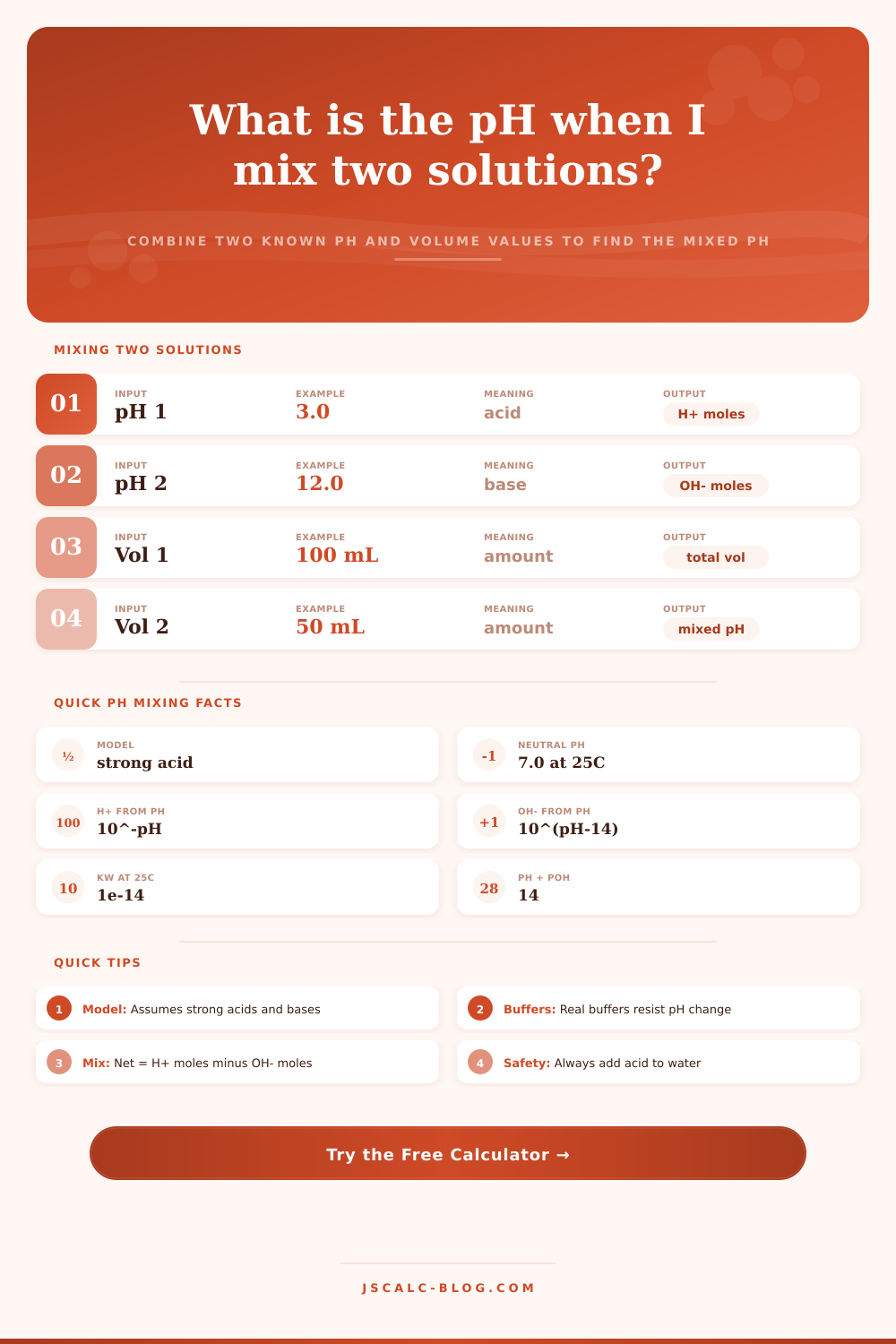
Mix two solutions of known pH and volume to estimate the combined pH, pOH, total volume, and net hydrogen or hydroxide ion concentration using a strong acid and strong base model at 25°C.
🧪Real Mixing Presets
📝Solution Inputs
Kw = 1e-14 and neutral pH = 7 are used at 25°C.
🔢Model Snapshot
🔗pH to Ion Concentration Lookup
| pH | [H+] mol/L | [OH-] mol/L | pOH | Character |
|---|---|---|---|---|
| 1 | 1.0 × 10^-1 | 1.0 × 10^-13 | 13 | Strong acid |
| 3 | 1.0 × 10^-3 | 1.0 × 10^-11 | 11 | Acid |
| 5 | 1.0 × 10^-5 | 1.0 × 10^-9 | 9 | Weak acid range |
| 7 | 1.0 × 10^-7 | 1.0 × 10^-7 | 7 | Neutral |
| 9 | 1.0 × 10^-9 | 1.0 × 10^-5 | 5 | Weak base range |
| 11 | 1.0 × 10^-11 | 1.0 × 10^-3 | 3 | Base |
| 13 | 1.0 × 10^-13 | 1.0 × 10^-1 | 1 | Strong base |
⚖Mixing Outcome Rules
| Solution 1 | Solution 2 | Net Ion | Result Trend | Formula Path |
|---|---|---|---|---|
| Acid | Acid | H+ adds up | Acidic, pH < 7 | pH = -log(sum H+ / Vt) |
| Base | Base | OH- adds up | Basic, pH > 7 | pOH = -log(sum OH- / Vt) |
| Acid | Base | H+ minus OH- | Depends on excess | net = H+ - OH- |
| Strong acid | Weak base | Excess H+ | Acidic result | [H+] = net / Vt |
| Weak acid | Strong base | Excess OH- | Basic result | [OH-] = -net / Vt |
| Equal H+ / OH- | Equal moles | Cancel out | Neutral pH 7 | net ≈ 0 |
📊Mixing Comparison Grid
| Scenario | V1 | pH 1 | V2 | pH 2 | Result pH |
|---|---|---|---|---|---|
| Equal acids | 100 mL | 3.00 | 100 mL | 3.00 | 3.00 |
| Acid + strong base | 1000 mL | 2.00 | 1000 mL | 12.00 | 7.00 |
| Dilute acid | 100 mL | 2.00 | 900 mL | 7.00 | 3.00 |
| Mild acid mix | 100 mL | 4.00 | 100 mL | 5.00 | 4.26 |
| Excess acid | 150 mL | 1.00 | 50 mL | 13.00 | 1.30 |
| Excess base | 50 mL | 1.00 | 150 mL | 13.00 | 12.70 |
| Equal bases | 100 mL | 11.00 | 100 mL | 11.00 | 11.00 |
| Base + water | 200 mL | 12.00 | 200 mL | 7.00 | 11.70 |
⚙Full Formula Breakdown
🧴Common Lab Mixes
| Mix | Typical pH 1 | Typical pH 2 | Expected Trend | Note |
|---|---|---|---|---|
| HCl + NaOH | 1 to 2 | 12 to 13 | Toward neutral | Classic titration pair |
| Vinegar + water | 2.5 to 3 | 7 | Slightly acidic | Dilution raises pH |
| Lemon + tap water | 2 to 2.5 | 7 to 8 | Acidic | Acid dominates |
| Ammonia + vinegar | 11 | 2.5 | Depends on volume | Weak acid vs weak base |
| Baking soda + water | 8 to 9 | 7 | Mildly basic | Weak base dilution |
| Two buffers | 4 | 5 | Between the two | Buffers resist change |
🔗pH and pOH Relationship
| pH | pOH | [H+] mol/L | [OH-] mol/L | Zone |
|---|---|---|---|---|
| 0 | 14 | 1.0 | 1.0 × 10^-14 | Very acidic |
| 2 | 12 | 1.0 × 10^-2 | 1.0 × 10^-12 | Acidic |
| 4 | 10 | 1.0 × 10^-4 | 1.0 × 10^-10 | Acidic |
| 7 | 7 | 1.0 × 10^-7 | 1.0 × 10^-7 | Neutral |
| 10 | 4 | 1.0 × 10^-10 | 1.0 × 10^-4 | Basic |
| 12 | 2 | 1.0 × 10^-12 | 1.0 × 10^-2 | Basic |
| 14 | 0 | 1.0 × 10^-14 | 1.0 | Very basic |
💡Practical Mixing Tips
In the end, mixing acids and bases isn’t so much a matter of chemistry equations as it is keeping track of your inventory. Counting particles is all there is to it. As long as you plug in your specific volumes and pH levels, the rest is handled by calculator above. You no longer have to convert logarithms to moles by hand while rushing to finish a lab at school or performing an unplanned experiment at home.
We assume perfect dissociation of strong acids and bases (which they do) and ignore messy dissociation constants of weak electrolytes. So you’ll have a simple starting point to understand where the resulting solution should lie on the spectrum. But that’s just because we want something fast, and it requires knowing what result you’re getting.
Simple Tips for Mixing Acids and Bases
But here’s the key: it does this by translating pH into true ion concentrations. A pH of 3 doesn’t equal “three times more acid” then a pH of 1. It equals one-hundredth as much. It may look like a gentle logarithmic scale, but in reality, its mathematically harsh.
If you take a small amount of a strong base and add it to a large amount of a strong acid, the pH will hardly change at all. Why? Because there are so many hydrogen ions already that they completely dwarf incoming hydroxide ions. Separately, the tool figures out how many moles of hydrogen and hydroxide ions is there altogether. Then it subtracts one from the other and divides that difference by resulting total volume. That’s where the final concentration comes from. It’s just an accounting exercise, although a really cleverly disguised one made to look complex.
Acid vs. Base: Volume enters into it as well. While folks tend to pay attention to the acidity value (which I get), they don’t think about amount of solution they add. If you mix equal volumes of pH 3 acid and pH 11 base, you are mixing solutions with vastly different ion densities; the acid has a million times more active ions than the base. There are a million times more actual ions in the acid than there are in the base. Even though they’re equal volume solutions, the acid is going to win out. Completely. The resulting solution will be acidic, probably around pH 4 or maybe 5 if you were precise about your concentrations.
Here is the lesson. You can’t simply do a mathematical average of two ph readings. That’s what people do wrong all the time and it means they underestimate the leftover acidity, which is really bad. These ion concentrations are laid out nicely in the reference table on the page. You’ll see just how much lower $[H+]$ gets as you increase the pH. And you’ll be able to see the difficulty of neutralizing around the middle ground.
There’s almost an equal number of molar hydrogen and hydroxide ions, which means that they cancel. What’s left? Water and a salt. If we’re at standard room temp, then the system snaps to neutral pH 7. If either ion has a tiny bit more than the other, though, it will very quickly swing the pH away from seven. The math is sensitive here in the narrow window. A tiny difference in measuring volume could mean it is either slightly basic or slightly acidic.
The bottom line for all this is still safety. No matter what you see on the screen, keep in mind that safety always trumps everything else. Never pour acid down your fish tank! ALWAYS add acid to water. Concentrated acids release significant heat when diluted or neutralized. If you pour water into an acid that has heated up inside its concentrated form, you’ll have boiling and likely splashing acid everywhere. This is why we recommend mixing slowly. That way the heat will dissipate.
The calculator presumes perfect mixing without any change in temperature. In the real world of chemistry, there’s energy created by that mixing. This is a theoretical model applied to a real physical process that has weight and temperature. The picture gets even more complicated with buffers. Weak acids and bases are less likely to change pH compared to strong electrolytes. They’re more like shock absorbers. When you add more ions, they soak them up without dramatically altering the overall pH.
The tool doesn’t take buffer capacity into account. It treats all the protons as freely available and able to react. Therefore the resulting pH will be closer to starting values of the components than the calculator’s prediction. This is something to keep in mind if you’re using vinegar-based mixes or other biological samples.
At the end of the day, all this mixing is a matter of weighing scales. Two containers are combined into one. On one hand, you have an inventory of hydroxide and on the other protons. Whichever was more heavily loaded will determine the outcome. How many? That’s what the calculator tells you precisely. This knowledge comes from an appreciation for the physical reality (heat and volume) and the logarithmic nature of the scale. If in doubt, begin with small test mixes. Confirm with a probe or strip. The theory shows you the way; the observation confirms it.