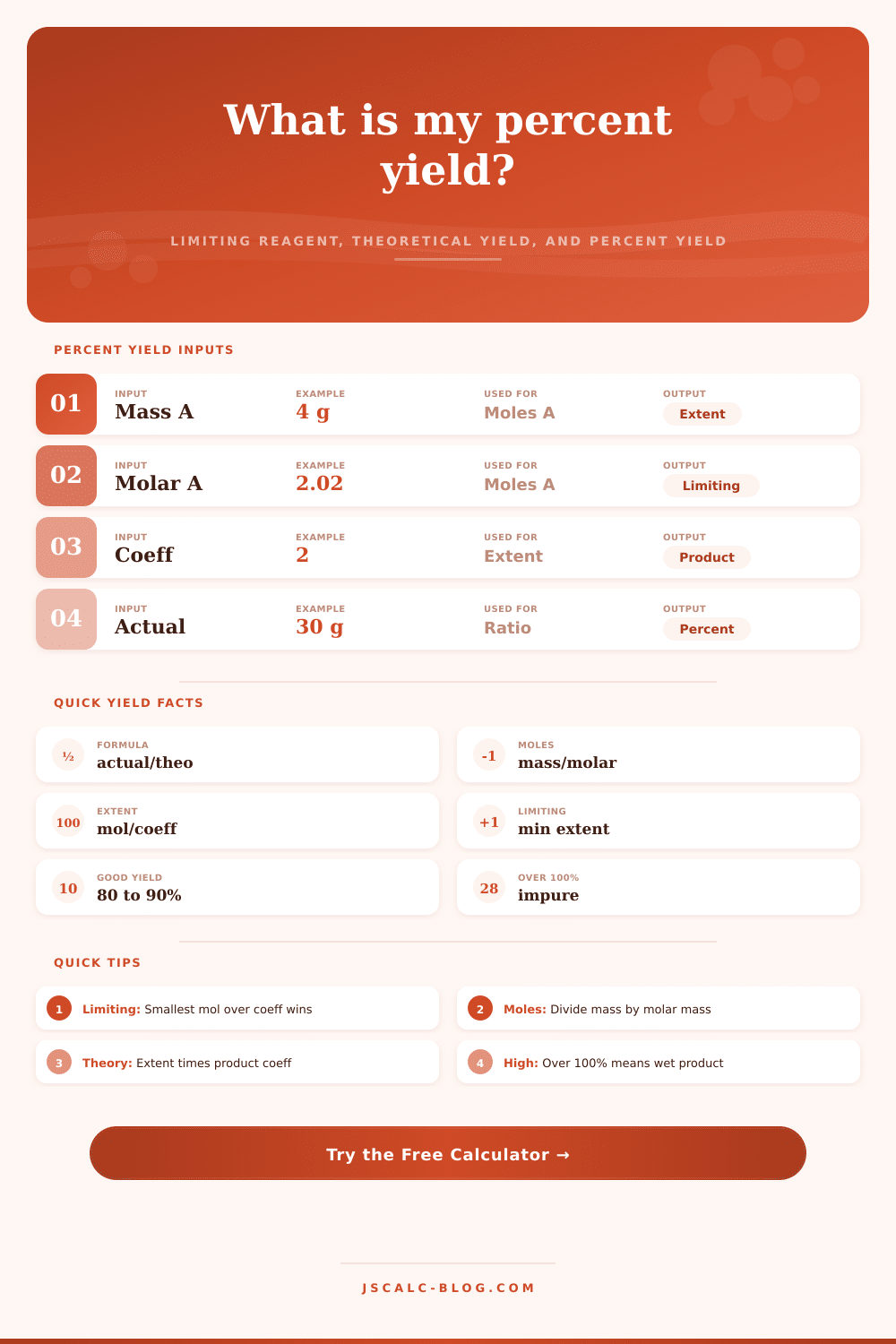
Chemistry Percent Yield Calculator
Determine the limiting reagent from reactant masses, molar masses, and balanced coefficients, then compute theoretical yield and percent yield with a full stoichiometry breakdown.
⚗Real Reaction Presets
📝Reaction Inputs
Reactant 1
Reactant 2 (2-reactant mode)
Product
🔢Stoichiometry Snapshot
🧪Common Reaction Molar Masses
| Species | Formula | Molar Mass (g/mol) | Common Role |
|---|---|---|---|
| Hydrogen gas | H2 | 2.016 | Reactant, fuel |
| Oxygen gas | O2 | 32.00 | Oxidizer |
| Water | H2O | 18.015 | Product |
| Nitrogen gas | N2 | 28.014 | Reactant |
| Ammonia | NH3 | 17.031 | Product |
| Carbon dioxide | CO2 | 44.01 | Product |
| Sodium chloride | NaCl | 58.44 | Salt product |
| Aspirin | C9H8O4 | 180.16 | Product |
| Salicylic acid | C7H6O3 | 138.12 | Reactant |
| Acetic anhydride | C4H6O3 | 102.09 | Reactant |
📊Typical Yield Ranges By Reaction Type
| Reaction Type | Typical Yield | Main Loss | Notes |
|---|---|---|---|
| Simple gas synthesis | 90% to 99% | Escaping gas | Few side paths |
| Acid-base neutralization | 95% to 100% | Spillage | Fast, clean |
| Esterification (Fischer) | 60% to 80% | Equilibrium | Reversible reaction |
| Aspirin synthesis | 65% to 85% | Recrystallizing | Filtration loss |
| Grignard reaction | 50% to 80% | Moisture | Water sensitive |
| Multi-step organic | 30% to 60% | Each step | Yields multiply |
🎯Percent Yield Quality Scale
| Percent Yield | Grade | What It Suggests | Action |
|---|---|---|---|
| 90% and up | Excellent | Efficient, clean transfer | Record method |
| 75% to 89% | Good | Normal lab loss | Acceptable |
| 50% to 74% | Fair | Side reactions or loss | Review steps |
| Below 50% | Low | Major loss or error | Repeat run |
| Above 100% | Invalid | Impure or wet product | Dry and reweigh |
🏁Limiting Reagent Rules
| Step | Rule | Formula | Result |
|---|---|---|---|
| 1 | Convert mass to moles | mass / molar mass | Moles each |
| 2 | Divide by coefficient | moles / coefficient | Reaction extent |
| 3 | Smallest extent limits | min(extent) | Limiting reagent |
| 4 | Scale to product | extent × product coeff | Product moles |
| 5 | Leftover excess | excess moles minus used | Excess grams |
🗂Worked Reaction Comparison Grid
| Reaction | Limiting | Theoretical (g) | Actual (g) | Percent Yield | Grade |
|---|---|---|---|---|---|
| 2 H2 + O2 to 2 H2O | H2 | 35.7 | 30.0 | 84.0% | Good |
| N2 + 3 H2 to 2 NH3 | H2 | 17.0 | 14.5 | 85.3% | Good |
| Fischer ester | Acid | 88.0 | 68.6 | 78.0% | Good |
| Aspirin synthesis | Salicylic | 13.1 | 9.8 | 74.8% | Fair |
| HCl + NaOH to NaCl | NaOH | 5.84 | 5.72 | 98.0% | Excellent |
| CH4 + 2 O2 to CO2 | CH4 | 27.5 | 26.9 | 97.8% | Excellent |
| Grignard alcohol | Halide | 22.0 | 13.2 | 60.0% | Fair |
| CaCO3 to CaO + CO2 | CaCO3 | 28.0 | 25.6 | 91.4% | Excellent |
⚙Full Formula Breakdown
💡Practical Yield Tips
Percent yield tells you how far off you are from where you should be. And we all know how it feels when that final weight doesn’t match up with expectations. However, despite not knowing why scale read different, it still told us the truth. It is less of a grade and more like a report of what actualy happened in chemistry.
After plugging in your masses, the calculator will do the math for you. If you’re sleepy, this spares you arithmetic mistakes AND time.
Why Your Chemical Yield Is Never Perfect
The theoretical yield refers to what should happen in best-case scenario. Every single molecule react according to the balanced equation. In reality, however, there are no such perfect molecules. They hit each other at strange angles, they adhere to glassware, some evaporate, and others may even react with something else.
This is where we start talking about a limiting reagent. At some point during reaction, one of the ingredients run out and the reaction ceases. However much excess you throw into the mixture, you can’t make any more product then is possible given the amount of your limiting reactant. The calculator compares stoichiometric coefficients against molar amounts to find this limitation.
This is a tough problem for many students, as it confuses them between moles and mass. Just because something is heavy doesn’t mean that it contain more atoms compared to something light. Although you can hold a gram of lead in your hand, there are fewer atoms in a gram of lead than a gram of hydrogen. To compare, all quantities need to be converted into moles first. Once you know the number of moles, divide it by coefficient from the balanced equation to see how much of the reaction has occurred. The least amount is the limiting factor, the amount that restricts what you can produce.
There will inevitably be some physical losses through the process. When you filter your crystals, some of them gets stuck on the filter paper and other dissolve in the wash water. During distillation, some vapors don’t make it back into the flask but float off into air.
For organic syntheses, an 80-90% yield is usually considered pretty good. If you end up with more than one hundred percent, then something went wrong. Most likely, you have a mixture of product and unreacted starting materials. Alternatively, your product might be wet or contaminated by solvent. Time to do another purification or let the sample sit longer to drive off any excess solvent.
Typical yields by reaction type are given in a reference table. Some reactions, like acid-base neutralizations, proceed cleanly and rapidly. They approach one hundred percent because ions readily combine in solution. Others such as esterification reaches an equilibrium with some of the product pulled back into the reactants, limiting its yield. Knowing this pattern will let you know what’s a reasonable result versus something that needs troubleshooting.
Did you only get a forty percent ester yield? Maybe you didn’t remove water to shift the equilibrium forward enough. Did you get only half the yield on your neutralization? You probably dropped half your solution when transferring it. It’s all relative.
If you’re running a reaction in your teaching lab and it yields poorly, that could just be sloppy pipetting. Imagine having several thousand batches per year in an industrial pharmaceutical manufacturing facility. If lowering your yield by 5% means losing hundreds of thousands or even millions of dollars in materials, plus a larger carbon footprint from getting rid of those waste products, you’ve got some serious problems. Reactions are optimized based off their yield efficiency, speed, and atom economy. Do you need to tinker with temperature? Do you need to change the solvent? Should you adds a catalyst?
Think of percent yield as a diagnostic instead of a final judgement. It shows you where the friction points is in your process, and it helps you see just how efficient your set up was at changing inputs to output. If you’re making aspirin for school, then good luck! If you’re trying to design an industrial catalyst, then same idea. Make more product and less waste. And if there’s a gap between theory and practice, you should of not think of it as failing science, but as the cost of doing experiments in the real world.