Two Dice Probability Calculator
Enumerate every outcome for two dice, tally the sum distribution, and read the exact probability, ways over total, fair odds, and cumulative chance. See the full outcome grid with your target highlighted.
🎲Real Dice Presets
📝Roll Setup
Used for the exactly, at least, and at most conditions.
Only used by the specific pair condition.
Only used by the specific pair condition.
🔢How The Count Works
📊2d6 Sum Distribution
| Sum | Ways | Probability | Percent | Odds Against |
|---|---|---|---|---|
| 2 | 1 | 1/36 | 2.78% | 35 : 1 |
| 3 | 2 | 2/36 | 5.56% | 17 : 1 |
| 4 | 3 | 3/36 | 8.33% | 11 : 1 |
| 5 | 4 | 4/36 | 11.11% | 8 : 1 |
| 6 | 5 | 5/36 | 13.89% | 31 : 5 |
| 7 | 6 | 6/36 | 16.67% | 5 : 1 |
| 8 | 5 | 5/36 | 13.89% | 31 : 5 |
| 9 | 4 | 4/36 | 11.11% | 8 : 1 |
| 10 | 3 | 3/36 | 8.33% | 11 : 1 |
| 11 | 2 | 2/36 | 5.56% | 17 : 1 |
| 12 | 1 | 1/36 | 2.78% | 35 : 1 |
🗂Cumulative Comparison Grid
| Sum | Ways | Probability | Odds Against | At Least | At Most |
|---|---|---|---|---|---|
| 2 | 1 | 2.78% | 35 : 1 | 100.00% | 2.78% |
| 3 | 2 | 5.56% | 17 : 1 | 97.22% | 8.33% |
| 4 | 3 | 8.33% | 11 : 1 | 91.67% | 16.67% |
| 5 | 4 | 11.11% | 8 : 1 | 83.33% | 27.78% |
| 6 | 5 | 13.89% | 31 : 5 | 72.22% | 41.67% |
| 7 | 6 | 16.67% | 5 : 1 | 58.33% | 58.33% |
| 8 | 5 | 13.89% | 31 : 5 | 41.67% | 72.22% |
| 9 | 4 | 11.11% | 8 : 1 | 27.78% | 83.33% |
| 10 | 3 | 8.33% | 11 : 1 | 16.67% | 91.67% |
| 11 | 2 | 5.56% | 17 : 1 | 8.33% | 97.22% |
| 12 | 1 | 2.78% | 35 : 1 | 2.78% | 100.00% |
🎯Doubles & Special Rolls (2d6)
| Roll | Meaning | Ways | Probability | Odds Against |
|---|---|---|---|---|
| Any double | Both dice show the same face | 6 | 16.67% | 5 : 1 |
| Snake eyes | Double ones, sum of 2 | 1 | 2.78% | 35 : 1 |
| Boxcars | Double sixes, sum of 12 | 1 | 2.78% | 35 : 1 |
| Natural (7 or 11) | Craps come-out win | 8 | 22.22% | 7 : 2 |
| Craps (2,3,12) | Craps come-out loss | 4 | 11.11% | 8 : 1 |
| Hard eight | Double fours summing to 8 | 1 | 2.78% | 35 : 1 |
🎲Mixed Dice Sum Ranges
| Dice Pair | Total Outcomes | Sum Range | Peak Sum | Peak Ways |
|---|---|---|---|---|
| d4 + d4 | 16 | 2 to 8 | 5 | 4 |
| d6 + d6 | 36 | 2 to 12 | 7 | 6 |
| d6 + d8 | 48 | 2 to 14 | 7 to 9 | 6 |
| d8 + d8 | 64 | 2 to 16 | 9 | 8 |
| d10 + d10 | 100 | 2 to 20 | 11 | 10 |
| d12 + d12 | 144 | 2 to 24 | 13 | 12 |
| d20 + d20 | 400 | 2 to 40 | 21 | 20 |
⚙Full Formula Breakdown
💡Two Dice Probability Tips
In gaming, there’s a familiar sound: the clatter of two dice bouncing off each other onto felt table. It mean luck is turning or changing, it can mean bad things or good. If you know how the numbers break down, you’ll become more than just player… You’ll understand what’s at stake.
This applies whether you’re on a tabletop role playing adventure, playing Settlers of Catan, or rolling for your next number on craps table. The above calculator does all that math after you pick the dice and conditions for which you want to roll. That way, when you’re sitting around game table, you don’t need to guess at probabilities or draw out grids.
How Two Dice Numbers Work
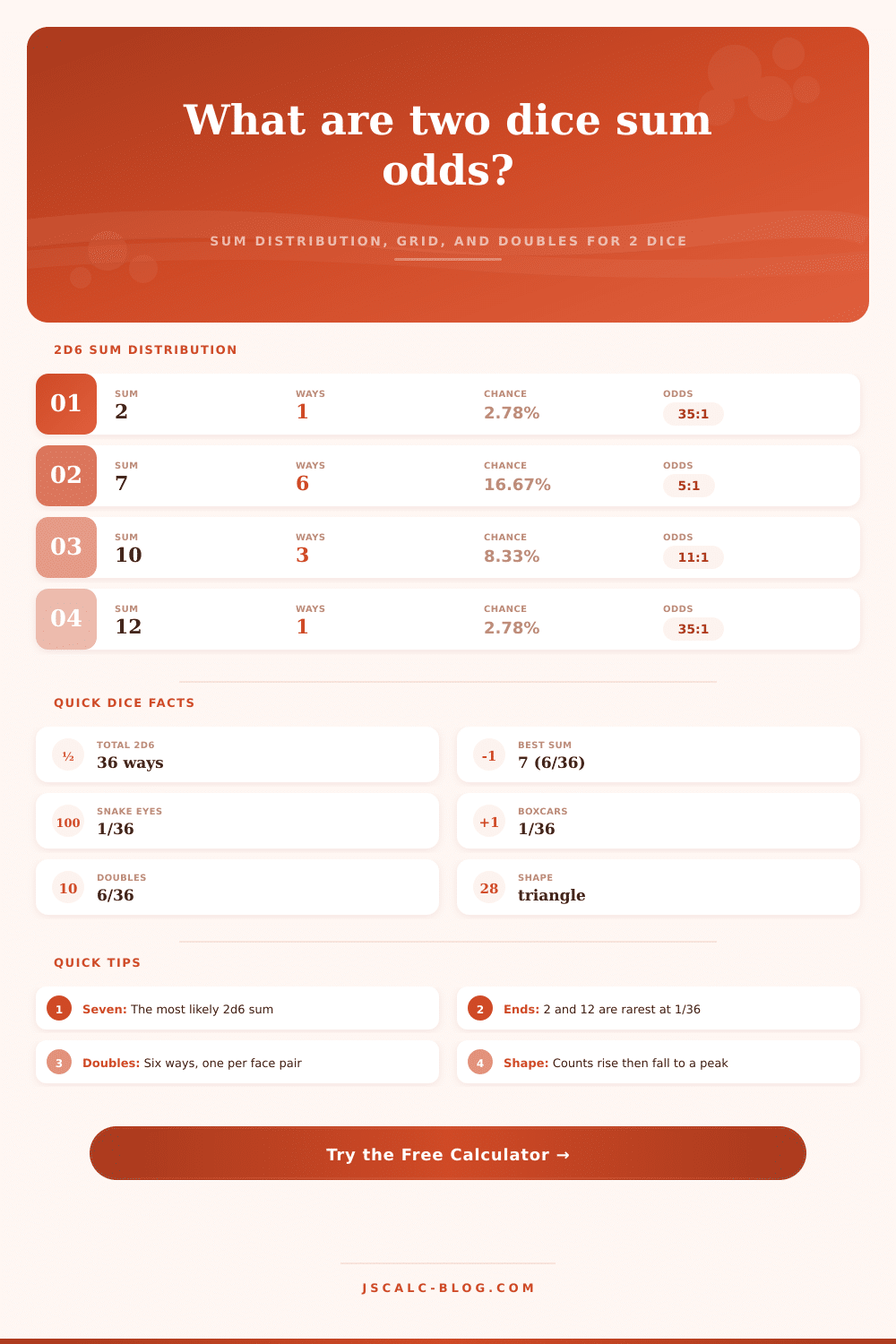
Probability isn’t as random as it seems on two dice. On one die, each number have an even shot at showing up. Add another die and that evenness go out the window. Combined outcomes fall into their own triangle shape; the middle numbers shows up much, much more often than extreme ones. Why? Because they has more ways of occurring. One plus six, two plus five, three plus four. Six different ways to combine together for a seven. It’s the most likely sum to occur.
And it all comes down to knowing what you’re measuring. Instead of simply rolling some numbers, you’re moving around field of combinations. It is called Snake Eyes. In order for you to roll snake eyes with two dice, each must display just a single dot. Out of all of the possible results (36), there’s really only one way that can happen. That’s why it happens so rarely: about 2.78% of the time.
As you’ll see from the reference table on page, the odds taper pretty steeply toward low and high ends of the spectrum, but this lopsidedness is built into structure of any game. It makes some events especially important; other ones sustains the momentum without bogging down the action too much. It prevents too many stalemates or interruptions.
This means sevens are popular, something most gamers are aware of, but what’s rarely understood is that numbers immediately next to each other (six and eight) appears similarly likely. While still lower than the chance of a seven, it isn’t equal. There are five ways for a six and five ways for an eight. Those odds reduce from 16.67% for a seven down to roughly 13.89% for neighboring digits. It is a small difference on paper, but it matter when you are betting over dozens of rolls.
The tool lets you tinker, swapping out traditional six-sided dice in favor of other polyhedral sets commonly used in fantasy RPGs. It’ll show you how a random combination between two different dice, such as a four- and a twenty-sided one, will completely change the shape of distribution chart. That kind of flexibility could assist game designers who want to tune difficulty of encounters. It could also help players decide if a risk is worth taking before they make a decision.
There’s another wrinkle that often gets folks: doubles. It feels like it should of happen less frequently, but it doesn’t. There are in fact six ways two dice could come up as a double (from a pool of thirty-six possibilities). That’s simply one-out-of-six, or about 16.67% of the time. It happens more often then you might think! If your game has special events when doubles occur, make sure to plan for it. Otherwise, it’ll overwhelm the system.
This tool makes those particular situations real and helps you see just how often those triggers will hit. No, this knowledge won’t make you win. But it will eliminate the fiction that winning and losing are random. Your vision becomes one of pattern amid chaos. And if you’re playing for perfection, or against disaster, that can help you make better choices. Because now you know what the odds look like.
And that’s the thing: That’s all we’re doing anyway.